

Countries that pride themselves on an abundance of scientific leaders they can call upon failed to translate that knowledge into tangible policies that effectively countered Covid-19, experts said on Tuesday.
The US and UK, often considered two of the most advanced societies and home to some of the most highly regarded institutions, recorded the first and fifth most deaths respectively from the coronavirus since the pandemic began.
“When you look at the response that these two countries and many others have had, you see a clear disconnect between science and policymaking,” said Dr Ali Nouri, a molecular biologist and president of the Federation of American Scientists.
He said it was not simply a case of funding the research of good scientists and engineers. Dr Nouri said their roles needed to be elevated so they could better contribute evidence-based science to the policy process.
Speaking to a Foresight News event on what 2021 could hold, he said there would be a lot of “soul searching” as to “how we can revitalise the role of science” in policymaking.
“We see over and over during this pandemic the disconnect between science and the role of that science and enabling public policy and health guidance. I think going forward we really need to think about how we reverse that.”
Misinformation has been rampant during the pandemic, but the UK and US governments were slow to inform the public on crucial issues, such as on how important it is to wear masks to stop the spread of the virus.
Prof Susan Michie, a British psychologist at University College London, criticised the UK’s much derided £12 billion ($16.04bn) test-and-trace system that relied on private companies and did not use local services that were already in place.
“One of the things we got badly wrong was not setting up an effective test, trace and isolate system, not using the public infrastructure that was there as the basis for developing it,” said Prof Michie, who is also a member of the UK Scientific Advisory Group for Emergencies, more commonly known as Sage.
-
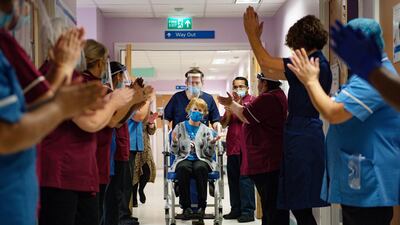
Margaret Keenan, 90, is applauded by staff as she returns to her ward after becoming the first person in the United Kingdom to receive the Pfizer-BioNtech Covid-19 vaccine at University Hospital, Coventry. EPA -
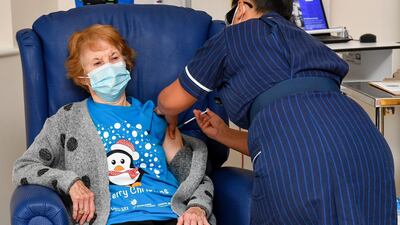
Margaret Keenan receives the vaccine, administered by nurse May Parson. EPA -
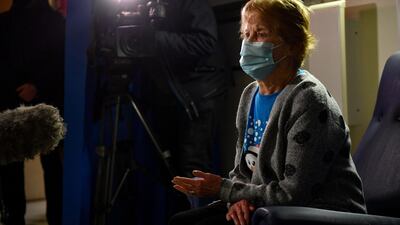
Margaret Keenan speaks to the media at University Hospital in Coventry. AFP -
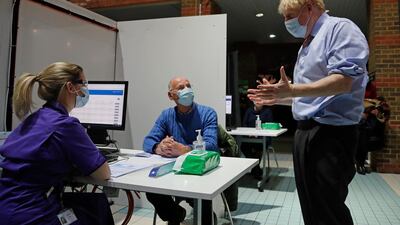
British Prime Minister Boris Johnson gestures as he speaks to staff at Guy's Hospital in London. AP Photo -
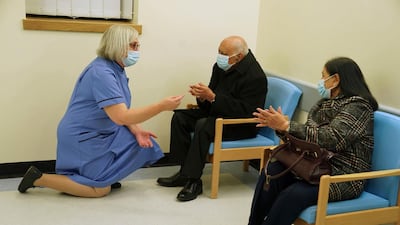
Retired nurse Suzanne Medows speaks to race relations campaigner Dr Hari Shukla, 87, and his wife Ranju, before he receives the Pfizer-BioNTech Covid-19 vaccine at the Royal Victoria Infirmary in Newcastle. AP Photo -
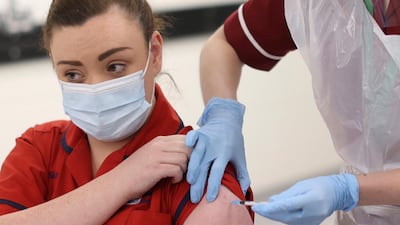
Sister Joanna Sloan receives the Pfizer-BioNTech Covid-19 vaccine, as the first person in Northern Ireland at the Royal Victoria Hospital, in Belfast. AP Photo -
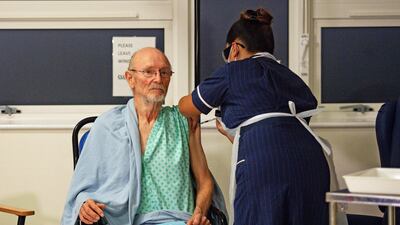
"Bill" William Shakespeare, 81, receives the Pfizer-BioNTech Covid-19 vaccine, at University Hospital, Coventry. AP Photo -
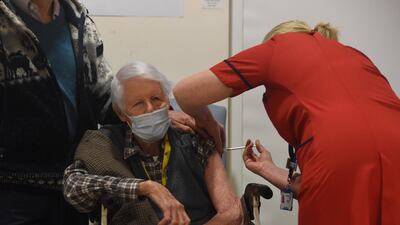
Michael Tibbs, 99 is given the Pfizer-BioNtech Covid-19 vaccine at Queen Alexandra Hospital in Portsmouth. Getty Images -

Michael Tibbs and his son Philip enjoy a cup of tea after Michael received the Pfizer-BioNtech Covid-19 vaccine at Queen Alexandra Hospital. Getty Images -

"I've had my covid vaccination" stickers at the Royal Victoria Infirmary in Newcastle. Getty Images -

A nurse holds a phial of the Pfizer-BioNTech Covid-19 vaccine at Guy's Hospital in London. Reuters -
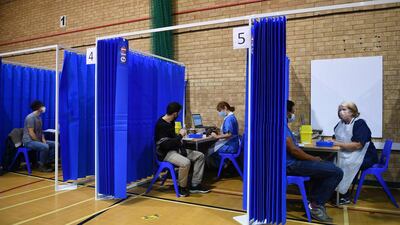
Medical personnel prepare to administer the Pfizer-BioNTech Covid-19 vaccine to recipients at a health centre in Cardiff. AFP -

A woman walks past graffiti with the words Victory to the NHS on a wall at the Royal Victoria Hospital in West Belfast, Northern Ireland. AP Photo


She questioned why billions of pounds were given to companies that did not know the local communities.
“We have failed dramatically and continue to fail on that. The government knows that we’ve been failing on that for a long time, hasn’t listened to the public health experts to give it to the local public health infrastructure,” Prof Michie said.

