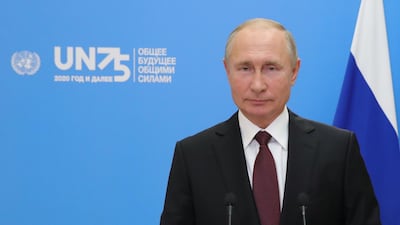

Russian President Vladimir Putin has proposed an international agreement to ban space weapons.
“Russia is promoting an initiative to sign a binding agreement between all the leading space powers that would provide for the prohibition of the placement of weapons in outer space, or the threat or use of force,” Mr Putin said during his speech at the UN General Assembly.
He dismissed US and British accusations that Russia has been testing weapons in space.
Mr Putin also likened Russia's development of a coronavirus vaccine to the Sputnik 1 mission that placed the first satellite in orbit.
The president said the vaccine should be made widely available and suggested an online high-level conference on Covid-19 vaccines.
“We are ready to share our experience and continue co-operating with all states and international entities, including in supplying the Russian vaccine, which has proved reliable, safe and effective, to other countries," Mr Putin said.
He said Russia would provide the vaccine to all UN officials.
“A dangerous virus can affect anyone," Mr Putin said.
"The coronavirus has struck the staff of the United Nations, its headquarters and regional structures. Russia is ready to provide the UN with all the necessary qualified assistance.
"We are offering to provide a vaccine free of charge for the voluntary vaccination of the staff of the UN.”
He told the UN that Russia and the US should enter talks to extend the Strategic Arms Reduction Treaty, which will expire in February next year.
“Russia declared a moratorium on deploying ground-launched, medium and long-range missiles in Europe and other regions, as long as the United States of America also refrains from such actions," Mr Putin said.
"Unfortunately, we have not received any reaction to our proposal from either our US partners or their allies."
Speaking in front of the UN and Russian flags on a video recording, Mr Putin said more needed to be done to strengthen arms treaties, including "the prohibition of chemical, biological, and toxic weapons".
Moscow is under pressure to allow an investigation into the illness of opposition leader Alexei Navalny, after claims that he was poisoned with the Soviet-era Novichok nerve agent.
The nerve agent was used in Salisbury, England, in 2018 to attempt to kill a former Russian military officer and double agent for the UK.
The Kremlin has denied any involvement in either attack.
Mr Putin also warned other countries against interference in Russian domestic affairs, and said “cyber security also deserves most serious deliberation within the UN”.

