
The UN has warned Greece against the forced return of migrants and refugees following reports the authorities were operating a secret site to deport a wave of new arrivals from Turkey without legal procedures.
The location of the clandestine facility has been confirmed by the New York Times through witness reports and analysis of satellite imagery provided by Maxar Technologies.
The secret site, on farmland between the border village of Poros and the Evros River, which divides Greece and Turkey, has served as an extrajudicial processing centre for refugees and migrants as they were expelled without due process.
"Over several years, UNHCR has regularly voiced strong concerns over reports on informal forced returns from Greece to Turkey through the land border in the Evros region," assistant communications officer Stella Nanou told The National.
“Medecins sans Frontieres health promoters met people separated from their family members.
"They reported harassment and threats from Greek coastguards, who allegedly pointed a gun at a boat full of children, women and men.
“Throughout the recent events at the land borders between Greece and Turkey, UNHCR has been made aware of reports of pushbacks and excessive use of force along the borders.
"We continue to call for calm and easing of tensions, and for all efforts to be made to avoid any violence."
-

A migrant speaks to a Greek policeman during minor clashes at the port of Mytilene after locals block access to the Moria refugee camp, on the northeastern Aegean island of Lesbos, Greece. AP Photo -

Migrants travel on a horse carriage near the Turkey's Pazarkule border crossing with Greece's Kastanies, near Edirne, Turkey. REUTERS -
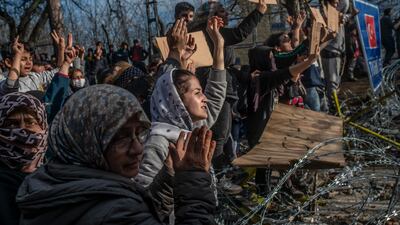
Migrants hold placards as they demonstrate, waiting at the buffer zone in front of the Pazarkule border crossing to Greece, in Edirne. AFP -

An aerial view shows refugees on road at Turkey's Pazarkule border crossing with Greece's Kastanies, southwest of Edirne. REUTERS -
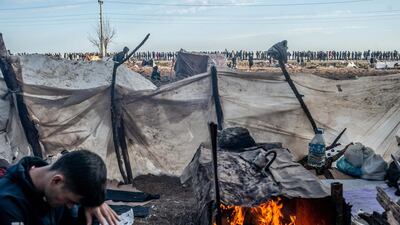
A migrant sits next to a bonfire as others wait for a food distribution in front of the Pazarkule border crossing to Greece, in Edirne. AFP -
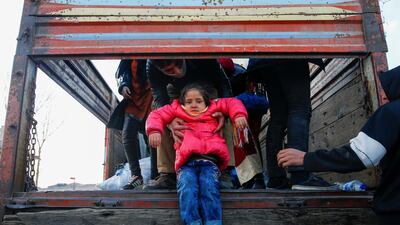
A migrant child is passed from a truck near the Turkey's Pazarkule border crossing with Greece's Kastanies, near Edirne, Turkey. REUTERS -
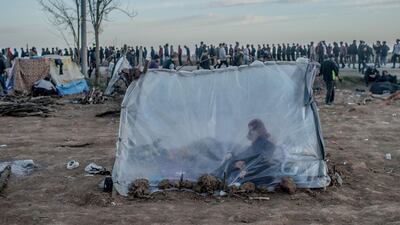
A Syrian woman sits in a tent with her son as others wait for food distribution in front of the Pazarkule border crossing to Greece, in Edirne. AFP -
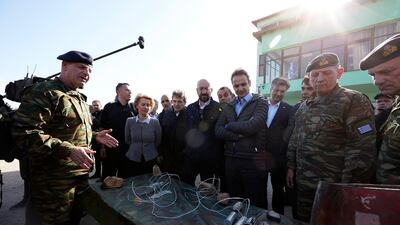
Greek Prime Minister Kyriakos Mitsotakis (4-R) with European Council President Charles Michel (C), European Commission President Ursula von der Leyen (3-L), European Parliament President David Sassoli (2-L) and Croatian Prime Minister Andrej Plenkovic (3-R) during a visit at the Greek-Turkish border in northern Greece. EPA -
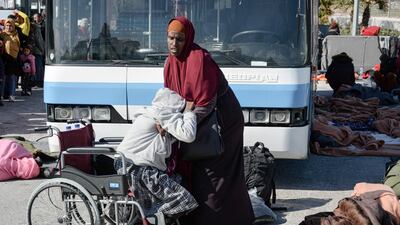
An elderly migrant woman is helped out of a wheelchair at the port of Mytilene on the northeastern Aegean island of Lesbos, Greece. AP Photo -
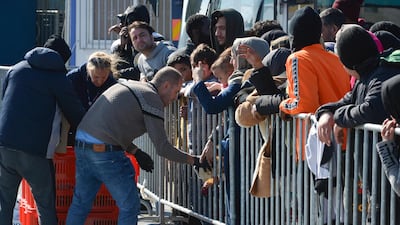
Migrants wait in line for food and water distribution at the port of Mytilene on the northeastern Aegean island of Lesbos, Greece. AP Photo -

Greek police in riot gear advance to push migrants away after minor clashes at the port of Mytilene on the northeastern Aegean island of Lesbos, Greece. AP Photo -

Greek police in riot gear stand before minor clashes with migrants at the port of Mytilene on the northeastern Aegean island of Lesbos, Greece. AP Photo


Thousands of migrants have massed on Greece's eastern border after the Turkish government said last month that it would no longer try to contain them within its territory.
An offensive by the Syrian regime in the country’s Idlib province has stoked fears as up to a million more refugees may be pushed towards Turkey.
Ankara has used its huge refugee population from Syria to exert pressure on Europe. More than 4 million refugees live in Turkey.
Greece hopes to avoid a repeat of the 2015 crisis when more than 1.3 million people arrived across Europe.
Those arrivals were mainly Syrian refugees crossing the Aegean from Turkey to Greece.
The use of the secret deportation site appears to be only one of the Greek government's aggressive tactics in 2020.
Witnesses said hundreds of migrants and refugees were forced to wait outside the site's three warehouses while dozens were crammed indoors.
Migrants have said they were beaten and had their possessions confiscated after being captured in Greece.
They said they were then returned to Turkey without access to a lawyer or the chance to claim asylum.
Francois Crepeau, a former UN special rapporteur on migrant rights, said the location was a domestic “black site”.
The term is used for unacknowledged centres run by governments to detain enemy combatants.
Greece has dismissed the possibility that the centre in the north-east of the country was being run in secret.
“There is no secret detention centre in Greece,” government spokesman Stelios Petsas said on Wednesday.
“All issues related to guarding the borders or issues of security are transparent. The constitution is being applied and there is nothing secret."
On March 3, Greece suspended asylum applications for a month, and said any migrants stopped after crossing the border would be immediately deported.
Athens posted riot police and guards at the border, who used tear gas, flash grenades and water cannon. Several clashes have erupted between the migrants and the Greek troops.
-
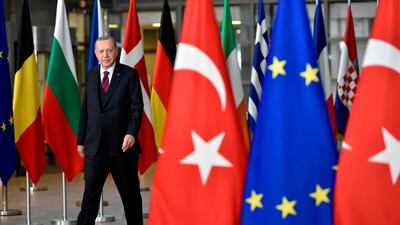
Turkish President Erdogan arrives before a meeting with European Commission President and EU Council President at the EU headquarters in Brussels. AFP -
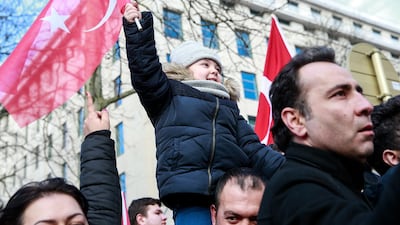
People from Turkish communities welcome Turkish President Erdogan ahead of a meeting and a press conference with NATO Secretary General Jens Stoltenberg in Brussels. EPA -
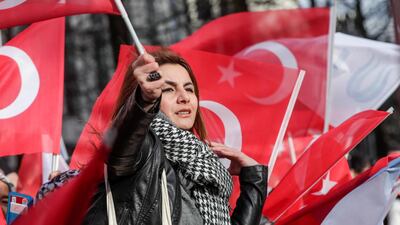
A member of a Turkish community welcomes Turkish President Erdogan ahead of a meeting and a press conference with NATO Secretary General Jens Stoltenberg in Brussels. EPA -

Turkish President Erdogan, center right, walks with European Council President Charles Michel, left, prior to a meeting at the European Council building in Brussels. AP -
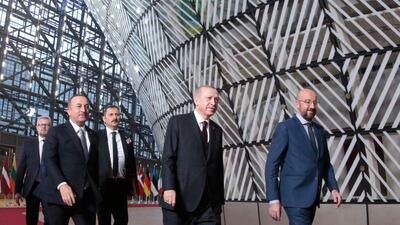
EU Council President Charles Michel (R) with Turkish President Erdogan (C) and Turkish Foreign Minister Mevlut Cavusoglu (L) attend their meeting at the European Council in Brussels. EPA -
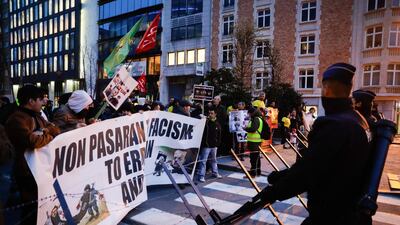
People gather to demonstrate against the arrival of Turkish President Erdogan in Brussels, Belgium. EPA -
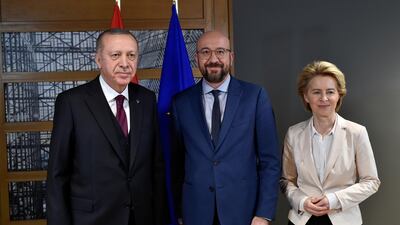
EU Council President Charles Michel (C) and European Commission President Ursula von der Leyen (R) pose with Turkish President Erdogan (L) before their meeting in Brussels. Reuters -
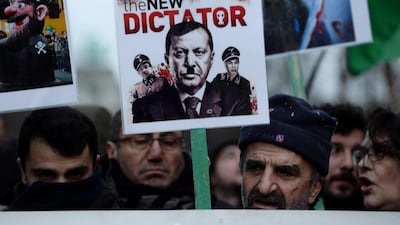
A protester holds a banner depicting Turkish President Erdogan during a demonstration against a visit of the president in Brussels. Reuters -
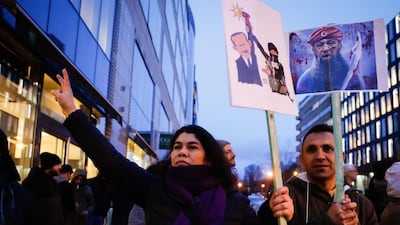
People gather to demonstrate against the arrival of Turkish President Erdogan in Brussels. EPA -
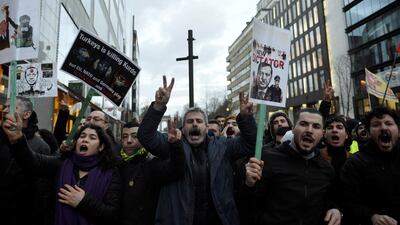
Protesters demonstrate against a visit of Turkey's President Erdogan in Brussels. Reuters -

Turkish President Erdogan addresses his supporters in Brussels, Belgium. Reuters


The New York Times also reported other hostile action against migrants and refugees in Greece.
The Greek coastguard has been recorded endangering migrant vessels in the Aegean with aggressive manoeuvres and shots. The Greek government denied live rounds were used.
The death of Mohammed Yaarub, 22, a Syrian from Aleppo, remains one of the most contested incidents in recent weeks.
The Greek government has dismissed the death, but videos show Mr Yaarub died on the western side of the border last week.
The UN refugee agency has decried forced returns and the lack of proper process for refugees in Greece.
As Turkey and Greece face off across the border, Turkish President Recep Tayyip Erdogan said Greece's actions have led to the deaths of four migrants and that about 1,000 were injured.
Mr Erdogan compared the actions of Greek security services with those of the Nazis.
Ankara has used the migrant situation to press for a better deal with the EU than the one they signed in 2016.
Under that agreement, the EU offered Turkey up to €6 billion (Dh24.85bn) in aid for the Syrian refugees it hosts, in return for it blocking arrivals from entering Europe.
On Monday, Mr Erdogan met Ursula von der Leyen, the president of the European Commission.
Ms von der Leyen indicated she was open to negotiating with him as long as any deal was reciprocal.

