
International travellers arriving in the UK face hefty fines and a 10-year prison sentence if they give false information to authorities.
Health Secretary Matt Hancock announced the new measures on Tuesday as he vowed to "buttress” the country’s security controls to keep out mutant strains of coronavirus.
He said that from next week a maximum fine of up to £10,000 ($13,000) would be imposed on travellers from so-called red list countries who refuse to quarantine in a government-approved hotel, while passengers who lie to authorities over the countries they have visited face a maximum 10-year jail term. The UAE is among the 33 countries on the UK's red list.
The government also announced a new Covid testing regime, with all international passengers required to test negative 72 hours before departure, as well as on day two and eight of their 10-day quarantine period upon arrival.
Travellers must book the tests on a new online platform before their departure, Mr Hancock said. The booking website will also be used for the new hotel quarantine system.
The government has entered into contracts with 16 hotels providing up to 4,600 rooms ahead of the launch date on Monday, February 15.
The 10-day stay will cost travellers £1,750, which includes transport to the hotel, accommodation and testing.
Mr Hancock said that passengers who test positive during their stay would have to quarantine for a further 10 days.
“I make no apologies for the strength of these measures because we’re dealing with one of the strongest threats to our health that we’ve faced as a nation,” he said. “We are buttressing our defences so we can protect the progress we’ve worked so hard to accomplish.”
Earlier on Tuesday, the Department for Health and Social Care said that the measure would provide a “further level of protection” enabling authorities to better track new cases as they enter the UK.
“Throughout the pandemic, the government has put in place proportionate measures, informed by the advice of scientists that have led to some of the toughest border regimes in the world,” a spokesman said.
“Enhancing our testing regime to cover all arrivals while they isolate will provide a further level of protection and enable us to better track any new cases, which might be brought into the country, and give us even more opportunities to detect new variants.”
Meanwhile, officials reassured the public that the Oxford University-AstraZeneca vaccine was still effective after South Africa suspended its inoculation campaign based on a study that showed the drug could not prevent infection or illness from the variant.
Prof Andrew Pollard, chief investigator on the Oxford Vaccine Group, urged people to continue getting the vaccine as the study did not analyse the effects of the South African variant on preventing serious illness among older people.
"There's clearly a risk in confidence in the way people may perceive [the study]," he told BBC Radio 4's Today programme.
"But I don’t think there is any reason for alarm. Today we have a variant spreading in the UK population that we can prevent with all the vaccines. The vaccine may indeed have an impact on the spread of the disease as well. It’s really important people get vaccinated and get protection against the virus that is here circulating today."
Deputy chief medical officer for England Jonathan Van-Tam said the new variant was unlikely to become the dominant strain in the UK because it did not spread as rapidly as other strains.
That is good news for the UK’s inoculation campaign as studies have shown all available vaccines are effective against the variant spreading in England and the UK.
Prof Van-Tam said “a lot of steps behind the scenes” were being taken to organise annual or biennial booster shots for the population as vaccines are altered to deal with new variants.
Oxford University said an updated vaccine that could attack new variants would be ready by autumn.
Prof David Heymann from the London School of Hygiene and Tropical Medicine said it was likely the world would have to learn to live with Covid-19 as the disease becomes endemic.
“All infections in humans likely came from the animal kingdom, HIV for example,” he said. “We learnt to live with it, as we’ll learn to live with this disease as well.”
Britain's opposition Labour party has been calling for the government’s hotel quarantine plan to apply to all travellers entering the country, criticising the targeted approach as ineffective in keeping out mutant strains.
However, Prof Heymann, a leading infectious disease epidemiologist, said viruses would eventually enter the UK regardless of border closures.
“We’ve seen that countries that have closed their borders such as New Zealand have kept the virus out, but now their problem is what do they do once they open those borders? I think the best way forward is to live with the understanding that viruses, bacteria and any infection can cross borders and we have to have the defences in our country to deal with them,” he said.
In pictures - coronavirus in the UK
-
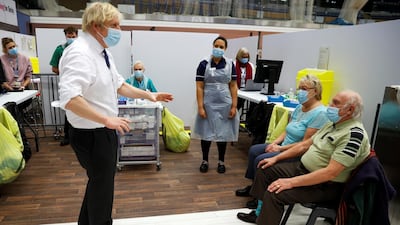
Britain's Prime Minister Boris Johnson visits a vaccination centre at the Derby Arena velodrome. Reuters -

Boris Johnson visits SureScreen Diagnostics in Derby. Reuters -
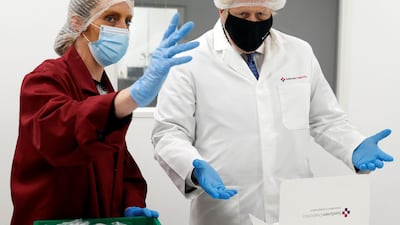
Boris Johnson speaks with an employee at SureScreen Diagnostics. Reuters -

An NHS employee looks over the vaccination bays at the Elland Road mass vaccination centre in Leeds. AP Photo -

A healthcare worker shows an elderly woman how to take her swab sample, at a minibus that was converted into a mobile test centre in Walsall. Reuters -
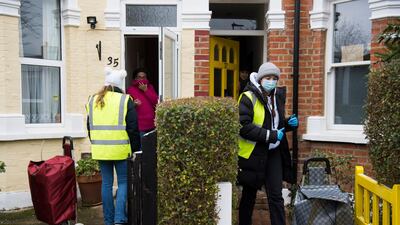
Members of staff speak to residents as they carry out mobile door-to-door virus testing to assess the prevalence of the South African Covid-19 variant in the Ealing district of London. AP Photo -
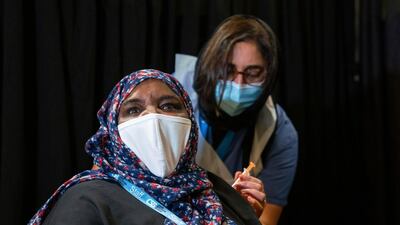
A woman is vaccinated at a Covid-19 pop-up vaccination centre, at the East London Mosque in Whitechapel, London. AP Photo -
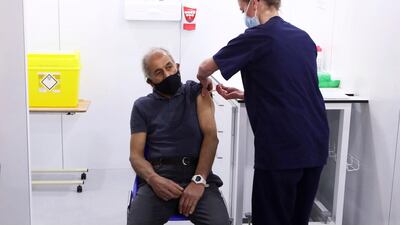
Olivia Smart, advanced practitioner, vaccinates Mewa Singh Khela, 72, with his first dose of the Oxford AstraZeneca coronavirus vaccine at the Elland Road vaccination centre in Leeds. AP Photo -
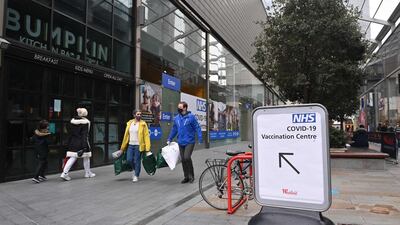
Pedestrians walk past an NHS Covid-19 vaccination centre in Westfield Stratford City shopping centre in east London. AFP -
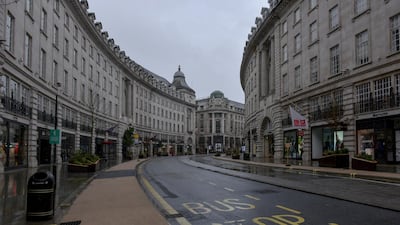
A deserted Regent Street in London as the third national lockdown continues. AP Photo -
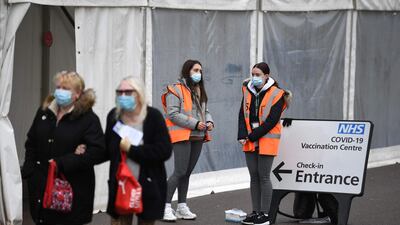
Volunteers stand outside a temporary vaccination hub at the Colchester Community Stadium in Colchester. AFP -

People arrive to receive the Covid-19 vaccine at Crystal Palace Football Club vaccination centre in London. Reuters -
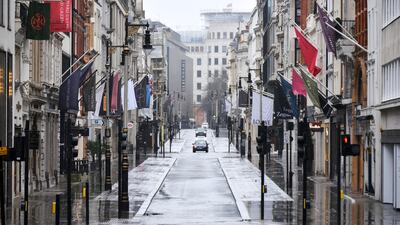
A very quiet Mayfair in London. AP Photo -
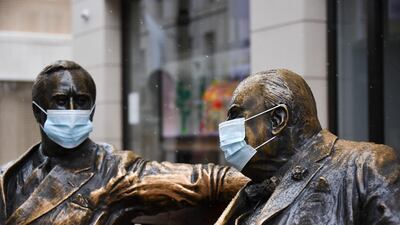
Face coverings are placed on the statues of former US President Franklyn D. Roosevelt and former British Prime Minister Winston Churchill in Mayfair, London. AP Photo



