

A robot capable of carrying out coronavirus swabs without the need for a human nurse on hand is being developed in Denmark.
A 3D-printed arm takes a throat swab and places the sample in a jar, and then a new arm is reprinted for use on the next patient.
The potential breakthrough reduces the danger for nursing staff and medics who currently conduct the test and risk contracting the disease.
"Robotics researchers ... have developed the world's first fully automatic robot capable of carrying out throat swabs for Covid-19, so that healthcare professionals are not exposed to the risk of infection," the University of Southern Denmark said in a statement.
The next step is to develop a prototype into a working product that can be sent into the field and into medical centres around the world.
Thiusius Rajeeth Savarimuthu, the project's leader, is in charge of the team of 10 researchers who have been working around the clock at the university.
"There are prospects in developing a throat swab robot so that robots can take over the swabbing work, both in relation to Covid-19 but also in all future viruses," he said in the statement.
He added: "I was one of the first to be swabbed. It went really well. I'm still sitting here.
"I was surprised at how softly the robot managed to land the swab at the spot in the throat where it was supposed to hit, so it was a huge success."
The researchers now hope to further develop the robot over the next couple of months.
-

A Chinese health worker carries out a nucleic acid test on a journalist covering events around the National People's Congress. Getty -
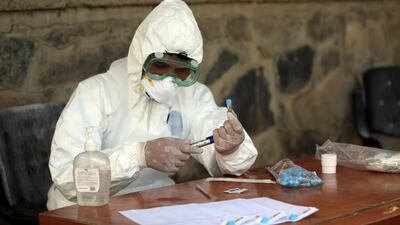
An Afghan lab technician processes a test sample for the coronavirus at the Afghan-Japan Communicable Disease Hospital, Kabul’s main facility for coronavirus testing and treatment. AP -
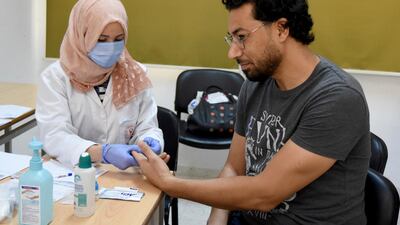
A teacher is tested in Tunis, Tunisia, ahead of a limited reopening of schools. AP -

Health workers visit riverside communities for Covid-19 coronavirus infections in Melgaco to test them at the mouth of the Amazon River in Brazil. AFP -

People wear protective masks and sit apart as they wait for the results of their coronavirus antibody tests in North Sumatra, Indonesia. AP -
A health worker takes a swab from a school worker in Cyprus. AFP -
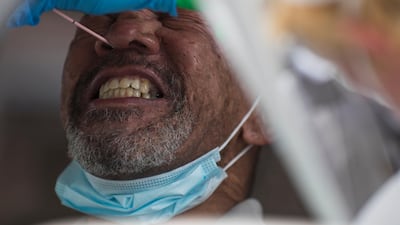
Stephen Price winces as he receives a nasal swab to test for Covid-19 in the US state of Tennessee AP


"The plan is that we have a prototype that swabs patients by the end of June, and that the robot is completed and ready for the market this fall when the second Covid-19 wave hits," said Soren Stig, director of Lifeline Robotics, the company set up to build the new robot.
The university added that as international travel begins to recover as pandemic restrictions ease, the robot could be used at borders and airports.

