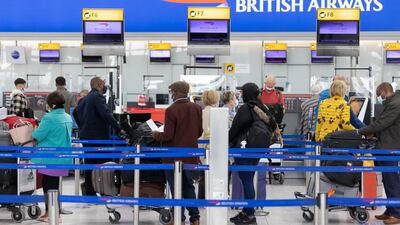
Egypt and Bahrain have been added to the UK's travel red list, with no new countries added to the green list.
Portugal was downgraded to the amber list in a blow to holidaymakers and travel firms.
Transport Secretary Grant Shapps said ministers had acted because of a rising positivity rate in Portugal and concerns over a new mutation of Covid-19.
He linked the travel update to the UK government's hopes of removing the last remaining restrictions on social contact on June 21.
"There's a sort of Nepal mutation of the so-called Indian variant which has been detected and we just don't know the potential for that to be a vaccine-defeating mutation," he said.
Afghanistan, Costa Rica, Sri Lanka, Sudan, and Trinidad & Tobago were the other countries added to the red list.
The government said it was introducing a trial in which people could fly direct from red list countries previously subject to flight bans. They would arrive at dedicated terminals at London Heathrow and Birmingham airports.
Hopes that popular destinations such as Spain and France would be added to the green list were dashed in a setback for travel companies who had called for it to be expanded.
The new rules come into effect at 4am on Tuesday, June 8.
Johan Lundgren, the CEO of easyJet, said the move to downgrade Portugal was not justified.
"This shock decision to add Portugal to the amber list is a huge blow to those who are currently in Portugal and those who have booked to be reunited with loved ones, or take a well-deserved break this summer," he said.
Stewart Wingate, the chief executive of Gatwick Airport, said the update was "bitterly disappointing news".
Travel companies including British Airways owner IAG fell on the stock market after reports emerged that Portugal would be downgraded.
Portugal was the only major holiday destination among the 12 countries included on the list of safe locations last month.
Saying that the UK would look to resume foreign holidays "given time", Mr Shapps said Europe was about 10 weeks behind in its vaccination programme.
UK Prime Minister Boris Johnson had said on Wednesday that the UK would downgrade countries to the amber or red lists if necessary.
“We will have no hesitation in moving countries from the green list to the amber list to the red list, if we have to do so,” Mr Johnson said.
“The priority is to continue the vaccine rollout, to protect the people of this country.”
Under the traffic-light system, people travelling to England from red-list countries – including those with links to Covid-19 variants such as Brazil, India and South Africa – have to quarantine in government-approved hotels.
Travellers returning from countries on the amber list, which covers most of the world, must isolate for 10 days at home and take Covid-19 tests on the second and eighth days.
Only the handful of countries on the green list can be visited without facing quarantine on returning to England.
The travel industry wants Britain's green list to be expanded as it seeks to recover from the disastrous economic effects of the pandemic.
IAG's former director of strategy, Robert Boyle, had suggested that some Spanish and Greek islands could be put on the green list.
But UK Health Secretary Matt Hancock said on Thursday that the restrictions were needed to preserve the success of the vaccine programme in Britain.
"We have seen hospitalisations and deaths come right down and we have got to protect the progress we have made here at home, whilst allowing for travel where it is safe," he said.
Travel to amber and red countries is not illegal but it is discouraged and many countries on those lists are not open to British tourists for holidays.
The EU updated its own list of safe countries on Thursday, adding Japan but not the UK or US.
The European Council agreed last month that entry restrictions should be eased for vaccinated people from outside the bloc, although individual countries have the final say.

Living in...
This article is part of a guide on where to live in the UAE. Our reporters will profile some of the country’s most desirable districts, provide an estimate of rental prices and introduce you to some of the residents who call each area home.
The White Lotus: Season three
Creator: Mike White
Starring: Walton Goggins, Jason Isaacs, Natasha Rothwell
Rating: 4.5/5
ONCE UPON A TIME IN GAZA
Starring: Nader Abd Alhay, Majd Eid, Ramzi Maqdisi
Directors: Tarzan and Arab Nasser
Rating: 4.5/5
More on Quran memorisation:
More from Neighbourhood Watch:
The National Archives, Abu Dhabi
Founded over 50 years ago, the National Archives collects valuable historical material relating to the UAE, and is the oldest and richest archive relating to the Arabian Gulf.
Much of the material can be viewed on line at the Arabian Gulf Digital Archive - https://www.agda.ae/en
ESSENTIALS
The flights
Fly Etihad or Emirates from the UAE to Moscow from 2,763 return per person return including taxes.
Where to stay
Trips on the Golden Eagle Trans-Siberian cost from US$16,995 (Dh62,414) per person, based on two sharing.
The%20specs
%3Cp%3E%3Cstrong%3EEngine%3A%3C%2Fstrong%3E%206.4-litre%20V8%0D%3Cbr%3E%3Cstrong%3ETransmission%3A%20%3C%2Fstrong%3E8-speed%20auto%0D%3Cbr%3E%3Cstrong%3EPower%3A%20%3C%2Fstrong%3E470bhp%0D%3Cbr%3E%3Cstrong%3ETorque%3A%20%3C%2Fstrong%3E637Nm%0D%3Cbr%3E%3Cstrong%3EPrice%3A%20%3C%2Fstrong%3EDh375%2C900%20(estimate)%0D%3Cbr%3E%3Cstrong%3EOn%20sale%3A%3C%2Fstrong%3E%20now%3C%2Fp%3E%0A
THE BIO
Age: 33
Favourite quote: “If you’re going through hell, keep going” Winston Churchill
Favourite breed of dog: All of them. I can’t possibly pick a favourite.
Favourite place in the UAE: The Stray Dogs Centre in Umm Al Quwain. It sounds predictable, but it honestly is my favourite place to spend time. Surrounded by hundreds of dogs that love you - what could possibly be better than that?
Favourite colour: All the colours that dogs come in
Mercer, the investment consulting arm of US services company Marsh & McLennan, expects its wealth division to at least double its assets under management (AUM) in the Middle East as wealth in the region continues to grow despite economic headwinds, a company official said.
Mercer Wealth, which globally has $160 billion in AUM, plans to boost its AUM in the region to $2-$3bn in the next 2-3 years from the present $1bn, said Yasir AbuShaban, a Dubai-based principal with Mercer Wealth.
“Within the next two to three years, we are looking at reaching $2 to $3 billion as a conservative estimate and we do see an opportunity to do so,” said Mr AbuShaban.
Mercer does not directly make investments, but allocates clients’ money they have discretion to, to professional asset managers. They also provide advice to clients.
“We have buying power. We can negotiate on their (client’s) behalf with asset managers to provide them lower fees than they otherwise would have to get on their own,” he added.
Mercer Wealth’s clients include sovereign wealth funds, family offices, and insurance companies among others.
From its office in Dubai, Mercer also looks after Africa, India and Turkey, where they also see opportunity for growth.
Wealth creation in Middle East and Africa (MEA) grew 8.5 per cent to $8.1 trillion last year from $7.5tn in 2015, higher than last year’s global average of 6 per cent and the second-highest growth in a region after Asia-Pacific which grew 9.9 per cent, according to consultancy Boston Consulting Group (BCG). In the region, where wealth grew just 1.9 per cent in 2015 compared with 2014, a pickup in oil prices has helped in wealth generation.
BCG is forecasting MEA wealth will rise to $12tn by 2021, growing at an annual average of 8 per cent.
Drivers of wealth generation in the region will be split evenly between new wealth creation and growth of performance of existing assets, according to BCG.
Another general trend in the region is clients’ looking for a comprehensive approach to investing, according to Mr AbuShaban.
“Institutional investors or some of the families are seeing a slowdown in the available capital they have to invest and in that sense they are looking at optimizing the way they manage their portfolios and making sure they are not investing haphazardly and different parts of their investment are working together,” said Mr AbuShaban.
Some clients also have a higher appetite for risk, given the low interest-rate environment that does not provide enough yield for some institutional investors. These clients are keen to invest in illiquid assets, such as private equity and infrastructure.
“What we have seen is a desire for higher returns in what has been a low-return environment specifically in various fixed income or bonds,” he said.
“In this environment, we have seen a de facto increase in the risk that clients are taking in things like illiquid investments, private equity investments, infrastructure and private debt, those kind of investments were higher illiquidity results in incrementally higher returns.”
The Abu Dhabi Investment Authority, one of the largest sovereign wealth funds, said in its 2016 report that has gradually increased its exposure in direct private equity and private credit transactions, mainly in Asian markets and especially in China and India. The authority’s private equity department focused on structured equities owing to “their defensive characteristics.”
Ten tax points to be aware of in 2026
1. Domestic VAT refund amendments: request your refund within five years
If a business does not apply for the refund on time, they lose their credit.
2. E-invoicing in the UAE
Businesses should continue preparing for the implementation of e-invoicing in the UAE, with 2026 a preparation and transition period ahead of phased mandatory adoption.
3. More tax audits
Tax authorities are increasingly using data already available across multiple filings to identify audit risks.
4. More beneficial VAT and excise tax penalty regime
Tax disputes are expected to become more frequent and more structured, with clearer administrative objection and appeal processes. The UAE has adopted a new penalty regime for VAT and excise disputes, which now mirrors the penalty regime for corporate tax.
5. Greater emphasis on statutory audit
There is a greater need for the accuracy of financial statements. The International Financial Reporting Standards standards need to be strictly adhered to and, as a result, the quality of the audits will need to increase.
6. Further transfer pricing enforcement
Transfer pricing enforcement, which refers to the practice of establishing prices for internal transactions between related entities, is expected to broaden in scope. The UAE will shortly open the possibility to negotiate advance pricing agreements, or essentially rulings for transfer pricing purposes.
7. Limited time periods for audits
Recent amendments also introduce a default five-year limitation period for tax audits and assessments, subject to specific statutory exceptions. While the standard audit and assessment period is five years, this may be extended to up to 15 years in cases involving fraud or tax evasion.
8. Pillar 2 implementation
Many multinational groups will begin to feel the practical effect of the Domestic Minimum Top-Up Tax (DMTT), the UAE's implementation of the OECD’s global minimum tax under Pillar 2. While the rules apply for financial years starting on or after January 1, 2025, it is 2026 that marks the transition to an operational phase.
9. Reduced compliance obligations for imported goods and services
Businesses that apply the reverse-charge mechanism for VAT purposes in the UAE may benefit from reduced compliance obligations.
10. Substance and CbC reporting focus
Tax authorities are expected to continue strengthening the enforcement of economic substance and Country-by-Country (CbC) reporting frameworks. In the UAE, these regimes are increasingly being used as risk-assessment tools, providing tax authorities with a comprehensive view of multinational groups’ global footprints and enabling them to assess whether profits are aligned with real economic activity.
Contributed by Thomas Vanhee and Hend Rashwan, Aurifer
