Nine Syrian refugees pretending to be a volleyball team were arrested in Greece as they tried to travel to Austria. Hellenic Police

Greek police arrest Syrian refugees disguised as volleyball team


Jamie Prentis
  • English
  • Arabic

Greek police detained nine Syrian refugees pretending to be a volleyball team as they attempted to board a flight for Vienna, Austria, with fake travel documents.

The refugees were wearing matching sports clothing and backpacks, but were stopped late on Sunday when police became suspicious.

It was found they did not belong to a sports club after the discovery of fake ID cards.

Greece is often the first EU country in which refugees and migrants fleeing Syria arrive. They are supposed to remain in the country while their asylum applications are processed.

There were two similar incidents in the past two years, authorities at Athens airport said.

In 2020, a dozen Syrians carrying fake Bulgarian passports and disguised as handball players were stopped while trying to board a flight to Vienna.

The year before, 10 Syrians dressed as volleyball players were detained at the airport after stolen and forged passports were discovered in their possession.

Under Prime Minister Kyriakos Mitsotakis, who took office in 2019, Greece has taken on a tougher position on migration.

The asylum process has been fast-tracked, border patrols increased and benefits cut for refugees, including those granted asylum.

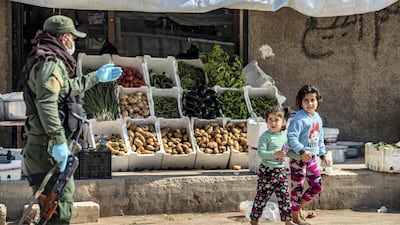
  • A member of the Kurdish Internal Security Forces of Asayesh urges children to return home, in Syria's northeastern city of Hasakeh on April 30, 2020, following measures taken by the Kurdish-led local authorities there, to limit the spread of the novel coronavirus. AFP
    A member of the Kurdish Internal Security Forces of Asayesh urges children to return home, in Syria's northeastern city of Hasakeh on April 30, 2020, following measures taken by the Kurdish-led local authorities there, to limit the spread of the novel coronavirus. AFP
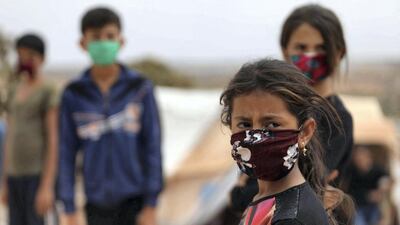
  • Children wear face masks sewed by displaced Syrian women at a camp for the internally displaced people near the town of Maaret Misrin in Syria's northwestern Idlib province on July 27, 2020 amid the COVID-19 pandemic crisis. AFP
    Children wear face masks sewed by displaced Syrian women at a camp for the internally displaced people near the town of Maaret Misrin in Syria's northwestern Idlib province on July 27, 2020 amid the COVID-19 pandemic crisis. AFP
  • Members of Syrian Civil Defence, also known as the White Helmets, transport the body of a man who died from the Covid-19 coronavirus for burial in Syria's rebel-held northwestern city of Idlib on November 19, 2020. AFP
    Members of Syrian Civil Defence, also known as the White Helmets, transport the body of a man who died from the Covid-19 coronavirus for burial in Syria's rebel-held northwestern city of Idlib on November 19, 2020. AFP
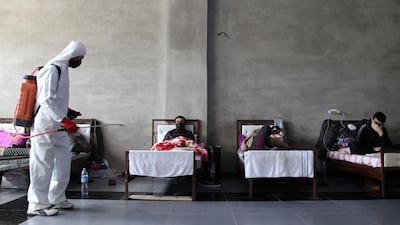
  • A man sanitises the room as Syrians who returned from Turkey rest at a quarantine facility in the countryside of the town of Jisr al-Shughur, west of the mostly rebel-held Syrian province of Idlib, on April 27, 2020 during the coronavirus COVID-19 pandemic. AFP
    A man sanitises the room as Syrians who returned from Turkey rest at a quarantine facility in the countryside of the town of Jisr al-Shughur, west of the mostly rebel-held Syrian province of Idlib, on April 27, 2020 during the coronavirus COVID-19 pandemic. AFP
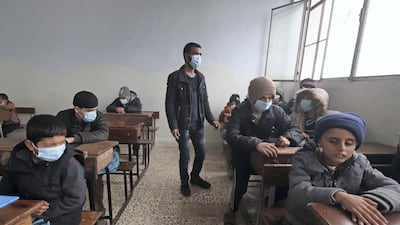
  • A blind Syrian teacher leads visually impaired pupils during a lesson, respecting social distancing amid the spread of the coronavirus disease, at a school for the blind in the rebel-held northwestern city of Idlib on December 20, 2020. AFP
    A blind Syrian teacher leads visually impaired pupils during a lesson, respecting social distancing amid the spread of the coronavirus disease, at a school for the blind in the rebel-held northwestern city of Idlib on December 20, 2020. AFP
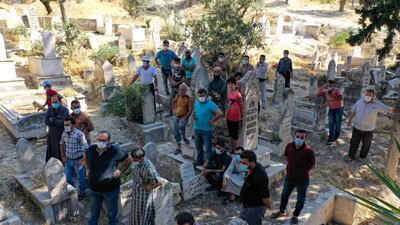
  • People wearing face masks, attned the funeral of a 62-year-old displaced Syrian man who died of the covid-19 disease, in the town of Salqin, in the northwestern Syrian Idlib province on September 17, 2020. AFP
    People wearing face masks, attned the funeral of a 62-year-old displaced Syrian man who died of the covid-19 disease, in the town of Salqin, in the northwestern Syrian Idlib province on September 17, 2020. AFP
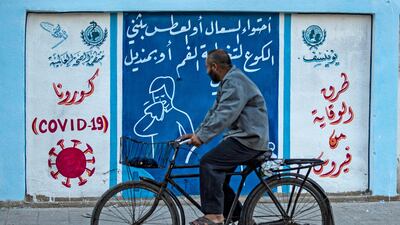
  • A Syrian man rides a bicycle past a mural painted as part of an awareness campaign by UNICEF and WHO initiative, bearing instructions on protection from COVID-19 in the Kurdish-majority city of Qamishli of Syria's northeastern Hasakeh province on August 16, 2020, after a spike in infections in the area. AFP
    A Syrian man rides a bicycle past a mural painted as part of an awareness campaign by UNICEF and WHO initiative, bearing instructions on protection from COVID-19 in the Kurdish-majority city of Qamishli of Syria's northeastern Hasakeh province on August 16, 2020, after a spike in infections in the area. AFP
Company%20Profile
%3Cp%3E%3Cstrong%3EName%3A%3C%2Fstrong%3E%20Neo%20Mobility%3Cbr%3E%3Cstrong%3EStarted%3A%3C%2Fstrong%3E%20February%202023%3Cbr%3E%3Cstrong%3ECo-founders%3A%3C%2Fstrong%3E%20Abhishek%20Shah%20and%20Anish%20Garg%3Cbr%3E%3Cstrong%3EBased%3A%3C%2Fstrong%3E%20Dubai%3Cbr%3E%3Cstrong%3EIndustry%3A%3C%2Fstrong%3E%20Logistics%3Cbr%3E%3Cstrong%3EFunding%3A%3C%2Fstrong%3E%20%2410%20million%3Cbr%3E%3Cstrong%3EInvestors%3A%3C%2Fstrong%3E%20Delta%20Corp%2C%20Pyse%20Sustainability%20Fund%2C%20angel%20investors%3C%2Fp%3E%0A
The specS: 2018 Toyota Camry

Price: base / as tested: Dh91,000 / Dh114,000

Engine: 3.5-litre V6

Gearbox: Eight-speed automatic

Power: 298hp @ 6,600rpm

Torque: 356Nm @ 4,700rpm

Fuel economy, combined: 7.0L / 100km

<html><head><meta http-equiv="Content-Type" content="text/html" charset="UTF-8" /></head><body><!--PSTYLE=* Labels%3aFH Label 18 Sport--><p>Beach soccer</p><!--PSTYLE=BY Byline--><p>Amith Passela</p><p /></body></html>
Results

4.30pm Jebel Jais – Maiden (PA) Dh60,000 (Turf) 1,000m; Winner: MM Al Balqaa, Bernardo Pinheiro (jockey), Qaiss Aboud (trainer)

5pm: Jabel Faya – Maiden (PA) Dh60,000 (T) 1,000m; Winner: AF Rasam, Tadhg O’Shea, Ernst Oertel

5.30pm: Al Wathba Stallions Cup – Handicap (PA) Dh70,000 (T) 2,200m; Winner: AF Mukhrej, Tadhg O’Shea, Ernst Oertel

6pm: The President’s Cup Prep – Conditions (PA) Dh100,000 (T) 2,200m; Winner: Mujeeb, Richard Mullen, Salem Al Ketbi

6.30pm: Abu Dhabi Equestrian Club – Prestige (PA) Dh125,000 (T) 1,600m; Winner: Jawal Al Reef, Antonio Fresu, Abubakar Daud

7pm: Al Ruwais – Group 3 (PA) Dh300,000 (T) 1,200m; Winner: Ashton Tourettes, Pat Dobbs, Ibrahim Aseel

7.30pm: Jebel Hafeet – Maiden (TB) Dh80,000 (T) 1,400m; Winner: Nibraas, Richard Mullen, Nicholas Bachalard

Ten tax points to be aware of in 2026

1. Domestic VAT refund amendments: request your refund within five years

If a business does not apply for the refund on time, they lose their credit.

2. E-invoicing in the UAE

Businesses should continue preparing for the implementation of e-invoicing in the UAE, with 2026 a preparation and transition period ahead of phased mandatory adoption. 

3. More tax audits

Tax authorities are increasingly using data already available across multiple filings to identify audit risks. 

4. More beneficial VAT and excise tax penalty regime

Tax disputes are expected to become more frequent and more structured, with clearer administrative objection and appeal processes. The UAE has adopted a new penalty regime for VAT and excise disputes, which now mirrors the penalty regime for corporate tax.

5. Greater emphasis on statutory audit

There is a greater need for the accuracy of financial statements. The International Financial Reporting Standards standards need to be strictly adhered to and, as a result, the quality of the audits will need to increase.

6. Further transfer pricing enforcement

Transfer pricing enforcement, which refers to the practice of establishing prices for internal transactions between related entities, is expected to broaden in scope. The UAE will shortly open the possibility to negotiate advance pricing agreements, or essentially rulings for transfer pricing purposes. 

7. Limited time periods for audits

Recent amendments also introduce a default five-year limitation period for tax audits and assessments, subject to specific statutory exceptions. While the standard audit and assessment period is five years, this may be extended to up to 15 years in cases involving fraud or tax evasion. 

8. Pillar 2 implementation 

Many multinational groups will begin to feel the practical effect of the Domestic Minimum Top-Up Tax (DMTT), the UAE's implementation of the OECD’s global minimum tax under Pillar 2. While the rules apply for financial years starting on or after January 1, 2025, it is 2026 that marks the transition to an operational phase.

9. Reduced compliance obligations for imported goods and services

Businesses that apply the reverse-charge mechanism for VAT purposes in the UAE may benefit from reduced compliance obligations. 

10. Substance and CbC reporting focus

Tax authorities are expected to continue strengthening the enforcement of economic substance and Country-by-Country (CbC) reporting frameworks. In the UAE, these regimes are increasingly being used as risk-assessment tools, providing tax authorities with a comprehensive view of multinational groups’ global footprints and enabling them to assess whether profits are aligned with real economic activity. 

Contributed by Thomas Vanhee and Hend Rashwan, Aurifer