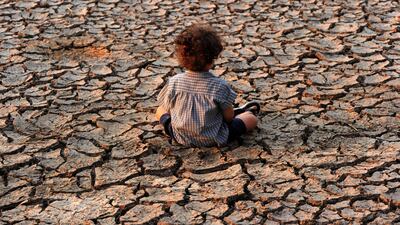
Hunger, drought and disease caused by climate change will affect millions more people within decades, the UN has said in a leaked report that sets out the dire human health consequences of a warming planet.
The forthcoming report by the Intergovernmental Panel on Climate Change, obtained by AFP, offers a distressing vision of the decades to come.
Policy choices made now, such as promoting plant-based diets, can limit these health consequences, but many are unavoidable in the short term, the report says.
It warns of the cascading impacts that simultaneous crop failures, soaring inflation and the falling nutritional value of basic foods are likely to have on the world’s most vulnerable people.
Depending on how well humans get a handle on carbon emissions and rising temperatures, a child born today could be confronted with numerous climate-related health threats before turning 30, the report says.
The IPCC’s 4,000-page draft report, scheduled for release next year, offers the most comprehensive rundown to date of the impacts of climate change on the planet and its species.
It predicts that up to 80 million more people than today will be at risk of hunger by 2050 and that disruptions to the water cycle will cause rain-fed staple crops to decline throughout sub-Saharan Africa.
Up to 40 per cent of rice-producing regions in India could become less suitable for farming the grain.
Global maize production has already declined 4 per cent since 1981 owing to climate change, and human-induced warming in West Africa has reduced millet and sorghum yields by up to 20 and 15 per cent respectively, it says.
The frequency of sudden food production losses has already increased steadily for the past 50 years.
“The basis for our health is sustained by three pillars: the food we eat, access to water, and shelter,” said Maria Neira, director of public health, environmental and social determinants of health at the World Health Organisation.
“These pillars are totally vulnerable and about to collapse.”

Even as rising temperatures affect the availability of core crops, nutritional value is declining, the report said.
The protein content of rice, wheat, barley and potatoes, for instance, is expected to fall by between 6 and 14 per cent, putting close to 150 million more people at risk of protein deficiency.
Essential micronutrients – already lacking in many diets in poorer nations – are also set to decline as temperatures rise.
Extreme weather events made more frequent by rising temperatures will cause “multi-breadbasket failures” to hit food production more regularly, the report predicts.
As climate change reduces yields, and demand for biofuel crops and carbon-absorbing forests grows, food prices are projected by rise as much as a third by 2050, bringing an additional 183 million people in low-income households to the edge of chronic hunger.
Throughout Asia and Africa, 10 million more children than now will suffer from malnutrition and stunting in 30 years’ time, saddling a new generation with life-long health problems despite greater socioeconomic development.
As with most climate impacts, the effects on human health will not be felt equally. The draft suggests that 80 per cent of the population at risk of hunger live in Africa or South-east Asia.
“There are hotspots emerging,” said Elizabeth Robinson, professor of environmental economics at the University of Reading, in England.
“If you overlay where people are already hungry with where crops are going to be most harmed by climate, you see that it’s the same places that are already suffering from high malnutrition.”

The report outlines in stark terms the fate potentially awaiting millions whose access to safe water will be thrown into turmoil by climate change.
About half of the world’s population is already water insecure, and climate impacts will undoubtedly make that worse.
Research looking at water supply, agriculture and rising sea levels shows that between 30 million and 140 million people will probably be internally displaced in Africa, South-east Asia and Latin America by 2050, the report says.
Up to three quarters of heavily tapped groundwater supply – the main source of potable water for 2.5 billion people – could also be disrupted by the middle of the century.
The rapid melting of mountain glaciers has already “strongly affected the water cycle”, an essential source for two billion people that could “create or exacerbate tensions over water resources”, the report says.
And while the economic cost of climate’s effect on water supply varies geographically, it is expected to shave half a percentage point off global gross domestic product by 2050.
“Water is one of the issues that our generation is going to confront very soon,” Ms Neira said.
“There will be massive displacement, massive migration, and we need to treat all of that as a global issue.”
As the warming planet expands habitable zones for mosquitoes and other disease-carrying species, the draft report warns that half the world’s population could be exposed to vector-borne pathogens such as dengue, yellow fever and Zika virus within decades.
Risks posed by malaria and Lyme disease are set to rise, and child deaths from diarrhoea are on track to increase until at least the 2050s, despite greater socioeconomic development in high-incidence countries.
The report also says climate change will increase the burden of non-communicable illnesses.
Diseases associated with poor air quality and exposure to ozone, such as lung and heart conditions, will “rise substantially”, it says.
“There will also be increased risks of food and water-related contamination” by marine toxins, it says.
As with most climate-related impacts, these diseases will ravage the world’s most vulnerable.
The report says the Covid-19 pandemic, while boosting international co-operation, has revealed many nations’ vulnerability to future shocks, including those made inevitable by climate change.
“Covid has made the fault lines in our health systems extremely visible,” said Stefanie Tye, research associate at the World Resources Institute’s Climate Resilience Practice, who was not involved in the IPCC report.
“The effects and shocks of climate change will strain health systems even more, for a much longer period, and in ways that we are still trying to fully grasp.”

