
Of a world in coronavirus turmoil, they may know little or nothing.
Submariners stealthily cruising the ocean deeps, purposefully shielded from worldly worries to encourage undivided focus on their top-secret missions of nuclear deterrence, may be among the last pockets of people anywhere who are still blissfully unaware of how the pandemic is turning life upside down.
Mariners aboard ballistic submarines are habitually spared bad news while underwater to avoid undermining their morale, say current and former officers who served aboard France’s nuclear-armed subs. So, any crews that left port before the virus spread around the globe are likely being kept in the dark about the extent of the rapidly unfurling crisis by their commanders until their return, they say.

“They won’t know,” said retired Admiral Dominique Salles, who commanded the French ballistic submarine squadron from 2003-2006. “The boys need to be completely available for their mission.”
Adm Salles said he believes submariners will likely only be told of the pandemic as they head back to port, in the final two days of their mission.
“Those who are at sea don’t need this information,” said Salles, who also commanded the nuclear-armed French submarine “L’Inflexible.”
“The commander, I think, is doubtless informed about what is happening. I don’t think he’ll have all the details,” he said.
The French navy won’t divulge what has or hasn’t been said to submarine crews. Nor will it say whether any of the four French ballistic submarines, laden with 16 missiles that each can carry six nuclear warheads, left harbour before France instituted a nationwide lockdown on March 17.
“Because the deterrent is wrapped in a bubble of protection and confidentiality, it is impossible to know whether the crews are informed or not of this situation,” French navy spokesman Lt Cmdr Olivier Ribard said.
-

Nurses put on their Personal Protective Equipment (PPE) before starting to work on the preparation of the Intensive care unit in the new Covid-19 Hospital in Verduno, near Alba, Northwestern Italy on the eve of its official opening. AFP -
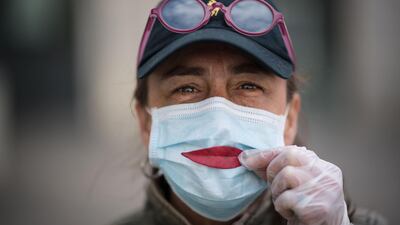
A woman wearing a protective mask holds a leaf as a smile in Nantes, western France, on the thirteenth day of a lockdown. AFP -

A lady is seen with binoculars in a hotel room at Crown Promenade Hotel in Melbourne. Travellers and Australian residents who arrive into the country from overseas are being sent straight to makeshift quarantine facilities across Australia, and will spend 14 days of quarantine in state-funded hotel rooms, with doors guarded by state police, defence personnel or private security guards. EPA -

A television journalist attempts to get a phone number of someone in quarantine at Crown Promenade Hotel in Melbourne. EPA -
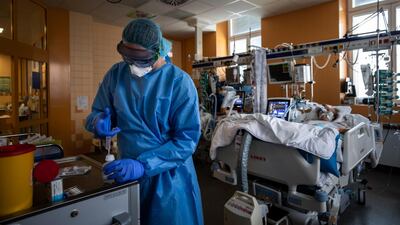
A medical professional wearing protective gear prepares drugs for a patient infected with coronavirus (COVID-19) in the intensive care unit of the General University Hospital in Prague, Czech Republic. Getty Images -

People wearing face masks are seen outside a Giorgio Armani store at a shopping mall in Wuhan, Hubei province, the epicentre of China's coronavirus disease (COVID-19) outbreak. REUTERS -
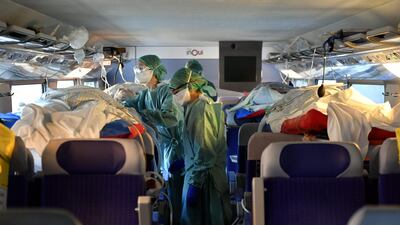
French nurses take care of four patients infected with the novel coronavirus (COVID-19) in a medicalised TGV (high-speed train) at Nancy train station as 24 patients from Nancy and Metz are being transfered from Nancy and Metz towards Bordeaux, Libourne, Pau and Bayonne. AFP -

A mother covers her child's face with a cloth outside Anand Vihar bus terminal as they leave India's capital for their homes during a government-imposed nationwide lockdown as a preventive measure against the COVID-19 coronavirus, in New Delhi. AFP -
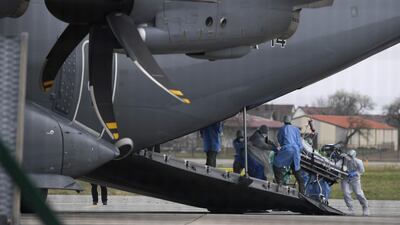
Medical staff move a patient infected with the novel coronavirus, COVID-19, into a German medicalised Airbus A400M transport plane in Strasbourg, eastern France, to be evacuated to the German cities of Stuttgart and Ulm for medical attention. AFP -
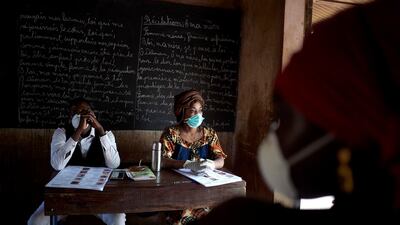
Electoral officials wear masks and gloves as a preventive measure against the spread of the COVID-19 coronavirus during the parliamentary elections in Bamako. AFP -
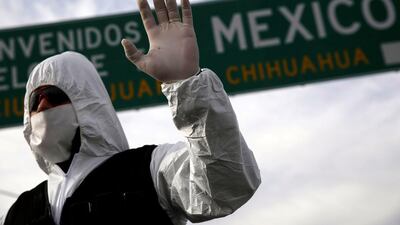
A member of traffic police wearing a protective suit gestures during the coronavirus disease (COVID-19) outbreak at the Mexico and United States border, in Ciudad Juarez, Mexico. REUTERS -

A worker inspects a disinfection chamber installed on a sidewalk as part of measures against the spreading of coronavirus disease (COVID-19), in Escobedo, on the outskirts of Monterrey, Mexico. REUTERS -
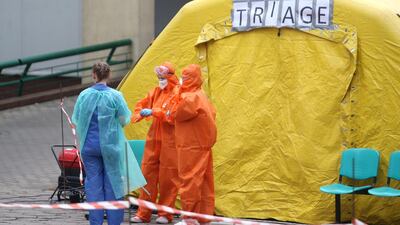
Medics wait outside a special tent during the coronavirus disease (COVID-19) outbreak, outside a hospital in Warsaw, Poland. REUTERS -

A woman wearing a face mask, runs in front of a truck spraying disinfectant on the street as part of measures to prevent the potential spread of coronavirus (COVID-19), in Addis Ababa, Ethiopia. REUTERS -
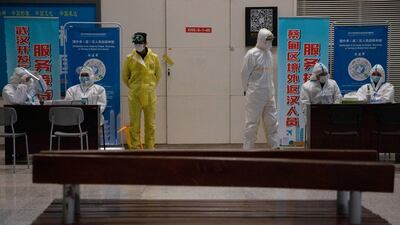
Workers in protective gear wait for arrivals at a train station in Wuhan in central China's Hubei province. AP Photo -

Passengers wearing face masks, amid concerns of the COVID-19 coronavirus, queueing up to check-in before boarding flights at Yichang Sanxia Airport in Yichang in China's central Hubei province. AFP


French submarine missions last 60 to 70 days, with about 110 crew members aboard. So a crew that left at the end of February wouldn’t be expected back before the end of April. In that case, they will return to a world changed by the pandemic. On March 1, France had just 130 confirmed Covid-19 cases and two deaths. In under a month, those numbers have surged past 2,600 dead and over 40,000 sickened.
For most people, the coronavirus causes mild or moderate symptoms, such as fever and cough that clear up in two to three weeks. But for some, especially older adults and people with existing health problems, it can cause more severe illness, including pneumonia, and death.
For submariners, the return to land could be a shock.
“They won’t have experienced the crisis as we did, with a bit of fear, the lockdown. So, for them it will be quite a surprise. They will learn the history, but it will be a history that is related to them,” said a serving officer who was the doctor on the ballistic submarine “Le Triomphant” for four years.
“All events that could affect or change the morale of the crew members are kept from them,” said the officer, Chief Doctor Gabriel. “Since there is no internet, no radio and no television on board, the only news you get comes from messages received by the commander, and the commander filters the messages to not give all of the information to everyone.”
The doctor was underwater in 2012 when an Islamist extremist killed three French paratroopers and later killed a rabbi, his two young sons and grabbed an 8-year-old girl and shot her in the head. Only later did the officer learn of the attacks, “so when people talk to me about it, I find it impossible to imagine,” he said.
“The only place where you are really cut off from all information is underwater, because even on a vessel in space there is still the radio, television, the internet,” he said.
When bombings hit Madrid in 2004, Adm Salles didn’t inform submariners who were at sea for the ballistic flotilla that was then under his command.
Adm Salles said the situation now will be toughest for any crews that leave harbour in the weeks ahead, because they’ll know they are leaving loved ones in the midst of the pandemic and, possibly, still living in lockdown. The French government has already extended its stay-home orders once, to April 15, and said it could do so again.
Adm Salles said he believes those crews will get regular coronavirus updates, but won’t be told of any family deaths until they are returning to the l’Ile Longue submarine base near Brest in Brittany.
The admiral was at sea in a sub when his father died. The news was kept from him until he had finished his 60-day mission.
“No matter how serious an event is, there is nothing a submariner can do about it. And since he cannot do anything, better that he know nothing,” Adm Salles said. “They know that they won’t know and accept it. It’s part of our deal.”

