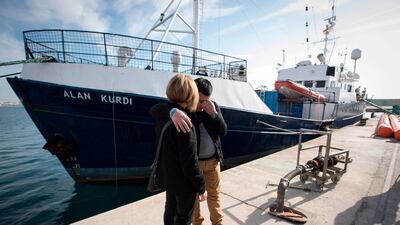
The Italian coastguard has taken three distressed people from a German ship after a man tried to kill himself 10 days after being rescued off the coast of Libya, charity officials said.
The 24-year-old, who was suffering from severe anxiety and haunted by his experiences in a Libyan jail, tried to kill himself early on Wednesday, according to the German charity, Sea-Eye, which is running the rescue ship. His nationality not identified.
Sea-Eye said that despair and hopelessness was reaching an “unprecedented level” on the ship with a man self-harming over a period of days after Italian and Maltese authorities refused to allow the ship to land because of the 149 rescued migrants on board.
Three of the most distressed were allowed to transfer to an Italian coastguard vessel after a Sea-Eye request on Wednesday.
“The people are totally desperate and have been held on the Alan Kurdi for ten days,” said operations manager Jan Ribbeck. “They indicated they wanted to jump into the water to reach the Italian boats. They almost couldn’t be calmed down.”
Instead of being allowed to dock, the charity said that Italy was preparing a boat to take the 149 on board to be taken care of and quarantined. It was not immediately clear what would happen after that.

Mercer, the investment consulting arm of US services company Marsh & McLennan, expects its wealth division to at least double its assets under management (AUM) in the Middle East as wealth in the region continues to grow despite economic headwinds, a company official said.
Mercer Wealth, which globally has $160 billion in AUM, plans to boost its AUM in the region to $2-$3bn in the next 2-3 years from the present $1bn, said Yasir AbuShaban, a Dubai-based principal with Mercer Wealth.
“Within the next two to three years, we are looking at reaching $2 to $3 billion as a conservative estimate and we do see an opportunity to do so,” said Mr AbuShaban.
Mercer does not directly make investments, but allocates clients’ money they have discretion to, to professional asset managers. They also provide advice to clients.
“We have buying power. We can negotiate on their (client’s) behalf with asset managers to provide them lower fees than they otherwise would have to get on their own,” he added.
Mercer Wealth’s clients include sovereign wealth funds, family offices, and insurance companies among others.
From its office in Dubai, Mercer also looks after Africa, India and Turkey, where they also see opportunity for growth.
Wealth creation in Middle East and Africa (MEA) grew 8.5 per cent to $8.1 trillion last year from $7.5tn in 2015, higher than last year’s global average of 6 per cent and the second-highest growth in a region after Asia-Pacific which grew 9.9 per cent, according to consultancy Boston Consulting Group (BCG). In the region, where wealth grew just 1.9 per cent in 2015 compared with 2014, a pickup in oil prices has helped in wealth generation.
BCG is forecasting MEA wealth will rise to $12tn by 2021, growing at an annual average of 8 per cent.
Drivers of wealth generation in the region will be split evenly between new wealth creation and growth of performance of existing assets, according to BCG.
Another general trend in the region is clients’ looking for a comprehensive approach to investing, according to Mr AbuShaban.
“Institutional investors or some of the families are seeing a slowdown in the available capital they have to invest and in that sense they are looking at optimizing the way they manage their portfolios and making sure they are not investing haphazardly and different parts of their investment are working together,” said Mr AbuShaban.
Some clients also have a higher appetite for risk, given the low interest-rate environment that does not provide enough yield for some institutional investors. These clients are keen to invest in illiquid assets, such as private equity and infrastructure.
“What we have seen is a desire for higher returns in what has been a low-return environment specifically in various fixed income or bonds,” he said.
“In this environment, we have seen a de facto increase in the risk that clients are taking in things like illiquid investments, private equity investments, infrastructure and private debt, those kind of investments were higher illiquidity results in incrementally higher returns.”
The Abu Dhabi Investment Authority, one of the largest sovereign wealth funds, said in its 2016 report that has gradually increased its exposure in direct private equity and private credit transactions, mainly in Asian markets and especially in China and India. The authority’s private equity department focused on structured equities owing to “their defensive characteristics.”
More from Tom Fletcher
On Women's Day
Dr Nawal Al-Hosany: Why more women should be on the frontlines of climate action
Shelina Janmohamed: Why shouldn't a spouse be compensated fairly for housework?
Justin Thomas: Challenge the notion that 'men are from Mars, women are from Venus'
The National Editorial: Is there much to celebrate on International Women's Day 2021?
Ten tax points to be aware of in 2026
1. Domestic VAT refund amendments: request your refund within five years
If a business does not apply for the refund on time, they lose their credit.
2. E-invoicing in the UAE
Businesses should continue preparing for the implementation of e-invoicing in the UAE, with 2026 a preparation and transition period ahead of phased mandatory adoption.
3. More tax audits
Tax authorities are increasingly using data already available across multiple filings to identify audit risks.
4. More beneficial VAT and excise tax penalty regime
Tax disputes are expected to become more frequent and more structured, with clearer administrative objection and appeal processes. The UAE has adopted a new penalty regime for VAT and excise disputes, which now mirrors the penalty regime for corporate tax.
5. Greater emphasis on statutory audit
There is a greater need for the accuracy of financial statements. The International Financial Reporting Standards standards need to be strictly adhered to and, as a result, the quality of the audits will need to increase.
6. Further transfer pricing enforcement
Transfer pricing enforcement, which refers to the practice of establishing prices for internal transactions between related entities, is expected to broaden in scope. The UAE will shortly open the possibility to negotiate advance pricing agreements, or essentially rulings for transfer pricing purposes.
7. Limited time periods for audits
Recent amendments also introduce a default five-year limitation period for tax audits and assessments, subject to specific statutory exceptions. While the standard audit and assessment period is five years, this may be extended to up to 15 years in cases involving fraud or tax evasion.
8. Pillar 2 implementation
Many multinational groups will begin to feel the practical effect of the Domestic Minimum Top-Up Tax (DMTT), the UAE's implementation of the OECD’s global minimum tax under Pillar 2. While the rules apply for financial years starting on or after January 1, 2025, it is 2026 that marks the transition to an operational phase.
9. Reduced compliance obligations for imported goods and services
Businesses that apply the reverse-charge mechanism for VAT purposes in the UAE may benefit from reduced compliance obligations.
10. Substance and CbC reporting focus
Tax authorities are expected to continue strengthening the enforcement of economic substance and Country-by-Country (CbC) reporting frameworks. In the UAE, these regimes are increasingly being used as risk-assessment tools, providing tax authorities with a comprehensive view of multinational groups’ global footprints and enabling them to assess whether profits are aligned with real economic activity.
Contributed by Thomas Vanhee and Hend Rashwan, Aurifer
Our legal consultants
Name: Hassan Mohsen Elhais
Position: legal consultant with Al Rowaad Advocates and Legal Consultants.
India squads
T20: Rohit Sharma (c), Shikhar Dhawan, KL Rahul, Sanju Samson, Shreyas Iyer, Manish Pandey, Rishabh Pant, Washington Sundar, Krunal Pandya, Yuzvendra Chahal, Rahul Chahar, Deepak Chahar, Khaleel Ahmed, Shivam Dube, Shardul Thakur
Test: Virat Kohli (c), Rohit Sharma, Mayank Agarwal, Cheteshwar Pujara, Ajinkya Rahane, Hanuma Vihari, Wriddhiman Saha (wk), Ravindra Jadeja, Ravichandran Ashwin, Kuldeep Yadav, Mohammed Shami, Umesh Yadav, Ishant Sharma, Shubman Gill, Rishabh Pant
The biog
Name: Fareed Lafta
Age: 40
From: Baghdad, Iraq
Mission: Promote world peace
Favourite poet: Al Mutanabbi
Role models: His parents
On Women's Day
Dr Nawal Al-Hosany: Why more women should be on the frontlines of climate action
Shelina Janmohamed: Why shouldn't a spouse be compensated fairly for housework?
Samar Elmnhrawy: How companies in the Middle East can catch up on gender equality
The National Editorial: Is there much to celebrate on International Women's Day 2021?
Skoda Superb Specs
Engine: 2-litre TSI petrol
Power: 190hp
Torque: 320Nm
Price: From Dh147,000
Available: Now
The specs
Engine: Two permanent-magnet synchronous AC motors
Transmission: two-speed
Power: 671hp
Torque: 849Nm
Range: 456km
Price: from Dh437,900
On sale: now
Director: Laxman Utekar
Cast: Vicky Kaushal, Akshaye Khanna, Diana Penty, Vineet Kumar Singh, Rashmika Mandanna
Rating: 1/5
The%20specs
THE SPECS
Engine: 1.5-litre turbocharged four-cylinder
Transmission: Constant Variable (CVT)
Power: 141bhp
Torque: 250Nm
Price: Dh64,500
On sale: Now
UK’s AI plan
- AI ambassadors such as MIT economist Simon Johnson, Monzo cofounder Tom Blomfield and Google DeepMind’s Raia Hadsell
- £10bn AI growth zone in South Wales to create 5,000 jobs
- £100m of government support for startups building AI hardware products
- £250m to train new AI models
The National's picks
4.35pm: Tilal Al Khalediah
5.10pm: Continous
5.45pm: Raging Torrent
6.20pm: West Acre
7pm: Flood Zone
7.40pm: Straight No Chaser
8.15pm: Romantic Warrior
8.50pm: Calandogan
9.30pm: Forever Young
WHAT IS A BLACK HOLE?
1. Black holes are objects whose gravity is so strong not even light can escape their pull
2. They can be created when massive stars collapse under their own weight
3. Large black holes can also be formed when smaller ones collide and merge
4. The biggest black holes lurk at the centre of many galaxies, including our own
5. Astronomers believe that when the universe was very young, black holes affected how galaxies formed
While you're here
National Editorial: World trade has started to look inwards
Callum Patton: ‘Arrival of Asian century’ has eclipsed US
Robin Mills: Importance of China's energy markets clearer
Healthy tips to remember
Here, Dr Mohamed El Abiary, paediatric consultant at Al Zahra Hospital Dubai, shares some advice for parents whose children are fasting during the holy month of Ramadan:
Gradual fasting and golden points - For children under the age of 10, follow a step-by-step approach to fasting and don't push them beyond their limits. Start with a few hours fasting a day and increase it to a half fast and full fast when the child is ready. Every individual's ability varies as per the age and personal readiness. You could introduce a points system that awards the child and offers them encouragement when they make progress with the amount of hours they fast
Why fast? - Explain to your child why they are fasting. By shedding light on the importance of abstaining from food and drink, children may feel more encouraged to give it there all during the observance period. It is also a good opportunity to teach children about controlling urges, doing good for others and instilling healthy food habits
Sleep and suhoor - A child needs adequate sleep every night - at least eight hours. Make sure to set a routine early bedtime so he/she has sufficient time to wake up for suhoor, which is an essential meal at the beginning of the day
Good diet - Nutritious food is crucial to ensuring a healthy Ramadan for children. They must refrain from eating too much junk food as well as canned goods and snacks and drinks high in sugar. Foods that are rich in nutrients, vitamins and proteins, like fruits, fresh meats and vegetables, make for a good balanced diet
You might also like
How a groundbreaking soil-less farming inititiave is empowering rural communities across Jordan
Essay: Venice's floods should serve as a wake-up call for the world
UAE ready for innovation in area of water management – this is not a pipe dream
Saudi artist Manal AlDowayan unveils new piece of land art addressing water scarcity in Al Ula
Dhadak
Director: Shashank Khaitan
Starring: Janhvi Kapoor, Ishaan Khattar, Ashutosh Rana
Stars: 3
Key figures in the life of the fort
Sheikh Dhiyab bin Isa (ruled 1761-1793) Built Qasr Al Hosn as a watchtower to guard over the only freshwater well on Abu Dhabi island.
Sheikh Shakhbut bin Dhiyab (ruled 1793-1816) Expanded the tower into a small fort and transferred his ruling place of residence from Liwa Oasis to the fort on the island.
Sheikh Tahnoon bin Shakhbut (ruled 1818-1833) Expanded Qasr Al Hosn further as Abu Dhabi grew from a small village of palm huts to a town of more than 5,000 inhabitants.
Sheikh Khalifa bin Shakhbut (ruled 1833-1845) Repaired and fortified the fort.
Sheikh Saeed bin Tahnoon (ruled 1845-1855) Turned Qasr Al Hosn into a strong two-storied structure.
Sheikh Zayed bin Khalifa (ruled 1855-1909) Expanded Qasr Al Hosn further to reflect the emirate's increasing prominence.
Sheikh Shakhbut bin Sultan (ruled 1928-1966) Renovated and enlarged Qasr Al Hosn, adding a decorative arch and two new villas.
Sheikh Zayed bin Sultan (ruled 1966-2004) Moved the royal residence to Al Manhal palace and kept his diwan at Qasr Al Hosn.
Sources: Jayanti Maitra, www.adach.ae

