

The number of migrants trying to reach Cyprus has surged in recent days after Turkey opened its western borders and stopped intercepting people trying to reach Europe last week.
At least 223 migrants have reached the island’s south this week from Turkey, 83 kilometres from Cyprus. Cypriot officials have recently accused Turkey of deliberately channelling people from the breakaway Turkish Cypriot north of the island to the international recognised south.
Interior minister Nicos Nouris said the number of “economic migrants” trying to enter Cyprus was becoming unmanageable although he said refugees would not be sent back to a country where their life is in danger.
“Certainly, this concerns us, and we want to see what measures we can take in order to guard against any change in the country’s demographic character but without discounting human suffering,” Cypriot President Nicos Anastasiades said.
-

A migrant speaks to a Greek policeman during minor clashes at the port of Mytilene after locals block access to the Moria refugee camp, on the northeastern Aegean island of Lesbos, Greece. AP Photo -

Migrants travel on a horse carriage near the Turkey's Pazarkule border crossing with Greece's Kastanies, near Edirne, Turkey. REUTERS -
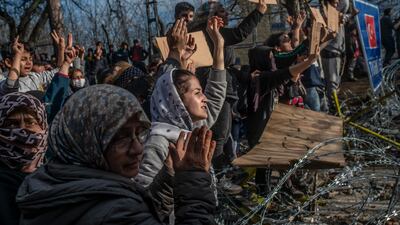
Migrants hold placards as they demonstrate, waiting at the buffer zone in front of the Pazarkule border crossing to Greece, in Edirne. AFP -

An aerial view shows refugees on road at Turkey's Pazarkule border crossing with Greece's Kastanies, southwest of Edirne. REUTERS -
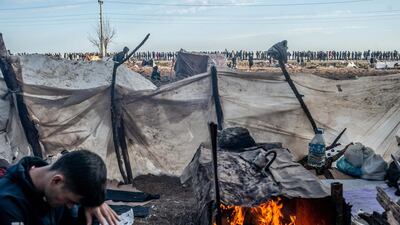
A migrant sits next to a bonfire as others wait for a food distribution in front of the Pazarkule border crossing to Greece, in Edirne. AFP -
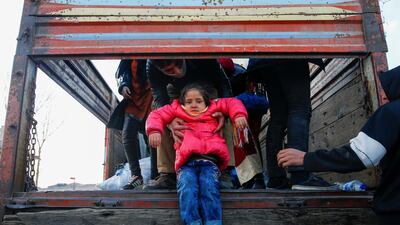
A migrant child is passed from a truck near the Turkey's Pazarkule border crossing with Greece's Kastanies, near Edirne, Turkey. REUTERS -
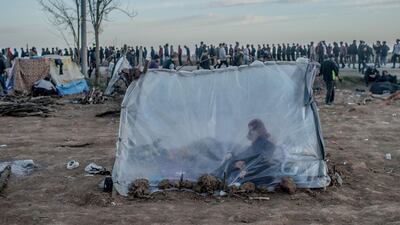
A Syrian woman sits in a tent with her son as others wait for food distribution in front of the Pazarkule border crossing to Greece, in Edirne. AFP -
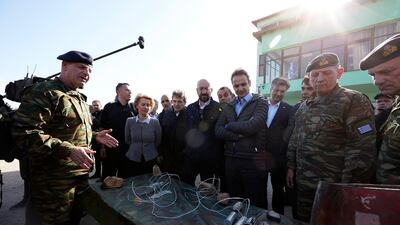
Greek Prime Minister Kyriakos Mitsotakis (4-R) with European Council President Charles Michel (C), European Commission President Ursula von der Leyen (3-L), European Parliament President David Sassoli (2-L) and Croatian Prime Minister Andrej Plenkovic (3-R) during a visit at the Greek-Turkish border in northern Greece. EPA -
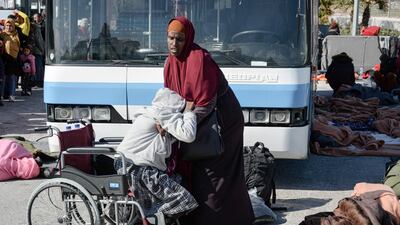
An elderly migrant woman is helped out of a wheelchair at the port of Mytilene on the northeastern Aegean island of Lesbos, Greece. AP Photo -
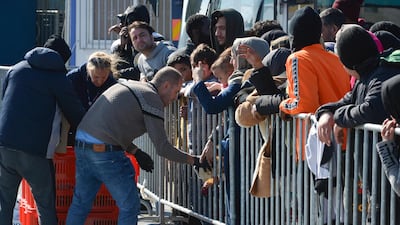
Migrants wait in line for food and water distribution at the port of Mytilene on the northeastern Aegean island of Lesbos, Greece. AP Photo -

Greek police in riot gear advance to push migrants away after minor clashes at the port of Mytilene on the northeastern Aegean island of Lesbos, Greece. AP Photo -

Greek police in riot gear stand before minor clashes with migrants at the port of Mytilene on the northeastern Aegean island of Lesbos, Greece. AP Photo


Separately, Mr Anastasiades said he spoke with Turkish Cypriot leader Mustafa Akinci to convey “our grave concern regarding the organised and increasing illegal flow of migrants through the Green Line, underlining that appropriate measures must be taken in order to prevent the further exacerbation of the situation,” the Cyprus News Agency reported.
Mr Nouris, the interior minister, said speeding up the asylum application process and getting the EU to take charge of negotiations with third countries were the key steps to make room for refugees fleeing conflicts while halting migrants only fleeing poverty.
“The number of economic migrants is no longer manageable, simply because our limits have been surpassed,” he added.
A senior figure in the Cypriot police force, Petros Zeniou, claimed a “large number” of immigrants and refugees were on standby in Turkey to cross into the European Union including Cyprus.
Thousands are massed at the Turkish frontier with Greece after Turkish President Recep Tayyip Erdogan allowed migrants to leave for Europe last week.
According to an agreement with the EU signed in 2016, Ankara is supposed to prevent migrants from setting off for European shores in return for billions of euros in EU funding to care for Syrian refugees in Turkey.
Mr Erdogan and other officials have complained that the EU has failed to support Turkey as amid a renewed surge of migrants stemming from an escalating in violence in neighbouring Syria.
Josep Borrell, the EU foreign affairs chief, said he had asked Mr Erdogan "not to encourage the further movement of refugees and migrants toward the EU borders."
He said Turkish officials had insisted they were not encouraging people to do so.
Meanwhile, Polish Prime Minister Mateusz Morawiecki said his country was ready to deploy guards at the Greek-Turkish border, while his Slovak counterpart Peter Pellegrini said the growing number of migrants “poses a security threat not just for Greece.”
Czech Prime Minister Andrej Babis said the situation was serious and the EU must protect its borders.

