
France's famed Louvre museum closed on Sunday as coronavirus cases mounted across Europe and beyond, with the global death toll nearing 3,000.
Some tourists at the Louvre, the world's most visited museum, arriving on Sunday complained that they had booked their tickets that morning with no warning of the closure.
France, which has 130 confirmed cases and two deaths from Covid-19, said it would ban gatherings of 5,000 people or more, close schools and cancel religious services in some of the hardest-hit zones. Sunday's half-marathon in Paris was cancelled.
Two confirmed cases in France on Sunday were children, aged 1 and 5, and their mother, 27, in the eastern city of Strasbourg. No children under 10 years old are reported to have died from the virus.
The virus has now infected more than 88,000 people and spread to more than 60 countries, well beyond the city of Wuhan, China, where it first emerged late last year.
It has rattled global markets and prompted unprecedented measures from governments trying to contain the outbreak, which the World Health Organisation has warned could become a pandemic.
The US and Australia announced their first coronavirus deaths at the weekend, while China reported 573 new infections on Sunday, the highest figure in a week after a dip.
While the numbers in China are still far lower than the huge daily increases reported in the first two weeks of February, Covid-19 has spread rapidly across borders, with South Korea, Italy and Iran emerging as hotspots.
-
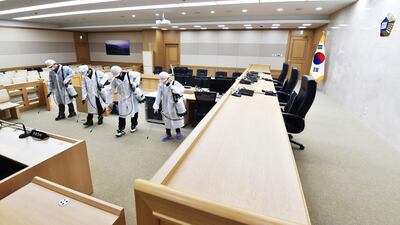
Workers wearing protective gear spray disinfectant as part of preventive measures against the spread of the COVID-19 coronavirus, in a courtroom at Suwon High Court in Suwon, South Korea. AFP -
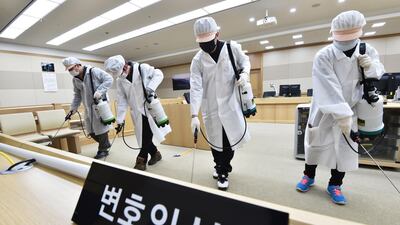
Workers wearing protective gear spray disinfectant as part of preventive measures against the spread of the COVID-19 coronavirus, in a courtroom at Suwon High Court in Suwon. AFP -
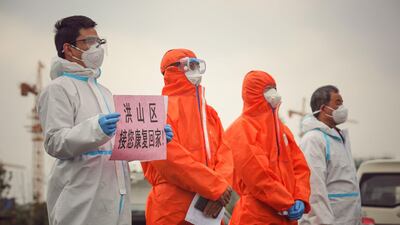
Staff members welcome recovered patients (unseen) as they are discharged from Leishenshan Hospital, the makeshift hospital for the COVID-19 coronavirus patients, in Wuhan in China's central Hubei province. AFP -
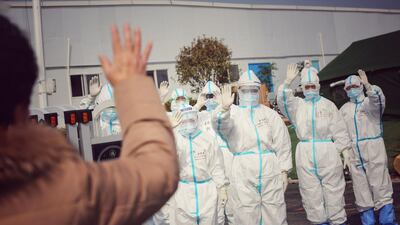
Medical staff members wave to a recovered patient (foreground L) at Leishenshan Hospital, the makeshift hospital for the COVID-19 coronavirus patients, in Wuhan in China's central Hubei province. AFP -
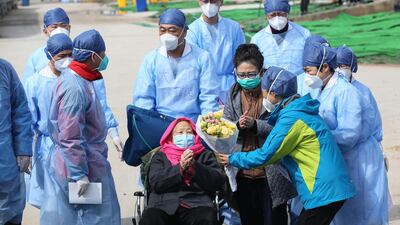
A recovered patient (in wheelchair), 98, is discharged from Leishenshan Hospital, the makeshift hospital for the COVID-19 coronavirus patients, in Wuhan in China's central Hubei province. AFP -
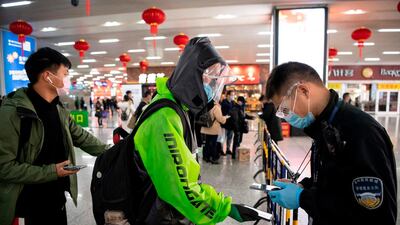
A passenger wearing a face mask as he shows a green QR code on his phone to show his health status to security upon arrival at Wenzhou railway station in Wenzhou. The National Health Commission on March 1 reported 573 new infections, bringing the total number of cases in mainland China to 79,824. AFP -

A passenger wearing a face mask as he shows a green QR code on his phone to show his health status to security upon arrival at Wenzhou railway station in Wenzhou. The National Health Commission on March 1 reported 573 new infections, bringing the total number of cases in mainland China to 79,824. AFP -
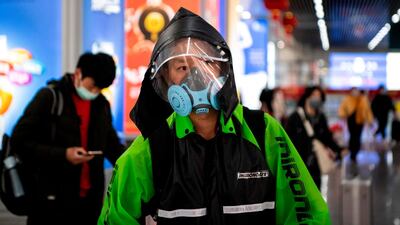
A passenger wearing a face mask upon arrival at Wenzhou railway station in Wenzhou. The National Health Commission on March 1 reported 573 new infections, bringing the total number of cases in mainland China to 79,824. AFP -
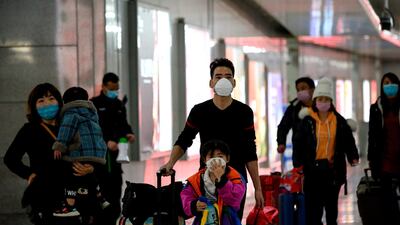
Passengers wearing face masks arriving at Wenzhou railway station in Wenzhou. The National Health Commission on March 1 reported 573 new infections, bringing the total number of cases in mainland China to 79,824. AFP -
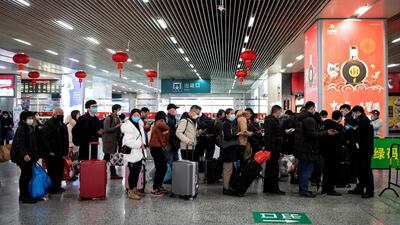
Passengers wearing face masks queueing to show a green QR code on their phones to show their health status to security upon arrival at Wenzhou railway station in Wenzhou. The National Health Commission on March 1 reported 573 new infections, bringing the total number of cases in mainland China to 79,824. AFP


In recent days, the epidemic has spread to sub-Saharan Africa, while Armenia and the Czech Republic reported their first cases on Sunday and cases in Germany doubled.
On Sunday, Bahrain's Ministry of Health said it registered seven new confirmed cases of the coronavirus, increasing the total to 33.
All people who have had contact with the infected patients have also been quarantined as part of preventive efforts.
Qatar, Ecuador, Luxembourg and Ireland all confirmed their first cases on Saturday as the virus continued its global march.
Europe's hardest hit country, Italy, said on Sunday that it would deliver €3.6 billion ($14.61bn) in emergency aid to sectors affected by the virus.
Italy on Saturday reported a sharp rise in new cases, bringing the total number of infections to above 1,000, with 29 deaths.
The outbreak also forced the postponement of five matches in Italy's top-flight Serie A football league, including the heavyweight clash between champions Juventus and Inter Milan.
Australia reported the first death on its soil. The man, 78, had been moved from the coronavirus-stricken Diamond Princess cruise ship in Japan.
Fears are mounting that the disease could hurt the global economy.
Stock markets in the Gulf states plunged on Sunday after global bourses were battered last week, diving to their lowest levels since the 2008 financial crisis.
China's economy has also been hit as factories have shut and millions of people stayed home after the government imposed lockdowns across entire areas of the country.
With fatalities from coronavirus registered in the US, Thailand and Australia over the weekend, and new cases increasing in Italy and Iran, traders began the week on edge.
Goldman Sachs economists now expect the virus to inflict a “short-lived global contraction” on the world economy, which forces the Fed to slash rates in the first half.
Fed Chairman Jerome Powell has opened the door to a rate cut, blaming the “evolving risks” posed to the US economy from the virus.

