
In the face of the coronavirus pandemic the global anti-ISIS coalition could provide a model for international cooperation against the virus, the heads of two leading think tanks have said.
Karin von Hippel, the director-general of the Royal United Services Institute and John Allen, the president of the Brookings Institution, have said a multilateral alliance similar to the coalition against ISIS could coordinate the global response where, thus far, organisations like the UN, G7 and G20 have failed.
Since the beginning of the coronavirus outbreak at the end of 2019, the global death toll from the disease has exceeded 183,000 with the number of cases at more than 2.6 million.
Speaking on Thursday at a RUSI event on mapping the pandemic, Professor Malcolm Chalmers explained the onset of Covid-19 would mark a watershed moment in international relations.
“It is even comparable in many ways to the end of the Cold War ... It's a shock. It will never be the same again after this crisis.”
While the disease began predominantly in the developed world, with the majority of cases still residing in the US and Europe, experts have predicted the coronavirus may soon take its toll more aggressively in the developing world.
“Even though pandemics have been anticipated for many years, we are profoundly unprepared for this crisis and the ripple effects across the system,” Dr Von Hippel wrote in a recent paper with Gen. Allen, a former US special envoy to the coalition against ISIS.
The pair explained that with the UN unable to take the lead and the US under President Donald Trump rejecting its role as a global authority the coalition against ISIS, formed in 2014, was an example of a “highly successful, ad hoc coalition that rapidly brought dozens of countries together to defeat a global threat.”
“The overall lesson is that coalitions can deliver effective results when backed by committed leadership. Coalitions can pool resources, create synergies, generate new opportunities, and accelerate outcomes,” they wrote in the Brookings Institution paper.
With the global emergency presented by the pandemic and its dire economic fallout far eclipsing recent international catastrophes, other voices have called for a multilateral response. Former British prime minister Gordon Brown has called for an international reaction similar to the 2008 crash which led to the Great Recession.
-

A woman wearing a face mask walks past an advertisement of a hair shop at a shopping district in Seoul. AFP -

Pacific Park's solar-powered Ferris wheel lights show a green "Earth" logo at sunset on Santa Monica Pier for Earth Day, in Santa Monica, California. AP -
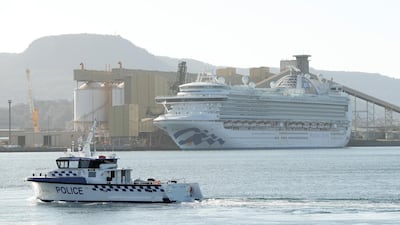
A water police boat is seen as the Ruby Princess cruise ship docks at Port Kembla in Wollongong, Australia. Getty -
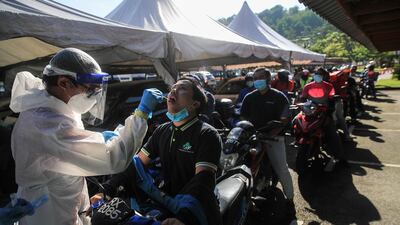
A health worker collects a sample from a man at a free coronavirus community screening service in Kuala Lumpur, Malaysia. EPA -
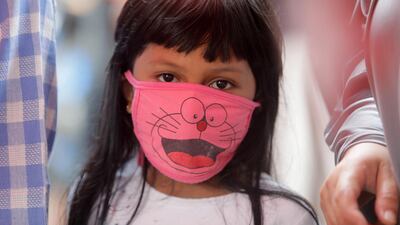
An Indonesian child wears a hand made protective mask at a temporary meat market, ahead of Ramadan in Banda Aceh, Indonesia. EPA -

A pedestrian is reflected in the window of a nail salon during a nationwide social distancing and stay-at-home order imposed due to coronavirus in Ho Chi Minh city, Vietnam. Bloomberg -

Visitors wearing protective face masks walk on a sightseeing spot on Enoshima Island after government asked citizens to be more diligent on social distancing under the state of emergency in Fujisawa, south of Tokyo, Japan. Reuters -
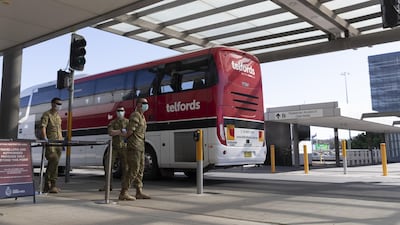
Army personnel watch as a charter bus that unloaded crew from the Ruby Princess Cruise ship departs Sydney Airport in Sydney, Australia. Getty -
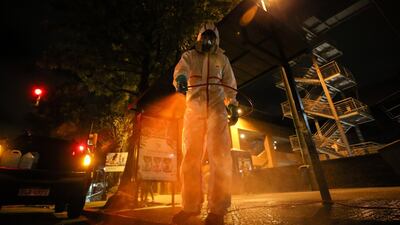
A municipality worker sprays disinfectant at a bus stop as a preventive measure against coronavirus in Montevideo, Uruguay. EPA -

School of Nursing assistant professor Dr Rhigel Jay Tan, a licensed nurse practitioner in psychiatric mental health, makes custom-made face shields called "iCareFaceShields" at his home for health care workers amid the coronavirus pandemic in Las Vegas, Nevada. AFP -

Technicians carry out a sample transfer during the opening of the new Covid-19 testing lab at Queen Elizabeth University Hospital in Glasgow, Scotland. Getty -
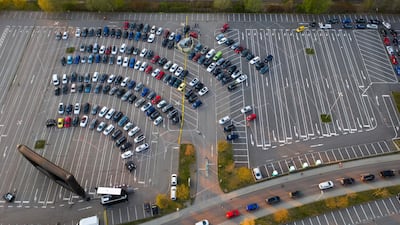
Visitors gather for a drive-in cinema event in Chemnitz, Germany. AP -

The Italian-operated cruise ship the Costa Atlantica is anchored at a port in Nagasaki, southern Japan. AP


When G7 foreign ministers were unable to devise a joint communique on the coronavirus because the US had demanded Covid-19 be referred to as the Wuhan virus, Microsoft co-founder Bill Gates added his voice to the more typical calls from the UN, the WHO and the ICRC for a more coordinated global response.
“It's shaping up to have a much deeper global impact than the crisis of 2014 and the Russian aggression in Ukraine. It's shaping up to be bigger that 9/11 in terms of its global impact,” he said.
While governments have reacted to the pandemic by turning inward, the experts on the Rusi panel said a truly international response was inevitable as the pandemic developed.
“I suspect that the longer this crisis goes on, the more likely that the virus will force us to converge in our approaches,” Mr Chalmers added at the meeting.
“Whether it is testing, tracking, quarantining, if countries have a succesful formula, even if it raises questions of civil liberties, the survival of people's economies will depend on getting that right.”
Professor Beatrice Heuser, echoed those sentiments. “One needs force multipliers, one needs allies, one needs to pull resources, one needs to cooperate and in that way make savings and that is only possible with partners on whom you can rely,” she said.

