• Rahmatullah, 10, poses in a classroom at Shahid Niamatullah Primary School in Panjwayi district, formerly occupied by ISAF and the Afghan National Police. Having lost his father to the war, he says he continues to hear the sounds of bullets at night. All photos by Stefanie Glinski
    Rahmatullah, 10, poses in a classroom at Shahid Niamatullah Primary School in Panjwayi district, formerly occupied by ISAF and the Afghan National Police. Having lost his father to the war, he says he continues to hear the sounds of bullets at night. All photos by Stefanie Glinski
  • Students sit in their classroom at Assad Suri Primary School in Kandahar's Zhari District. Many of the buildings have been destroyed in airstrikes and by blasts, leaving classrooms exposed and bullet riddled. Part of the school continues to be occupied by the local police.
    Students sit in their classroom at Assad Suri Primary School in Kandahar's Zhari District. Many of the buildings have been destroyed in airstrikes and by blasts, leaving classrooms exposed and bullet riddled. Part of the school continues to be occupied by the local police.
  • Aisha, 9, (L) sits with her friend Rapia, 10, at Assad Suri Primary School. The girls are one of the few attending the school, hoping to become teachers themselves one day to teach other girls.
    Aisha, 9, (L) sits with her friend Rapia, 10, at Assad Suri Primary School. The girls are one of the few attending the school, hoping to become teachers themselves one day to teach other girls.
  • Students sit in their classroom at Assad Suri Primary School in Kandahar's Zhari District.
    Students sit in their classroom at Assad Suri Primary School in Kandahar's Zhari District.
  • Students sit in their classroom at Assad Suri Primary School in Kandahar's Zhari District.
    Students sit in their classroom at Assad Suri Primary School in Kandahar's Zhari District.
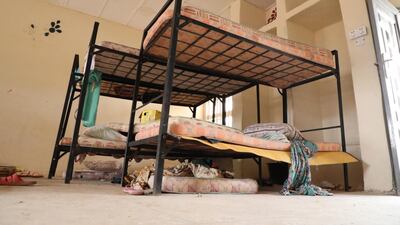
  • Once a classroom, now the police dormitory at Assad Suri Primary School in Kandahar's Zhari District. Many of the buildings have been destroyed in airstrikes and by blasts.
    Once a classroom, now the police dormitory at Assad Suri Primary School in Kandahar's Zhari District. Many of the buildings have been destroyed in airstrikes and by blasts.
  • Students sit in their classroom at Assad Suri Primary School in Kandahar's Zhari District.
    Students sit in their classroom at Assad Suri Primary School in Kandahar's Zhari District.
  • Students sit in their classroom at Assad Suri Primary School in Kandahar's Zhari District. Many of the buildings have been destroyed in airstrikes and by blasts, leaving classrooms exposed and bullet riddled. Part of the school continues to be occupied by the local police.
    Students sit in their classroom at Assad Suri Primary School in Kandahar's Zhari District. Many of the buildings have been destroyed in airstrikes and by blasts, leaving classrooms exposed and bullet riddled. Part of the school continues to be occupied by the local police.
  • Boys make their way home after school as Assad Suri Primary School.
    Boys make their way home after school as Assad Suri Primary School.
  • Children peak through a classroom window at Shahid Niamatullah Primary School in Panjwayi district, formerly occupied by ISAF and the Afghan National Police.
    Children peak through a classroom window at Shahid Niamatullah Primary School in Panjwayi district, formerly occupied by ISAF and the Afghan National Police.
  • Boys make their way home after school as Assad Suri Primary School.
    Boys make their way home after school as Assad Suri Primary School.
  • Aisha, 9, says she is not afraid to attend Assad Suri Primary Schools, as many girls aren't able to receive an education at all and this is her only option.
    Aisha, 9, says she is not afraid to attend Assad Suri Primary Schools, as many girls aren't able to receive an education at all and this is her only option.
  • Children sit in a classroom at Shahid Niamatullah Primary School in Panjwayi district, formerly occupied by ISAF and the Afghan National Police.
    Children sit in a classroom at Shahid Niamatullah Primary School in Panjwayi district, formerly occupied by ISAF and the Afghan National Police.

Annual $59bn funding gap could leave millions of children without basic skills


Jamie Prentis
  • English
  • Arabic

A $59 billion annual funding gap means more than half of the world’s children could lack the basic skills needed for employment by the end of the decade, education leaders say.

Governments were urged to step up and give priority to young people in Covid-19 recovery efforts.

Global children’s charity Theirworld calculated $75bn a year is needed in aid if the UN’s sustainable development goal of inclusive, equitable quality primary and secondary education by 2030 is to be met.

In 2019, only $16bn was given – a figure likely to fall after the pandemic savaged the global economy, and indications that governments are likely to cut aid programmes.

“Already underfunded, global education now needs additional resources for catch-up programmes, digital inclusion and the safe return to school,” said Gordon Brown, the UN’s special envoy for global education and former UK prime minister.

“To meet the sustainable development goal commitments between now and 2030, we must pressure governments not to cut their education budgets but to increase them, and call on the international community to reverse current plans for cuts in aid budgets for education."

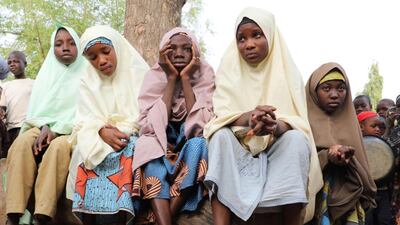
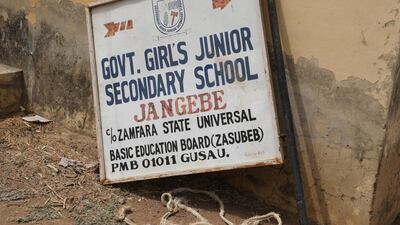
  • Nigerian security forces are searching for gunmen who abducted more than 300 pupils from a government girls junior secondary school in Jangebe, northern Nigeria, on Friday. AP photo
    Nigerian security forces are searching for gunmen who abducted more than 300 pupils from a government girls junior secondary school in Jangebe, northern Nigeria, on Friday. AP photo
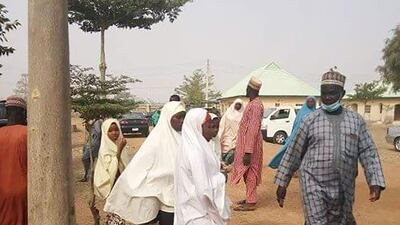
  • Students who escaped from gunmen wait outside the school premises for their parents after 317 girls were taken at gunpoint from their school in Zamfara state, Nigeria. EPA
    Students who escaped from gunmen wait outside the school premises for their parents after 317 girls were taken at gunpoint from their school in Zamfara state, Nigeria. EPA
  • Parents of kidnapped pupils of wait at Jangebe Government Girls Junior Secondary School wait for information about their children from Zamfara state police. AP
    Parents of kidnapped pupils of wait at Jangebe Government Girls Junior Secondary School wait for information about their children from Zamfara state police. AP
  • Parents arrive at the school compound in search of children kidnapped by gunmen in Jangede, Zamfara state in northern Nigeria. AFP
    Parents arrive at the school compound in search of children kidnapped by gunmen in Jangede, Zamfara state in northern Nigeria. AFP
  • Nigerian President Muhammad Buhari said the people who took pupils from the government girls junior secondary school in Jangebe were "bandits, kidnappers and terrorists". AP
    Nigerian President Muhammad Buhari said the people who took pupils from the government girls junior secondary school in Jangebe were "bandits, kidnappers and terrorists". AP
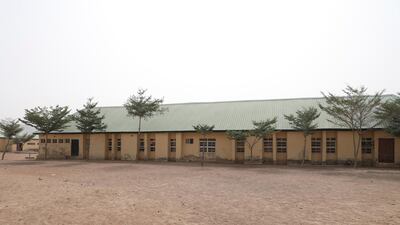
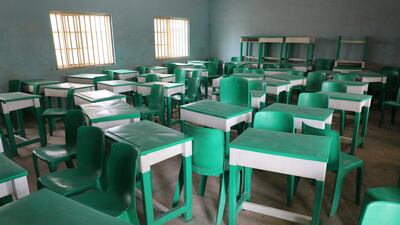
  • Empty classroom of the government girls junior secondary school following an attack by gunmen in Jangebe, Nigeria. AP
    Empty classroom of the government girls junior secondary school following an attack by gunmen in Jangebe, Nigeria. AP
  • A ransacked dormitory at the school in Jangede, northern Nigeria, after more than 300 pupils were taken at gunpoint. EPA
    A ransacked dormitory at the school in Jangede, northern Nigeria, after more than 300 pupils were taken at gunpoint. EPA
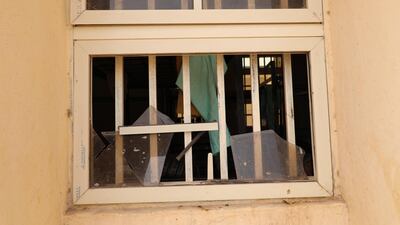
  • A broken window of a dormitory at Jangebe Government Girls Secondary School in Zamfara state, Nigeria. EPA
    A broken window of a dormitory at Jangebe Government Girls Secondary School in Zamfara state, Nigeria. EPA
  • An empty classroom of at the government girls junior secondary school following an attack by gunmen in Jangebe, Nigeria. AP
    An empty classroom of at the government girls junior secondary school following an attack by gunmen in Jangebe, Nigeria. AP

Justin van Fleet, president of Theirworld, said leaving the next generation without basic skills would have a knock-on effect on global issues such as climate change, security and economic growth.

Before the pandemic, about 260 million children were not in school, a figure that rose to 1.6 billion last year when classrooms closed around the world.

Now, another 24 million, typically from the most marginalised and poorest regions, are at risk of never returning to school.

"Girls are now more vulnerable," Mr van Fleet told The National. Communities are less safe, more people are unemployed. Climate change remains unaddressed. Refugees are still not in school.

“Children are dying, really, before the age of 5, because their mothers didn’t have a basic education. That’s what we’re up against.”

In its Education Finance Playbook, Theirworld calls on the G7 nations to set the standard in prioritising education when they meet in south-west England in June.

“There’s no way to invest in economic recovery and not make sure every young person has the skills that they need to participate in society, get a job and help to grow the economy,” Mr van Fleet said.

The pandemic should serve as “a real eye-opener” for the importance of sustainable development goals and education, he said.

While the monetary black hole is vast and requires “serious commitment", Theirworld said it was “attainable and practical” during the recovery from Covid-19.

It called on institutions to be fully funded and for greater support for the International Finance Facility for Education, a new fund designed to support lower-middle-income countries, and aiming to maximise the money donated.

It uses a mixtures of guarantees and grants from donors, alongside existing initiatives and institutions, to “supercharge” finance pools for education for developing countries.

“In the traditional aid model, making $22bn would cost $22bn,” the Education Finance Playbook said.

“But through innovative finance, it would only require the international community to contribute $2.75bn [$750m in cash payments guaranteeing contingent financing and $2bn in grants] for lower-income countries to gain access to $22bn for education.”

Theirworld said a collective $1bn commitment from the G7 to innovative funding such as the International Finance Facility for Education could lead to $25bn for children’s education.

The facility was backed by top officials including Mr Brown, who also served as the UK’s chancellor of the exchequer.

But Mr van Fleet believes there was a need to raise awareness.

Mr Brown urged that the international facility be used immediately and said that “for obvious reasons, we will need innovative financial instruments”.

Hiro Mizuno, the UN special envoy for innovative finance and sustainable investments, called for major global organisations and summits to commit to the fund in 2021.

“Conventional finance approach will not sufficiently support and fill the funding gap," Mr Mizuno said.

"It's critical for all financial players in the public and private sector to bring in innovative finance ideas."

Mr van Fleet said global leaders must honour their pledges and increase their ambition.

"Countries are investing a lot right now in recovery efforts and if the one thing that they want to save money on is on the backs of the poorest and most marginalised young people, I think that sends the wrong signal,” he said.

"We really need our leaders to step up for the next generation.”

His call was echoed by Amina Mohammed, deputy Secretary General of the UN, who called for more “investment in national education budgets, fully funding institutions and leveraging innovative finance”.

“Education must be at the core of the pandemic recovery efforts and the financing gap must be filled,” Ms Mohammed said.


Mobile phone packages comparison
The biog

Favourite books: 'Ruth Bader Ginsburg: A Life' by Jane D. Mathews and ‘The Moment of Lift’ by Melinda Gates

Favourite travel destination: Greece, a blend of ancient history and captivating nature. It always has given me a sense of joy, endless possibilities, positive energy and wonderful people that make you feel at home.

Favourite pastime: travelling and experiencing different cultures across the globe.

Favourite quote: “In the future, there will be no female leaders. There will just be leaders” - Sheryl Sandberg, COO of Facebook.

Favourite Movie: Mona Lisa Smile 

Favourite Author: Kahlil Gibran

Favourite Artist: Meryl Streep

Asia Cup 2018 final

Who: India v Bangladesh

When: Friday, 3.30pm, Dubai International Stadium

Watch: Live on OSN Cricket HD

Who's who in Yemen conflict

Houthis: Iran-backed rebels who occupy Sanaa and run unrecognised government

Yemeni government: Exiled government in Aden led by eight-member Presidential Leadership Council

Southern Transitional Council: Faction in Yemeni government that seeks autonomy for the south

Habrish 'rebels': Tribal-backed forces feuding with STC over control of oil in government territory

RESULTS

6pm: Mazrat Al Ruwayah – Group 2 (PA) $40,000 (Dirt) 1,600m
Winner: AF Alajaj, Tadhg O’Shea (jockey), Ernst Oertel (trainer)

6.35pm: Race of Future – Handicap (TB) $80,000 (Turf) 2,410m
Winner: Global Storm, William Buick, Charlie Appleby

7.10pm: UAE 2000 Guineas – Group 3 (TB) $150,000 (D) 1,600m
Winner: Azure Coast, Antonio Fresu, Pavel Vashchenko

7.45pm: Business Bay Challenge – Listed (TB) $100,000 (T) 1,400m
Winner: Storm Damage, Patrick Cosgrave, Saeed bin Suroor

20.20pm: Curlin Stakes – Listed (TB) $100,000 (D) 2,000m
Winner: Appreciated, Fernando Jara, Doug O’Neill

8.55pm: Singspiel Stakes – Group 2 (TB) $180,000 (T) 1,800m
Winner: Lord Glitters, Daniel Tudhope, David O'Meara

9.30pm: Al Shindagha Sprint – Group 3 (TB) $150,000 (D) 1,200m
Winner: Meraas, Antonio Fresu, Musabah Al Muhairi

The specs

Engine: 6.2-litre V8

Transmission: seven-speed auto

Power: 420 bhp

Torque: 624Nm

Price: from Dh293,200

On sale: now

The burning issue

The internal combustion engine is facing a watershed moment – major manufacturer Volvo is to stop producing petroleum-powered vehicles by 2021 and countries in Europe, including the UK, have vowed to ban their sale before 2040. The National takes a look at the story of one of the most successful technologies of the last 100 years and how it has impacted life in the UAE. 

Read part four: an affection for classic cars lives on

Read part three: the age of the electric vehicle begins

Read part two: how climate change drove the race for an alternative 

Paatal Lok season two

Directors: Avinash Arun, Prosit Roy 

Stars: Jaideep Ahlawat, Ishwak Singh, Lc Sekhose, Merenla Imsong

Rating: 4.5/5

COMPANY PROFILE

Name: Qyubic
Started: October 2023
Founder: Namrata Raina
Based: Dubai
Sector: E-commerce
Current number of staff: 10
Investment stage: Pre-seed
Initial investment: Undisclosed 

Some of Darwish's last words

"They see their tomorrows slipping out of their reach. And though it seems to them that everything outside this reality is heaven, yet they do not want to go to that heaven. They stay, because they are afflicted with hope." - Mahmoud Darwish, to attendees of the Palestine Festival of Literature, 2008

His life in brief: Born in a village near Galilee, he lived in exile for most of his life and started writing poetry after high school. He was arrested several times by Israel for what were deemed to be inciteful poems. Most of his work focused on the love and yearning for his homeland, and he was regarded the Palestinian poet of resistance. Over the course of his life, he published more than 30 poetry collections and books of prose, with his work translated into more than 20 languages. Many of his poems were set to music by Arab composers, most significantly Marcel Khalife. Darwish died on August 9, 2008 after undergoing heart surgery in the United States. He was later buried in Ramallah where a shrine was erected in his honour.