



The head of the EU border agency Frontex said on Wednesday that halting the movement of people completely "seems very difficult, not to say impossible" and the organistation expects overall arrivals to continue to grow in 2024.
Frontex head Hans Leijtens made the comments ahead of a trip by the EU chief Ursula von der Leyen and Spanish Prime Minister Pedro Sanchez on Thursday to Mauritania, which has become a major point of departure for Europe.
With migration expected to be a top issue in upcoming EU-wide parliamentary elections in June, the former Dutch border guard told Reuters that stopping irregular arrivals completely was not realistic.
"Migration is a global phenomenon. We need to manage migration because we can't cope with unmanaged migration to Europe," he said.
"But a full stop - for me that seems very difficult, not to say impossible."
Mr Leijtens said orderly management of the bloc's external borders was an important part of a broader "European portfolio" needed to face the challenge and stressed the need for EU development and other aid to foreign countries.
Last year saw highest number of irregular border crossings since 2016
Last year, Frontex recorded 380,000 irregular border crossings, the highest since 2016. That marked another consecutive year of growth since the 2020 Covid pandemic lows, a trend Mr Leijtens saw holding in 2024.
"I don't think there will be a new trend in terms of the numbers going down," he said, expecting more people from sub-Saharan Africa to seek to get to Europe, while the situation of Palestinians fleeing Gaza was uncertain.
"I don't want to sound very alarmist but I think it's an assumption that can be proven right."
Migrant arrivals in Spain - in pictures
-
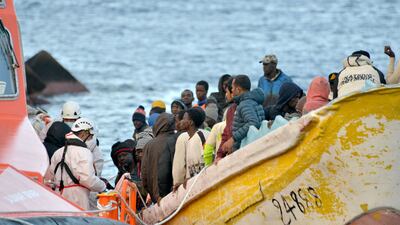
A boat carrying 156 migrants arrives at La Restinga seaport on the Canary Island of El Hierro, on December 15, after their rescue by the Spanish-based Salvamar Adhara Salvamento Maritimo off the island. AFP -

A member of the Red Cross checks migrants on La Restinga dock on October 26. AFP -

Migrants arrive at La Restinga in Spain's Canary Islands on January 3. EPA -

Migrants at Arguineguin port, in Gran Canaria, Canary islands, on January 2. EPA -

Migrants are fed and wrapped in thermal blankets after arriving at La Garita beach in Arrieta, on the Canary Island of Lanzarote, on December 27. EPA -

Two migrants rest on a beach after arriving at the coast of Teguise in Lanzarote island on December 26. EPA -
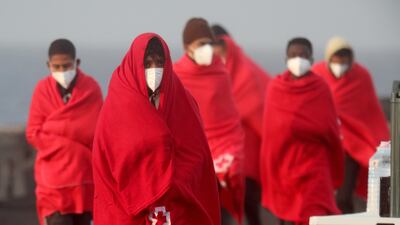
Migrants covered in blankets arrive at the port in Arrecife, Canary Islands, in February 2023, after being rescued at sea by Spanish authorities. EPA -
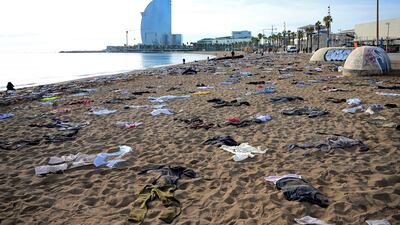
The Spanish NGO Proactiva Open Arms displays clothes at San Sebastian Beach, Barcelona, to draw attention on the migrants dying at sea, on December 11. AFP -
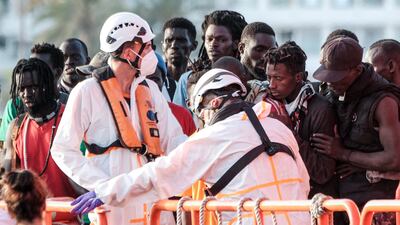
Members of Spanish Maritime Safety and authorities assist rescued migrants on their arrival at Arguineguin in Gran Canaria on July 10. EPA -
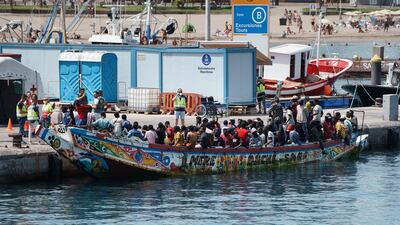
A group of 157 migrants arrives at Los Cristianos harbour, Tenerife, in the Canary Islands on July 4. EPA -
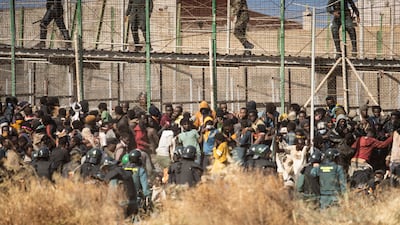
Riot police cordon off the area around the border between the Spanish enclave of Melilla and Morocco after migrants crossed the fences on June 24, 2022. AP -
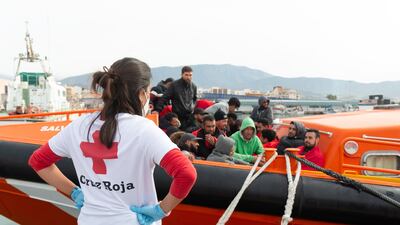
Red Cross members take care of migrants rescued by Spanish Salvamento Maritimo on their arrival at Motril in Granada, Andalusia, Spain, on April 26, 2022. EPA -
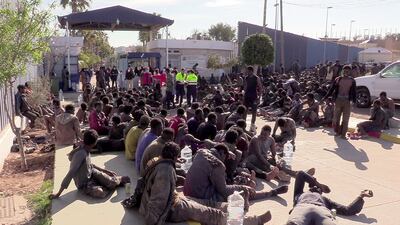
Migrants arrive at the Temporary Centre for Immigrants and Asylum Seekers in Melilla after jumping the border fence from Morocco on March 2, 2022. AFP -
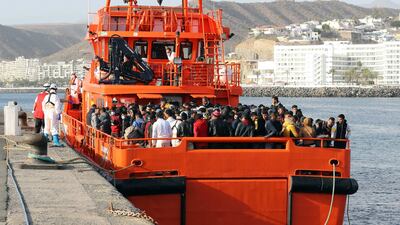
Another boatload of rescued migrants arrives at Arguineguin harbour, Gran Canaria, on February 11, 2022. EPA


Those fleeing wars have the right to asylum in the EU, which has sheltered millions of Ukrainians fleeing Russia's invasion since 2022. Africans are mostly seen as labour migrants and the bloc wants to keep a tight lid on such arrivals.
Atlantic route busiest irregular migration path into the EU
Reuters saw the Frontex January data ahead of official publication. It showed the Atlantic route as the busiest irregular migration path into the EU, representing almost a half of the total nearly 14,000 arrivals last month.
Overall, irregular arrivals fell marginally year-on-year and by a third from December, the data showed, with winter months typically seeing low numbers.
The opposite is true for the summer. UN data shows more than 3,700 migrants died on the way to Europe last year, with some of the deadliest disasters taking place off Italy's seaside town of Steccato di Cutro and Greece's island of Pylos.
Anti-immigration rhetoric increases across the EU
Anti-immigration rhetoric has grown across the EU since more than a million people - mostly Syrian refugees - arrived via the Mediterranean in 2015, catching the bloc unprepared.
Spain's Canaries reported record arrivals last year, an example of continued challenges that play out prominently in election campaigns with promises to cut immigration.
Mr Leijtens said increasing the number of effective returns of failed asylum-seekers was key to rebuilding Europeans' trust.
"A credible return operation is very important to show both to the inhabitants of Europe, but also to the migrants. If you don't need our protection ... you will be returned."
Frontex wants human rights 'part of its DNA'
He welcomed the new EU Migration Pact - an overhaul of the bloc's defunct migration and asylum rules - but stressed the 27 member states had more work to deliver on returns.
He said Frontex had no mandate to get involved in Albania under a new deal with Italy to build centres for migrants there - part of Rome's efforts to reduce immigration.
Under Mr Leijtens' predecessor, who eventually resigned amid criticism, Frontex faced multiple accusations of involvement in human rights violations. After nearly a year on the job, Mr Leijtens said he wanted Frontex to have human rights as "part of our DNA".
"If there are violations, there will be consequences," he said.

