Migrants wait on the island of Lampedusa as Italian authorities prepare to transfer them on September 17. EPA

Germany suspends scheme to take migrants from Italy


Soraya Ebrahimi
  • English
  • Arabic

Germany withdrew from a European voluntary solidarity scheme on Wednesday under which it takes in migrants from Italy, in what could become a new stand-off over asylum seekers in the bloc.

The EU-wide scheme is aimed at easing pressure on member order nations that are often the first port of call for migrants.

Germany was due to receive 3,500 asylum seekers who had first sought refuge in Italy. But only 1,700 arrived before Berlin decided to pause the intake.

"Given the currently high migratory pressure on Germany, the ongoing suspension of Dublin transfers by some member states, including Italy, reinforces the major challenges Germany is currently facing in terms of its reception and accommodation capacity," a spokesman for the Interior Ministry said.

As a result, Berlin told Italy of its decision to "postpone until further notice" its intake of migrants.

Under the so-called Dublin procedure, irregular migrants should be registered in the EU country they first enter. Should they head to another nation in the bloc, they could be returned to their EU first port of call.

But Mediterranean countries such as Italy say the rules place an excessive burden on border nations, particularly since new arrivals often want to move on and live in other EU countries.

Italy migrant boat tragedy - in pictures

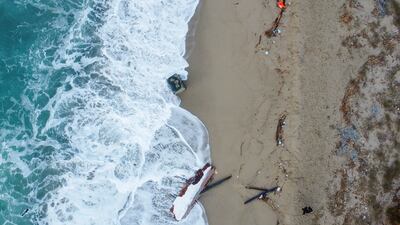
  • A view of the wreckage of a capsized boat that was washed ashore at a beach near Cutro, southern Italy. AP
    A view of the wreckage of a capsized boat that was washed ashore at a beach near Cutro, southern Italy. AP
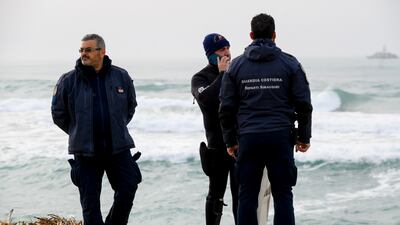
  • Italian Coastguard officers stand by as rescue crews search for people believed still missing from the migrant shipwreck. AP
    Italian Coastguard officers stand by as rescue crews search for people believed still missing from the migrant shipwreck. AP
  • Pieces of the boat on the shore near Cutro. AP
    Pieces of the boat on the shore near Cutro. AP
  • People say prayers in Crotone, where the coffins of some of the victims were laid out. EPA
    People say prayers in Crotone, where the coffins of some of the victims were laid out. EPA
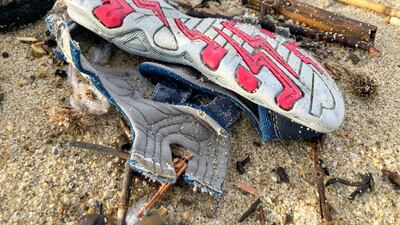
  • Personal belongings among the wreckage. AP
    Personal belongings among the wreckage. AP
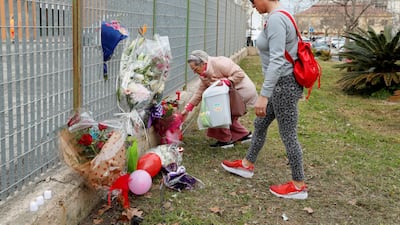
  • People lay tributes in Crotone. Reuters
    People lay tributes in Crotone. Reuters
  • Divers of the Firefighters Corps patrol the beach. AFP
    Divers of the Firefighters Corps patrol the beach. AFP
  • Rescue teams search for people believed to be still missing. AP
    Rescue teams search for people believed to be still missing. AP

Germany took in more than a million asylum seekers, mainly from Syria and Iraq, between 2015 and 2016 before the arrival numbers began falling sharply.

But over the past year, authorities have recorded a surge in arrivals again.

The latest numbers provided by federal police show 15,100 irregular migrants arriving in August, up 40 per cent from July's 10,714.

Italian Prime Minister Giorgia Meloni, whose far-right party won elections a year ago on a promise to stop mass migration, said on Wednesday that she was not surprised by Berlin's decision.

Her government temporarily suspended the Dublin rules in December for "purely technical reasons" linked to overworked reception centres, known as hotspots.

"The issue of relocation is secondary," Ms Meloni said in an interview to be broadcast later Wednesday.

"The question … is stopping arrivals into Italy. I still don't see any concrete answers."

She repeated her call for more EU help, adding: "Our hotspots are full."

The number of migrants arriving in Italy after crossing on boats from North Africa has surged this year, at almost 124,000 since January, up from 65,500 during the same period in 2022, according to government data.

Many land on the island of Lampedusa, where the reception centre on Wednesday warned it was reaching critical capacity.

The Italian Red Cross, which has run the hotspot since June, said more than 100 landings within a few hours left it hosting more than 6,000 people in a centre built for fewer than 400.

"The situation is difficult," the charity said.

The Lost Letters of William Woolf
Helen Cullen, Graydon House 

Ten tax points to be aware of in 2026

1. Domestic VAT refund amendments: request your refund within five years

If a business does not apply for the refund on time, they lose their credit.

2. E-invoicing in the UAE

Businesses should continue preparing for the implementation of e-invoicing in the UAE, with 2026 a preparation and transition period ahead of phased mandatory adoption. 

3. More tax audits

Tax authorities are increasingly using data already available across multiple filings to identify audit risks. 

4. More beneficial VAT and excise tax penalty regime

Tax disputes are expected to become more frequent and more structured, with clearer administrative objection and appeal processes. The UAE has adopted a new penalty regime for VAT and excise disputes, which now mirrors the penalty regime for corporate tax.

5. Greater emphasis on statutory audit

There is a greater need for the accuracy of financial statements. The International Financial Reporting Standards standards need to be strictly adhered to and, as a result, the quality of the audits will need to increase.

6. Further transfer pricing enforcement

Transfer pricing enforcement, which refers to the practice of establishing prices for internal transactions between related entities, is expected to broaden in scope. The UAE will shortly open the possibility to negotiate advance pricing agreements, or essentially rulings for transfer pricing purposes. 

7. Limited time periods for audits

Recent amendments also introduce a default five-year limitation period for tax audits and assessments, subject to specific statutory exceptions. While the standard audit and assessment period is five years, this may be extended to up to 15 years in cases involving fraud or tax evasion. 

8. Pillar 2 implementation 

Many multinational groups will begin to feel the practical effect of the Domestic Minimum Top-Up Tax (DMTT), the UAE's implementation of the OECD’s global minimum tax under Pillar 2. While the rules apply for financial years starting on or after January 1, 2025, it is 2026 that marks the transition to an operational phase.

9. Reduced compliance obligations for imported goods and services

Businesses that apply the reverse-charge mechanism for VAT purposes in the UAE may benefit from reduced compliance obligations. 

10. Substance and CbC reporting focus

Tax authorities are expected to continue strengthening the enforcement of economic substance and Country-by-Country (CbC) reporting frameworks. In the UAE, these regimes are increasingly being used as risk-assessment tools, providing tax authorities with a comprehensive view of multinational groups’ global footprints and enabling them to assess whether profits are aligned with real economic activity. 

Contributed by Thomas Vanhee and Hend Rashwan, Aurifer

Our legal consultant

Name: Hassan Mohsen Elhais

Position: legal consultant with Al Rowaad Advocates and Legal Consultants

Our legal advisor

Ahmad El Sayed is Senior Associate at Charles Russell Speechlys, a law firm headquartered in London with offices in the UK, Europe, the Middle East and Hong Kong.

Experience: Commercial litigator who has assisted clients with overseas judgments before UAE courts. His specialties are cases related to banking, real estate, shareholder disputes, company liquidations and criminal matters as well as employment related litigation. 

Education: Sagesse University, Beirut, Lebanon, in 2005.

Updated: September 13, 2023, 10:13 PM