


"No fight, no win," said Kyiv's mayor Vitali Klitschko on Wednesday, summing up the resolve and attitude of Ukrainians nine months into a war from which it remains determined to emerge victorious.
Despite relentless Russian strikes that have halved the country's power capacity, which will lead to months of power cuts, and warnings from the United Nations health body of a humanitarian disaster in Ukraine this winter, the rhetoric from senior Ukrainian figures remains defiant.
Klitschko said his people may need to move temporarily to satellite villages outside the city to remain safe but would not leave the country as happened at the start of the invasion. "It's a huge mistake to think we're afraid. We're depressed, we're angry. But we're staying, it's our home. We will fight and never give up."
As winter’s freeze descends across the land, The National spoke to military experts on what might lie ahead.
What happens next?
Russia's attacks on Ukrainian energy facilities follow a series of battlefield setbacks that have included a pullout of Russian forces from the southern city of Kherson to the east bank of the mighty Dnipro River that bisects the country.
With the fall of Kherson and the onset of winter, a crucial point in the war has arrived as Kyiv’s generals decide whether to press on while they have their boot on Russia's throat or regroup, readying themselves for a decisive spring attack. Temperatures have been unseasonably mild in Ukraine this autumn, but are starting to dip below zero and are expected to drop to -20 Celsius (-4 Fahrenheit) or even lower in some areas during the winter months.
Ukrainian President Volodymyr Zelenskyy said Tuesday in a video speech to a French municipal group that Russian missile strikes have destroyed nearly half of the country’s energy facilities “to turn the cold of winter into a weapon of mass destruction.” Later, in his nightly video address, he announced the establishment of “Points of Invincibility” where people can gather for electricity, mobile communications, internet access, heat, water, and first aid.
The fresh wave of attacks comes after a nine-month saga of error and miscalculation by Russia that has eroded its war machine. UK intelligence said on Wednesday it believes Russia has likely very nearly exhausted it current stock of drone missiles.
“Momentum is an important factor in war,” seasoned military analyst Frederick Kagan said. "Ukraine has it now. Kyiv and its partners must make the most of it."
That attitude may yet lead to Ukrainian forces launching another surprise attack to retake conquered territory.
But Russia has adopted a largely defensive posture, including digging trenches near Crimea, which could blunt Ukraine’s arms and weaken them for a resurgent Moscow offensive next year.
Surovikin’s grip
Retaking the strategic city of Kherson before winter has been both a military and political success but analysts have ruled out a “forced crossing” of the 1km-wide Dnipro river to attack the well-defended Russians on the eastern bank.
A more clear-headed approach by the Russians has also been noted by western officials.
“Gen [Sergey] Surovikin has got a grip of what is militarily defensible and achievable,” a western official said.
“He's shortened his lines and he's made it easier to defend using natural barriers. It's sound military logic. Surovikin also understood that he could not have stayed and fought in Kherson.”
The “biggest danger” for the Ukrainians would be if the Russians “start making sensible decisions”, said Sam Cranny-Evans of the Royal United Services Institute.
“Surovikin is a cautious person and withdrawing from Kherson was one of the first sensible decisions they've made," he said. "They are starting to pull themselves together and make rational decisions about what gets defended.”

Southern thrust
Winter will certainly bring many challenges. Keeping weapons effective will be one, as well as shorter days and a lack of cover, although the hardened ground will assist the side best-suited to armoured-manoeuvre warfare.
Ukraine’s senior military figures are understood to be rapidly training a number of mechanised brigades that could be unleashed on the Russians to potentially sever Crimea from the border.
This might lead to an armoured thrust directly south that could retake the Zaporizhzhia nuclear plant, then push 90km to Melitopol city and the coast of the Sea of Azov.
This could trap a large portion of Russian troops between the east bank of the Dnipro and Crimea and prove to be a major loss of territory and prestige for Moscow.
The Kherson retreat means not only that Gen Surovikin now has stronger defensive lines but more than 20,000 of his most seasoned soldiers are back.
How he deploys that force will be important. A wily commander would likely prefer to rest and re-equip them as a mobile reserve, ready to counter any Ukrainian offensive.
But he may well be under pressure from the Kremlin to bring about some much-needed victories to bolster President Vladimir Putin’s political image.
The force could also be used in a joint offensive with Wagner Group mercenaries, volunteer units as well as the newly mobilised reservists who make up what is in effect a newly formed Third Army after two largely failed offensive formations.
“A lot of Russia's best and brightest troops are still at large for Ukraine and that's problematic,” Mr Cranny-Evans said.
Russian forces are prioritising offensive operations in the Donetsk region, with 500 clashes in the past week.
“We shouldn't forget that Russia has been forming this new Third Army, which it may be husbanding for a major offensive,” warned Brig Ben Barry of the International Institute for Strategic Studies.

Christmas truce
It will be a mark of Gen Surovikin’s leadership on whether he can resist political pressure to retain troops for a spring offensive.
Russian stocks of 152mm artillery ammunition have been reduced to only a month’s supply and their missile armoury has been depleted severely.
What Gen Surovikin needs is time to train troops and rebuild war stocks. The offer of a Christmas truce cannot be discounted, said Brig Barry.
“If Russia thinks its main effort needs to be replenishing, reconstituting and re-equipping, they could declare a winter ceasefire, especially with Christmas coming. That might enable Russia to seize the moral high ground and Ukraine would have a difficult question to answer.”
Other analysts believe this should be resisted.
“Any attempt at a ceasefire or cessation of hostilities at this time would overwhelmingly favour Russia,” said Mr Kagan of the Institute for the Study of War.
He said a temporary truce would give Russia a chance to recover and “allow the reservists flowing into the theatre time to integrate into their units, train up and prepare for serious combat”.
Chatham House Ukraine specialist Orysia Lutsevych argued strongly against accepting any Russian pause.
“The Ukrainians are not willing to give them that time, even over Christmas,” she said. “I think we are beyond that symbolism.”
Train strikes
One of Ukraine’s greatest successes has been their ability to combine surveillance with precision strikes using western-supplied weapons to hit Russia’s logistic hubs.
Already in areas where bottlenecks are appearing along the limited roads and rail in eastern Kherson, rockets and shells are landing, degrading Russia's ability to supply and regroup.
But it now appears Moscow’s main effort will be in the Bakhmut area near Donetsk, where the fight is intensifying.
“They are desperate to secure a rail network that will allow supplies to flow to the front line for the larger amount of troops,” said Ms Lutsevych. “Ukraine understands that their goal is to actually prevent the Russians from strengthening positions to enable further counter-attacks.”

More ammunition
With up to 10,000 fresh troops trained by Britain and other countries, Ukraine will soon have forces for a new offensive.
But its war effort is not without problems. Although it is accepted that Russia has lost about 25,000 troops, there are no figures for Ukrainian casualties, although some analysts believe they have lost a similar amount.
“The big question is what has the past two-month offensive cost Ukraine and are they even in a position to continue?” Mr Cranny-Evans said.
Another problem is the supply of high-end western weapons. The GMLRS missile is causing the most problems but there remains an issue over whether defence companies can continue to meet Ukraine’s voracious usage.
“If they don't have the artillery munitions to ensure success, they probably won't attack,” Mr Cranny-Evans said.
“The western industrial military base is creaking but the Russian one is not going to creak because precision munitions for them are not what we thought — all they need is artillery shells and a few guided versions.”
The effectiveness of the strikes was vital to Kyiv’s efforts, Ms Lutsevych said.
“Artillery is proving a death by a thousand cuts for Russia, so supply is crucial.”
War in 2023
Defence analysts have not ruled out a surprise strike by Kyiv early next year.
“In terms of a Ukrainian breakthrough, this is a hard question with Ukrainians continuing to surprise us,” a western source said.
“What they have been very good at is creating gaps and exploiting them to their fullest extent so you just can't rule out surprises.
"But as we go into 2023, we are still expecting the grind to be largely static and neither side to particularly win or lose.”
Precisely where Ukraine strikes next is, for good reason, a closely guarded secret. Its military has been adept in ensuring the media is kept in the dark.
But strike they will, said Ms Lutsevych, who is from Ukraine and has extensive contacts in the country.
“There is quite strong confidentiality around any offensive but they will do something," she said. "We should keep in mind that every offensive is different — what they do today doesn't mean it will repeated.”
Mr Cranny-Evans argued that Ukraine would resume its strikes on supplies and command headquarters with the occasional rapid advance exploiting a weakness in Russian lines.
"I’d be surprised if the Ukrainians are going to stop doing what's really working,” he added.
Ukraine war latest - in pictures
-
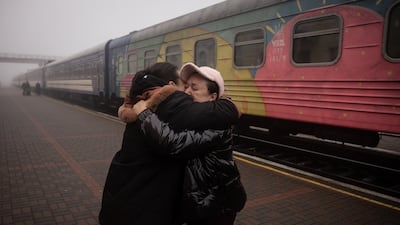
Friends hug after the arrival of a train in the southern city of Kherson. Getty -
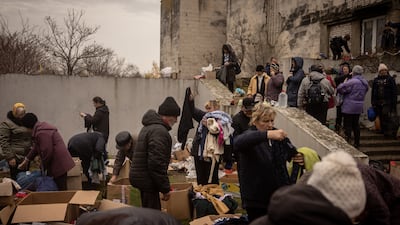
Residents sort through donated clothing at an aid centre in Kherson. Getty -
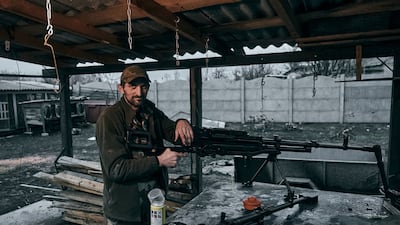
A Ukrainian soldier stands with a machinegun near Liman in the Donetsk region. AP -
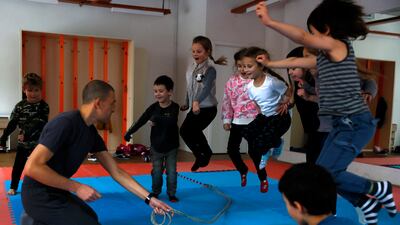
Children attend a physical education class at Spilno School in Kyiv. Getty -
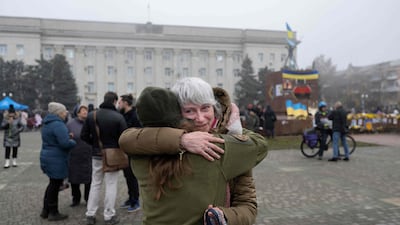
A woman embraces her friend, a soldier in the Ukrainian army, in Kherson. AFP -
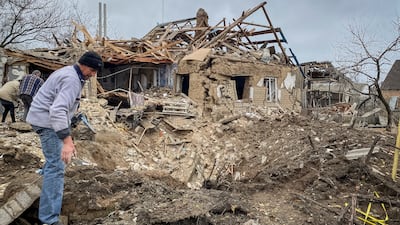
Residents inspect a crater left by a Russian military strike in the village of Komyshuvakha in the Zaporizhzhia region. Reuters -
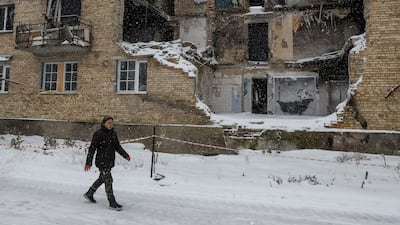
Resident Tetiana Reznychenko walks past a work by world-renowned graffiti artist Banksy, on the wall of a destroyed building in the Ukrainian village of Horenka. Reuters -
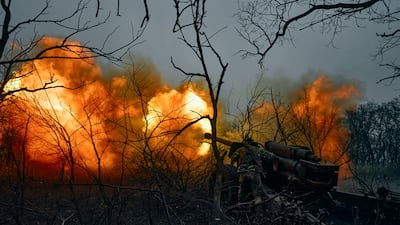
Ukrainian soldiers fire artillery at Russian positions near Bakhmut in the Donetsk region. AP -
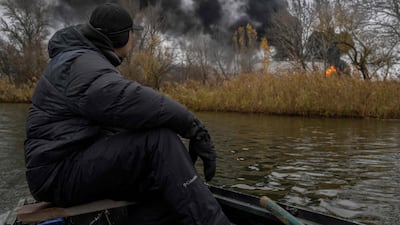
A fisherman sails his boat on the Dnipro as black smoke rises from an oil reserve in Kherson. AFP



