



Russian forces are trying to slow down tanks in Ukraine by building "dragon's teeth", a type of fortification not seen in combat since the Second World War.
The obstacles, concrete blocks in the shape of pyramids, were built in Britain during the war as fears of a Nazi invasion grew, as well as in Germany.
Russia has started to build the defences around the occupied southern Ukrainian city of Mariupol, the UK's Ministry of Defence said on Wednesday.
"Dragon’s teeth have likely been installed between Mariupol and Nikolske village, and from northern Mariupol to Staryi Krym village," it said.
The concrete “teeth” are embedded at least one metre into the ground to hamper attempts to dislodge them.
Ukrainian tanks, which were mainly designed during the Soviet era, could be damaged if they are driven over the blocks.
-
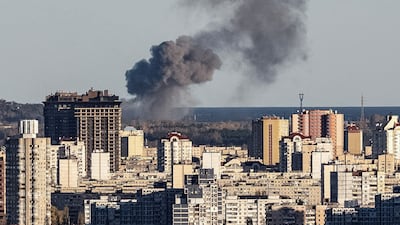
Smoke rises on the outskirts of the city during a Russian missile attack in Kyiv. Reuters -

Workers surround the Monument to the Heroes of the Heavenly Hundred with sandbags against damage from shelling in Mykolaiv. EPA -

Russian President Vladimir Putin welcomes Azerbaijan President Ilham Aliyev for talks before a meeting between the Russian president and the leaders of Armenia and Azerbaijan in the Black Sea resort city of Sochi, Russia. AFP -

People take water from a water pump in Kyiv. EPA -
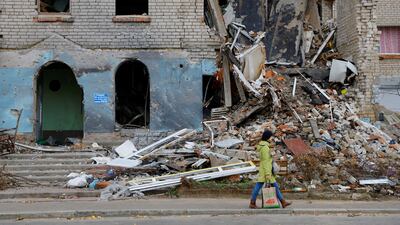
A woman walks past a damaged building in the town of Nova Kakhovka. Reuters -
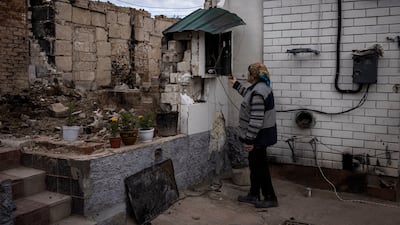
A woman outside her home, which was destroyed during battles at the start of the conflict, in Yahidne, Chernihiv. Getty Images -
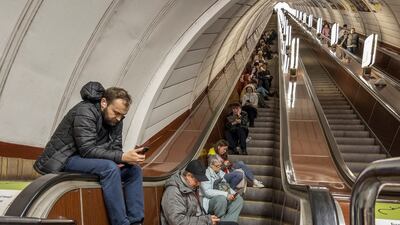
People shelter inside a subway station during a Russian missile attack in Kyiv. Reuters -
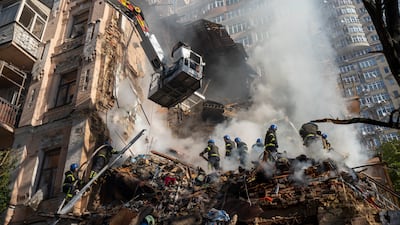
Firefighters at the site of a drone attack in Kyiv, Ukraine. AP -
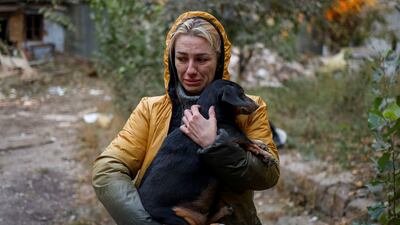
A woman walks past the site of a Russian missile strike in the southern Ukrainian city of Mykolaiv. Reuters -
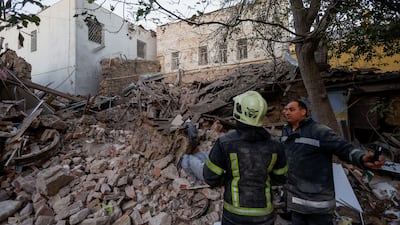
Rescuer workers at a building destroyed in an attack in Mykolaiv. Reuters -
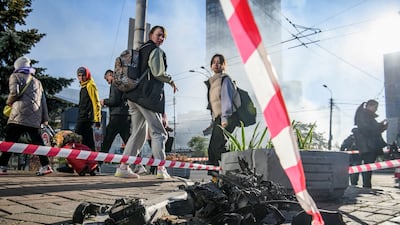
Parts of a drone lie on a street in Kyiv. Reuters -
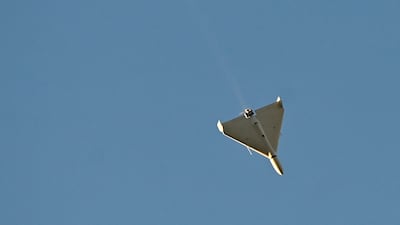
A drone flies over the Ukrainian capital during an attack. AFP -
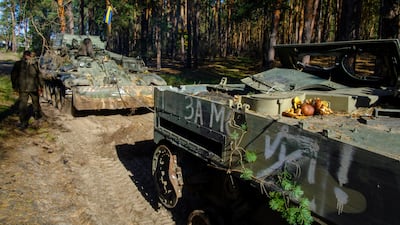
Ukrainian servicemen tow a captured Russian armoured vehicle in Rudneve village, Kharkiv. EPA -
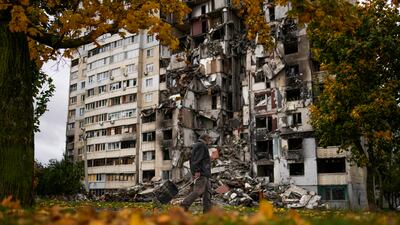
A partially destroyed residential building in Saltivka, in Kharkiv. AP -
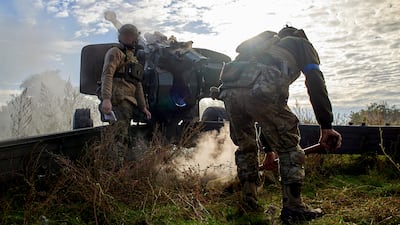
Ukrainian servicemen fire a captured Russian howitzer on a front line near Kupyansk city, Kharkiv. EPA -
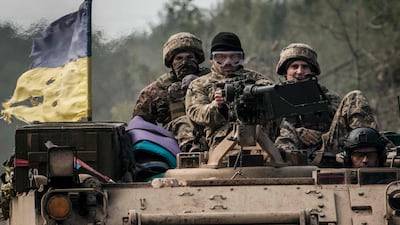
Ukrainian servicemen near the recently retaken town of Lyman in Donetsk region. AFP -
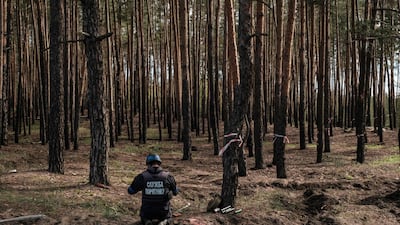
An officer from a Ukrainian national police emergency demining team prepares to detonate collected anti-tank mines and explosives near Lyman, in the Donetsk region. AFP -
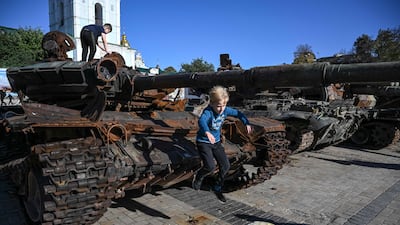
A boy playing on a destroyed Russian tank on display in Kyiv. AFP -

A young couple hiding underground during an air alert in Zaporizhzhia. AFP -
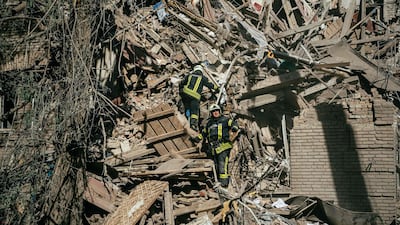
Ukrainian firefighters looking for survivors after a strike in Zaporizhzhia. AFP -
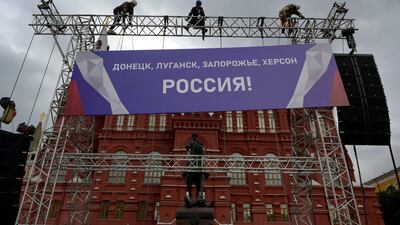
Workers fix a banner reading 'Donetsk, Luhansk, Zaporizhzhia, Kherson - Russia!' to the State Historical Museum near Red Square in Moscow. AFP -

Residents try to cross a destroyed bridge in the Kharkiv region of Ukraine. AFP -
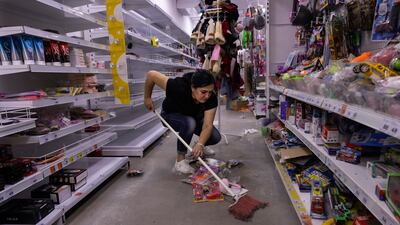
Alyona Kishinskaya helps to clean up a shop as it prepares to reopen in Balakiya, Ukraine, after a six-month Russian occupation. Getty Images -
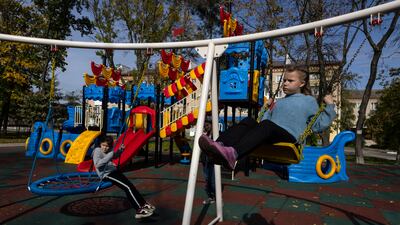
Alla, 12, has a swinging time in Balakiya, Ukraine, as life goes on despite the war. Getty Images -

Ukrainian flags in the town square in Balakiya. Getty Images -
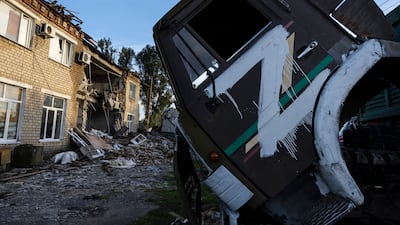
A destroyed Russian command centre in Izium, Ukraine. Getty Images -

In what may be a final farewell, young Russian recruits - escorted by their wives - walk to a train station in Volgograd before being sent to war in Ukraine. AP -
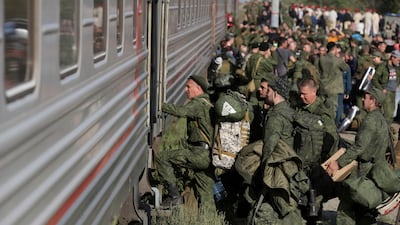
Russian recruits board the train to Ukraine in Volgograd. AP -
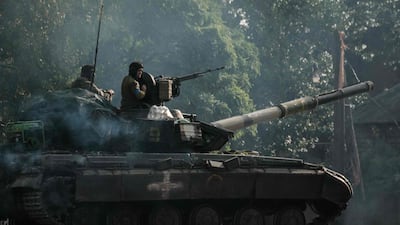
Ukrainian soliders drive a tank at the recently retaken eastern side of the Oskil River in Kharkiv region, Ukraine. AFP -
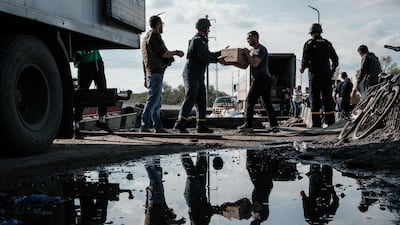
Volunteers pass boxes of food aid on a destroyed bridge over the Oskil River. AFP -
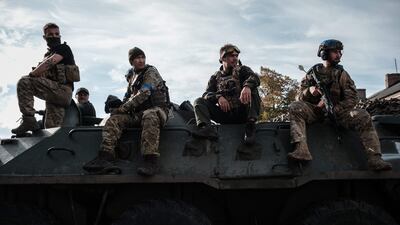
Ukrainian soliders rest on an armoured personnel carrier. AFP -
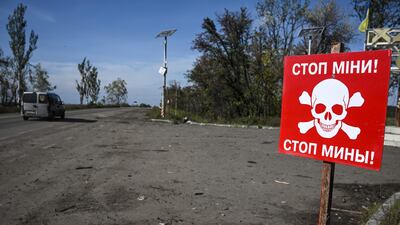
A sign warns of landmines in Izyum, eastern Ukraine. AFP -
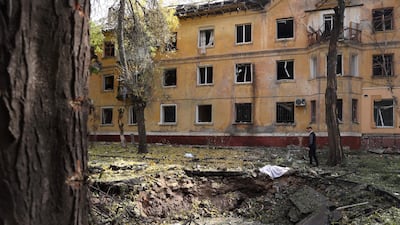
This crater was left after a missile strike in the Donetsk region of Ukraine. AFP


Ukraine’s T-64BM Bulat tanks weigh 38 tonnes, making them a little heavier than the largest variant of the American Shermans used in the Second World War. The US vehicles were unable to pass over dragon’s teeth.
In the 1990s, South Korea built dense rows of the concrete blocks near Goyang, a satellite city of the capital Seoul, in the belief they could slow down the North’s Soviet-era tanks.
The defences are not intended to be completely impassable, but are instead used to channel attackers towards ambushes and areas where artillery fire can be concentrated, experts say.
The teeth were a major problem for the US Third Armoured Division as its tanks entered western Germany by crossing the Siegfried Line, which comprised bunkers and dragon’s teeth.
The US 23rd Armoured Engineer Battalion succeeded in crawling forward and placing explosives on the obstacles, but not before being attacked with heavy machinegun fire and mortars.
The teeth proved effective for Germany when American forces could not find a way around.
Are dragon's teeth effective today?
Russia is unlikely to install a defensive line in Ukraine as dense as the Siegfried Line, which was built over a period of several years starting in 1936, covered 600 kilometres, included nearly 20,000 bunkers and used about eight million tonnes of concrete.
It is possible that more modern tanks will be able to deal with the obstacles by using their main guns, a last resort in the Second World War when the guns were less powerful and less accurate.
Ukraine also has the US-supplied M58 Mine Clearing Line Charge, a trailer that lays a line of C-4 plastic explosives more than 100 metres long.
It is designed to clear obstacles as well as mines, and in theory could remove dragon’s teeth.
Ukraine is more likely to seek a way around the defences or send infantry to seize the far side of the barrier until engineering units arrive.

