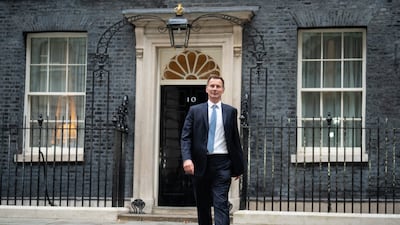
Sterling was on the back foot on currency markets on Friday as Britain entered another political rollercoaster after the resignation of Prime Minister Liz Truss.
The pound fell 0.8 per cent to a weekly low of $1.115, reversing a brief rally after Ms Truss announced her departure. It dropped 0.5 per cent against the euro, to €1.142.
The slide came as Conservative MPs began manoeuvring for the frantic week-long leadership contest to succeed Ms Truss.
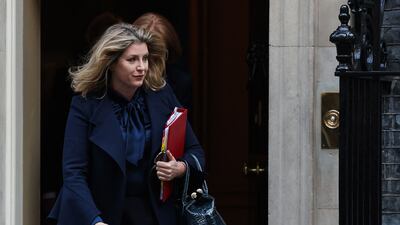
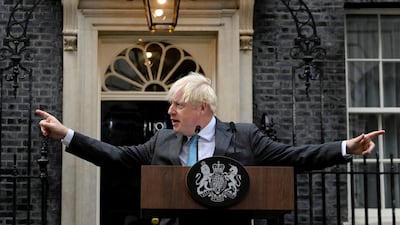
The picture was highly uncertain, with Rishi Sunak, Boris Johnson and Penny Mordaunt in the frame to succeed Ms Truss but none of them considered the clear favourite.
Negative news from economic indicators also weighed on the market. Friday figures showed lower consumer spending and higher government borrowing than expected last month, underlining the scale of the economic challenge.
The blue-chip FTSE 100 index fell 0.6 per cent in early trading.
The yield on the British government's 30-year bond, or gilt, climbed back above four per cent on Friday as traders mulled over the political crisis.
"The problems facing the UK have not gone away, despite the removal of Liz Truss as PM," Stuart Cole, chief macroeconomist at brokerage Equiti Capital and a former Bank of England trader, told The National.
Mr Cole said sterling's slide was partly down to a strong dollar, but also reflected the ongoing political turmoil.
"It is further change and every time this happens the bar for restoring investor credibility in gilts, sterling – indeed the UK in general – gets raised higher,and I think we are seeing this being reflected today as both sterling and UK assets take a move lower," he said.
"I think it will be at least the New Year before a modicum of confidence starts to return."
Chancellor of the Exchequer Jeremy Hunt said in response to the new economic figures that he would make the "difficult decisions" to reassure markets about the state of Britain's finances.
"We will do whatever is necessary to drive down debt in the medium term and to ensure that taxpayers’ money is well spent, putting the public finances on a sustainable path as we grow the economy," he said.
Markets.com analyst Neil Wilson said markets were retracing their initial moves as they take in the "huge uncertainty" that remains.
"The economic policies [of Ms Truss] were already dead in the water so the market doesn't have a huge amount of genuine new information to move on despite the seismic events of the last 24 hours," he said.
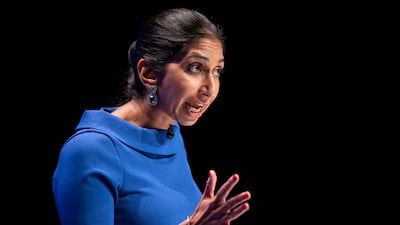
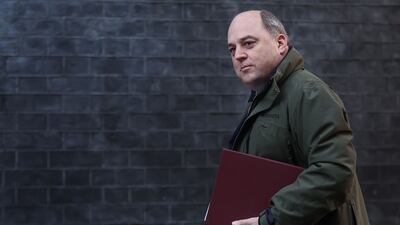
Potential Conservative leadership candidates - in pictures
Market moves have been eagerly watched in Westminster since a botched mini-budget on September 23 drove Britain into economic turmoil.
The package of more than £40 billion ($44.5bn) in tax cuts led to a crash in sterling's value, a jump in mortgage costs and an emergency intervention by the Bank of England to protect pension funds.
Ms Truss's authority never recovered from the mayhem and she announced her resignation on her 45th day in office, making her Britain's shortest-serving prime minister.
The contest to succeed her is being compressed into a week so that the new leader will be in place before October 31, when the chancellor is expected to set out a new fiscal plan.
A budget forecast will be published on that date after Mr Hunt tore up the Truss plan, by cancelling cuts in income and corporation tax and reining in subsidies for energy bills.
Allies of Mr Sunak, who has yet to say whether he will enter the race, said the former chancellor had been vindicated after advising against Ms Truss's tax cuts over the summer.
But supporters of Mr Johnson say he is the man to lead the Tories out of a catastrophic polling slump, having won the last election with an 80-seat majority.

Ten tax points to be aware of in 2026
1. Domestic VAT refund amendments: request your refund within five years
If a business does not apply for the refund on time, they lose their credit.
2. E-invoicing in the UAE
Businesses should continue preparing for the implementation of e-invoicing in the UAE, with 2026 a preparation and transition period ahead of phased mandatory adoption.
3. More tax audits
Tax authorities are increasingly using data already available across multiple filings to identify audit risks.
4. More beneficial VAT and excise tax penalty regime
Tax disputes are expected to become more frequent and more structured, with clearer administrative objection and appeal processes. The UAE has adopted a new penalty regime for VAT and excise disputes, which now mirrors the penalty regime for corporate tax.
5. Greater emphasis on statutory audit
There is a greater need for the accuracy of financial statements. The International Financial Reporting Standards standards need to be strictly adhered to and, as a result, the quality of the audits will need to increase.
6. Further transfer pricing enforcement
Transfer pricing enforcement, which refers to the practice of establishing prices for internal transactions between related entities, is expected to broaden in scope. The UAE will shortly open the possibility to negotiate advance pricing agreements, or essentially rulings for transfer pricing purposes.
7. Limited time periods for audits
Recent amendments also introduce a default five-year limitation period for tax audits and assessments, subject to specific statutory exceptions. While the standard audit and assessment period is five years, this may be extended to up to 15 years in cases involving fraud or tax evasion.
8. Pillar 2 implementation
Many multinational groups will begin to feel the practical effect of the Domestic Minimum Top-Up Tax (DMTT), the UAE's implementation of the OECD’s global minimum tax under Pillar 2. While the rules apply for financial years starting on or after January 1, 2025, it is 2026 that marks the transition to an operational phase.
9. Reduced compliance obligations for imported goods and services
Businesses that apply the reverse-charge mechanism for VAT purposes in the UAE may benefit from reduced compliance obligations.
10. Substance and CbC reporting focus
Tax authorities are expected to continue strengthening the enforcement of economic substance and Country-by-Country (CbC) reporting frameworks. In the UAE, these regimes are increasingly being used as risk-assessment tools, providing tax authorities with a comprehensive view of multinational groups’ global footprints and enabling them to assess whether profits are aligned with real economic activity.
Contributed by Thomas Vanhee and Hend Rashwan, Aurifer
The National Archives, Abu Dhabi
Founded over 50 years ago, the National Archives collects valuable historical material relating to the UAE, and is the oldest and richest archive relating to the Arabian Gulf.
Much of the material can be viewed on line at the Arabian Gulf Digital Archive - https://www.agda.ae/en
THE BIO
Bio Box
Role Model: Sheikh Zayed, God bless his soul
Favorite book: Zayed Biography of the leader
Favorite quote: To be or not to be, that is the question, from William Shakespeare's Hamlet
Favorite food: seafood
Favorite place to travel: Lebanon
Favorite movie: Braveheart
Gifts exchanged
- King Charles - replica of President Eisenhower Sword
- Queen Camilla - Tiffany & Co vintage 18-carat gold, diamond and ruby flower brooch
- Donald Trump - hand-bound leather book with Declaration of Independence
- Melania Trump - personalised Anya Hindmarch handbag
Gender pay parity on track in the UAE
The UAE has a good record on gender pay parity, according to Mercer's Total Remuneration Study.
"In some of the lower levels of jobs women tend to be paid more than men, primarily because men are employed in blue collar jobs and women tend to be employed in white collar jobs which pay better," said Ted Raffoul, career products leader, Mena at Mercer. "I am yet to see a company in the UAE – particularly when you are looking at a blue chip multinationals or some of the bigger local companies – that actively discriminates when it comes to gender on pay."
Mr Raffoul said most gender issues are actually due to the cultural class, as the population is dominated by Asian and Arab cultures where men are generally expected to work and earn whereas women are meant to start a family.
"For that reason, we see a different gender gap. There are less women in senior roles because women tend to focus less on this but that’s not due to any companies having a policy penalising women for any reasons – it’s a cultural thing," he said.
As a result, Mr Raffoul said many companies in the UAE are coming up with benefit package programmes to help working mothers and the career development of women in general.