



Lives and limbs are being saved in Ukraine after the world’s leading mine-clearing group teamed up with a Californian tech company that uses social media to pinpoint dangerous spots.
With an unprecedented amount of unexploded ammunition spread throughout the country, the Halo Trust charity has developed a unique system of tracking down unexploded bombs.
Staff have also witnessed horrific booby traps left by retreating Russian troops and designed to maim and kill children and adults. They include cuddly toys attached to hand grenades.
But the group hopes its new data gathering system will enable it to clear towns and fields so that Ukrainians can rapidly return once areas are recaptured.
A key part of that system is the Open Source Research Project, developed in co-operation with Californian company Esri, which specialises in data harvesting and mapping.
When the war began, Halo Trust staff saw that civilians and soldiers were posting pictures of unexploded missiles and bombs on Twitter, Instagram, Facebook, Reddit and other platforms.
They are using mapping and data analysis with Esri to capture the information. Geolocation from the photographs is used to produce a map that pinpoints precisely the street, house or field where a device needs to be made safe.
The programme now has 13,000 data points that provide evidence of unexploded ordnance, or landmine contamination, damaged infrastructure and civilian accidents.
“It's the first time we've done it on this scale,” said Andro Mathewson of the Halo Trust. “There’s a huge amount of information that's on social media; everyone in Ukraine, even in the trench lines, has an iPhone and almost everything is getting reported in real time.”
This allows the Halo Trust to respond and investigate an incident within days, and to deal with other dangers in the area.
“It helps speed up the work and reduces the load on the ground,” said Mr Mathewson. “The amount of added knowledge that we get from this is beyond helpful.”

Facebook finds
“What is different from previous wars is that we're making very considerable use of social media,” Halo Trust chief executive James Cowan told The National. “This is the most documented war ever, so when a householder sees an artillery round outside their bedroom window they take a photograph and they put it on Twitter or Telegram which has a digital signature and a location.”
The data is then fed into a computer system in which the software gives geolocation tags to build an accurate picture of all the unexploded bombs.

With Russian mines planted beneath many of Ukraine’s roads, driving in formerly occupied territory has become extremely hazardous.
Anti-tank mines have been buried 10 to 20 centimetres under the road, with only the detonator tip in view. In a recent accident, two people were killed in their car when they drove over a pair of the large mines. In another, two men working for an energy company were blown up attempting to repair power cables.
“If you're driving a car, it's very difficult to spot,” said Mr Mathewson. “But very often people don't have a choice. They have to go and make a living somehow.”
Halo has so far recorded 83 deaths and 130 injuries from 110 different explosions.

People’s army
In addition to mainstream social media, Halo uses a broad range of resources that feed information into the programme.
They receive crucial information from the Armed Conflict Location Event Database, Unicef, and an army of volunteers.
“A whole crowd of open source intelligence people are online and have been doing this as volunteers,” said Mr Mathewson.
-
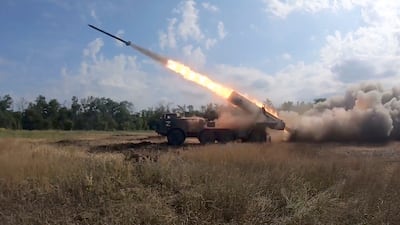
A Russian multiple-launch 'Hurricane' rocket system in action during battles in an undisclosed area in Ukraine. EPA -

The Turkish bulk carrier 'Osprey S' is anchored off the shore near Istanbul. The vessel was expected to arrive in Ukraine's Chornomorsk port carrying grain, becoming the first ship to arrive at a Ukrainian port during the war. Reuters -
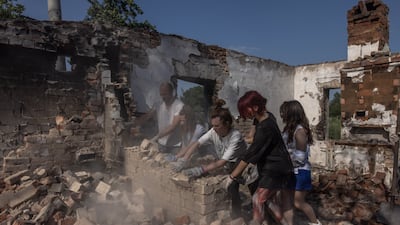
Young volunteers from the 'Repair Together' initiative, together with the local residents, clear rubble from a house that was destroyed during fighting, in Ivanivka, Chernihiv region. EPA -
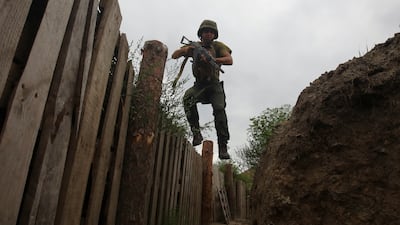
A member of the Ukrainian National Guard jumps into a trench at a position near a front line, in the Kharkiv region. Reuters -
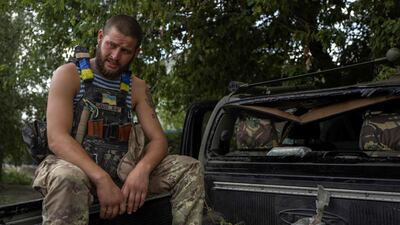
A Ukrainian soldier after a rocket fragment hit his car, in Bakhmut. AFP -
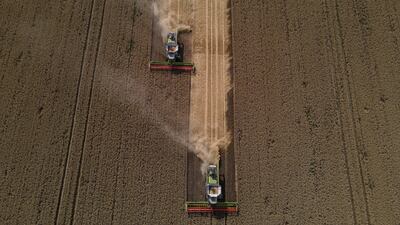
Combine harvesters of the Continental Farmers Group agricultural company harvest wheat in the Ternopil region of Ukraine. Getty Images -
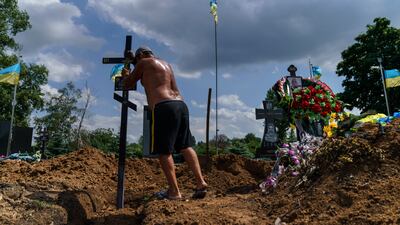
A cemetery worker places a cross on the grave of Ukrainian soldier Serhiy Marchenko, who died aged 26, after his burial in Pokrovsk, Donetsk region. AP -
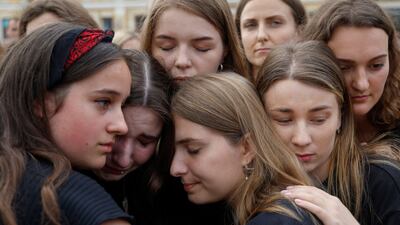
Women attend a rally of relatives and friends of defenders of the Azovstal Iron and Steel Works in Mariupol. Reuters -
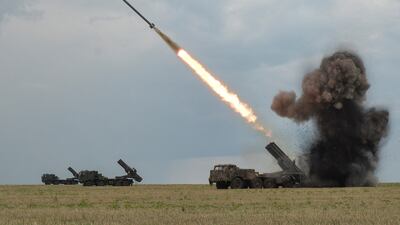
Ukrainian troops fire with a BM27 Uragan multiple-launch rocket system, in the Kharkiv region. Reuters -
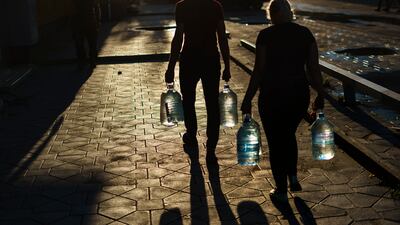
A couple carry water bottles after filling them up at a store in Pokrovsk, Donetsk region. AP -
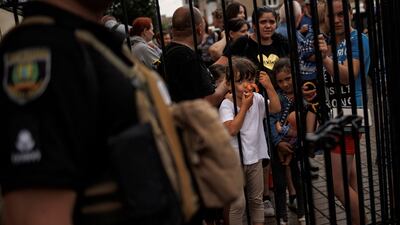
A girl holds a doll as people wait in Pokrovsk, to board a train to Dnipro and Lviv, during an evacuation effort from war-affected areas of eastern Ukraine. Reuters -
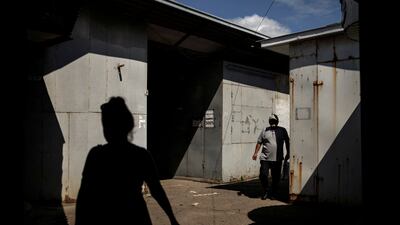
People make their way through the partially-closed Market of Kramatorsk. Reuters


“Geoconfirmed is a wonderful group of volunteers on Twitter that have given us access to a spreadsheet of events, and Small Drones is an independent researcher — Faine Greenwood — who's tracked all occurrences of drones being used in the conflict. It’s all low cost for quite high reward.”
Artificial intelligence is also being used to speed up the dissemination of the vast amounts of open source information.
“AI is helping with the research and the data cleaning, speeding up the process of searching for stuff online, as there’s so much material out there,” said Mr Mathewson. “We’re also exploring a tool that helps us to search faster, removing things we're not interested in.”
Fatal fields
With Ukraine supplying 12 per cent of the world’s wheat crops and half the sunflower oil, it is vital that farmers can safely sow and harvest their crops.
While Ukraine’s extensive farmland is very hard in summer and frozen in winter, autumn and spring rains make it soft, meaning artillery rounds are buried deep in the earth.

With thousands of shells pounding Ukraine each day, ploughing and harvesting become extremely hazardous, with tractors detonating rounds that have penetrated the ground.
“The Russians have high failure rates with all their ammunition types because they are badly made so it's going to take years to address this,” said Mr Cowan. “What is really disturbing about all this is we're talking about a global food crisis so we have a really important part to play in getting Ukraine's agriculture back up and running.”
Booby traps
In the town of Bucha, where 1,300 Ukrainian civilians were allegedly massacred by Russian forces, a number of deadly devices were discovered.
“The classic is the fluffy toy attached by a pull wire to a grenade that goes off when picked up,” said Mr Cowan. “When a town falls back into Ukrainian hands, there’s huge pressure with families wanting to come back but when they start doing amateur clearance it’s hugely dangerous.”

Another Russian tactic is the “stacked mine”, where a large anti-tank mine is placed on top of a hidden anti-personnel mine. “People think that it's an anti-tank mine sitting there and lift it to move it to the roadside thinking it won't go off if they don’t touch the pressure plate on top,” said Mr Cowan. “But what they don't know is that underneath it is an anti-personnel mine which detonates the moment you lift the anti-tank mine.”
Kherson clearance
If the key Russian-held port city of Kherson is retaken by Ukraine then the Halo Trust teams will be the first civilians in to make it habitable.
“Effectively, once the Russians are pushed out of artillery range, we want to be hard on the heels of the army,” said Mr Cowan.
“There is no point in winning the war militarily if we're not going to win it from a reconstruction point of view. And no humanitarian organisation can go in unless it's safe so we are an essential precursor to aid and reconstruction.”
Female detail
The Halo Trust has been present in Ukraine since Russia invaded Crimea in 2014, so when Moscow attacked again in February they already had 400 staff on the ground, mostly in the Donbas area.
Once Russian troops retreated from around Kyiv the charity increased its number of employees to 740, with a third of them women.
“Women can be better de-miners, mainly because they have a commitment and attention to detail that perhaps not all men have,” said the Halo Trust chief.
Their first task was tackling the mountains of ammunition that Russian troops abandoned in their retreat from Kyiv, leaving stockpiles of artillery shells, RPG rounds, grenades and bullets, much of it booby trapped.
With Nato arms also arriving, the teams now have to deal with 400 types of ammunition being used in the war.
“There is enough work for us to keep us going indefinitely for years to come,” Mr Cowan said.
Halo's work in Iraq and Afghanistan — in pictures
-
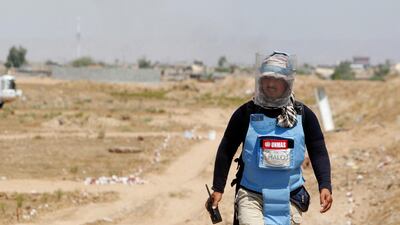
An Iraqi mine clearer working for Halo Trust, near the town of Baiji, an oil-rich region ravaged by fighting. AFP -
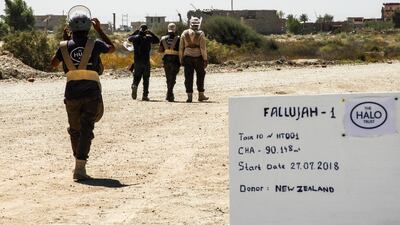
Halo deminers at work in Fallujah, where there is a minefield six miles long and about 200m deep. The Halo Trust -
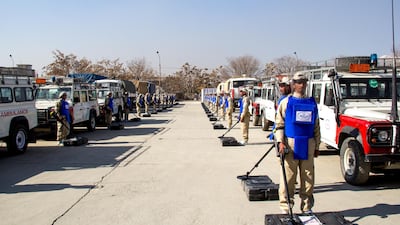
The Kabul compound. Since 1988 Halo has cleared 210,000 hectares of minefield and battlefield and more than 200,000 cluster munitions . Courtesy The Halo Trust -
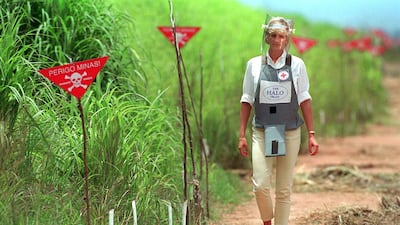
The charity first gained international recognition for its de-mining work in 1997 when the late Princess Diana walked in Halo protective kit across a minefield in Angola. Getty Images -
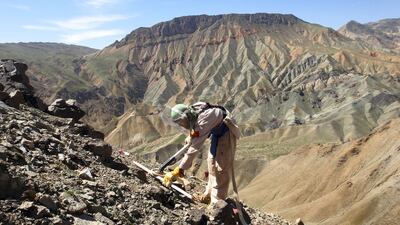
A third of Halo's 9,000 operators are employed in Afghanistan.The Halo Trust



