


Breaking three days of silence, President Emmanuel Macron on Wednesday urged France's political forces to make compromises to end a political deadlock after he failed to keep a parliamentary majority.
A new left-wing coalition and the far right made major gains in Sunday's parliamentary elections, leaving Mr Macron's centrist alliance 44 seats short of a majority in a situation that could paralyse government.
The situation has called into question his plans for reform — including raising the retirement age — in his second term after his April presidential re-election and could harm his international image.
In a televised address to the nation on Wednesday, Mr Macron ruled out a national unity government but appeared upbeat on the chances for progress, even if he did not offer any concrete solutions.
He said France's political forces must "collectively learn to govern and legislate differently" by building "compromises, additions and amendments but doing so in complete transparency, for the sake of national unity".
Mr Macron acknowledged that the parliamentary elections had highlighted social problems in France, but he called on the opposition parties to "leave in-fighting behind" and move "beyond politics".
Over the past two days he has hosted rare talks at the Elysee Palace with opposition leaders to find a way out of the crisis.
He met the head of the far-right National Rally, Marine Le Pen, on Tuesday, while the head of the left-wing Nupes alliance, hard-leftist Jean-Luc Melenchon, sent MP Adrien Quatennens, 32, to represent him in talks on Wednesday.
The meetings so far appear to have made little headway, and Mr Macron has also rejected an offer from under-fire French Prime Minister Elisabeth Borne to resign.
But he said the opposition was ready "to advance on major topics" such as the cost of living, jobs, energy, climate and health".
He said urgent draft laws, especially to alleviate the effects of inflation and rising energy prices, would be submitted to parliament over the summer.
French election: Emmanuel Macron loses parliament majority - in pictures
-

France's President Emmanuel Macron arrives to vote in the second stage of parliamentary elections in Le Touquet, northern France. Mr Macron is set to lose absolute majority, following a far-right surge. AFP -

Jean-Luc Melenchon, leader of the France Unbowed party, at a gathering in Paris, following the first round of voting. The second-largest group is on track to be Nupes, a leftist coalition led by Mr Melenchon. Bloomberg -

Mr Melenchon speaks to supporters following the first round of voting in parliamentary elections, in Paris. Bloomberg -
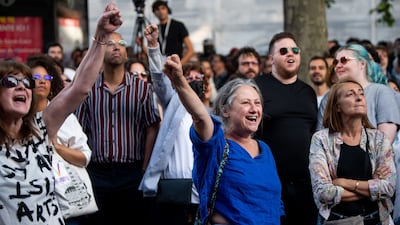
Supporters of the France Unbowed party celebrate results in Paris. The poll elects the 577 members for the National Assembly of the French Republic. Bloomberg -

A subdued election night party at the headquarters of Mr Macron's centrist Ensemble alliance, in Paris, France. EPA -

Electoral posters in front of a polling station during the second round of voting, in Paris. Bloomberg -

Voters cast their ballots in Paris. Before the poll, Mr Macron had said the country faces chaos if it didn’t hand him an absolute majority. Bloomberg -

Mr Macron greets members of the public at Le Touquet. -

The French president and his wife Brigitte Macron arrive to vote. Reuters -

Mr Macron casts his ballot. The outcome will determine how much leeway his party will have to implement an ambitious domestic agenda. EPA -

Mr Macron leaves after casting his vote in Le Touquet. AFP


Mr Macron called on the opposition parties to "clarify in all transparency, in the coming days, how far they are willing to go" in their support of such measures, which he said would not be paid for with higher taxes.
The parliamentary impasse should not lead to "stagnation", Mr Macron said, but to "dialogue and the willingness to listen to each other".
Mr Macron's intervention on Wednesday was crucial for indicating his future strategy, especially as he is to be distracted by foreign policy and outside France for much of the next week.
He is due to attend an EU summit on Thursday and Friday, then the G7 meeting in Germany from Sunday and the Nato forum in Madrid from Tuesday.
Analysts have said the most viable solution would be a deal between Mr Macron's centrist alliance and the right-wing Republicains, a party on the decline but which still won 61 seats.
But after talks with Mr Macron on Tuesday, its leader Christian Jacob ruled out any kind of "pact" with Mr Macron's Together alliance.
Olivier Veran, the minister in charge of relations with parliament, told BFM on Wednesday that "all options" were on the table.
But he ruled out working with Ms Le Pen's party or Mr Melenchon's hard-left France Unbowed to find a majority.
This could be achieved, he said, either through an alliance or on a "bill by bill" basis, with the government finding a majority thanks to certain MPs on the right or left, depending on the legislation.
Julien Bayou, the leader of the Green EELV party that is part of Nupes, said after his talks with Mr Macron on Wednesday that his party would be in opposition.
But it would vote "according to the national interest" and would put forward its own legislation on climate change, Mr Bayou said.
French President Emmanuel Macron loses parliamentary majority - video
Mr Melenchon has threatened to file a motion of no-confidence against Ms Borne next month, but other opposition leaders have shown less appetite for such action.
Ms Borne, an experienced technocrat with little experience of frontline campaign politics and in office for just over month, has been widely criticised for her performance in the election.
While Mr Macron has rejected her offer to resign, her future remains in question.
Francois Bayrou, a key Macron ally who leads the MoDem party, part of his coalition, increased the pressure on Ms Borne on Wednesday.
France needs a "political" prime minister, Mr Bayrou said.

