


Live updates: follow the latest news on Russia-Ukraine
Stateless people are having problems fleeing Ukraine because they cannot prove they are eligible to shelter in neighbouring countries, the European Union has been told.
About 35,000 people in Ukraine are estimated to be stateless, among them homeless people, minority groups such as Roma people and older residents of Russian or Moldovan origin with defunct Soviet passports.
They also include children who were born in parts of Ukraine occupied by Russia and pro-Kremlin separatists since 2014, leaving them with an uncertain status despite growing up iwithin Ukraine’s internationally recognised borders.
Under the EU’s special refugee rules for Ukraine, stateless people are only eligible to enter the bloc if they had an international protection status before Russia invaded or if they cannot return to a safe country of origin.
But aid groups say most of the people in question in Ukraine are “stateless in their own country”, meaning Ukraine is their home and they have no other home nation where they could take shelter.
It leaves them in difficulty when they join the 5.7 million people who have fled Ukraine since Russia began its invasion, most of whom have crossed the EU perimeter into member countries Poland, Romania, Hungary and Slovakia.
The European Network on Statelessness, a coalition of 170 groups including charities and think tanks supporting stateless people, demanded a rethink from Brussels in a letter to EU migration chief Ylva Johansson.

The network’s director Chris Nash wrote that stateless people faced “burdensome procedures” at EU borders as they struggled to prove they lived in Ukraine or sought other forms of asylum that limited their options.
“The latest information from our members suggests that stateless people and those at risk of statelessness fleeing Ukraine are facing significant barriers to protection," he said.
“If able to flee, stateless people and those at risk of statelessness face being stuck in limbo in the EU with options limited to applying for asylum, humanitarian protection or statelessness status.”
Russia’s two-month onslaught has uprooted more than a quarter of Ukraine’s 44 million people, with 7.7 million internally displaced as well as the millions more who have left the country.
The EU’s 27 countries in February invoked a mechanism called temporary protection, available since 2001 but never previously used, to rapidly offer refugee status to millions of Ukrainians.
The idea was to ease the pressure at Europe’s borders by circumventing the usual asylum procedures and granting Ukrainians an automatic one-year residency permit, including the right to work and study in the EU.
But Mr Nash wrote in his letter to Ms Johansson that this purpose was being defeated by stateless people having to seek alternatives such as asylum which took longer and did not provide immediate shelter.
-
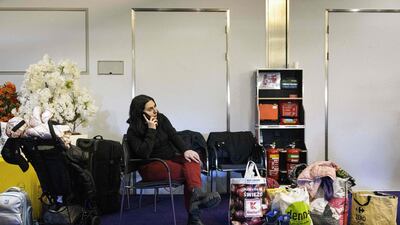
A Ukrainian refugee waits to be given shelter in Amsterdam, the Netherlands. AFP -
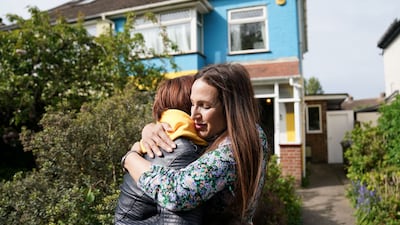
Campaigner Rend Platings, right, embraces her Ukrainian best friend Kristina Korniiuk as they are reunited outside her home in Cambridge. Ms Platings went on hunger strike until MsKorniiuk's UK visa was approved and painted her house in the colours of the Ukrainian flag. PA -
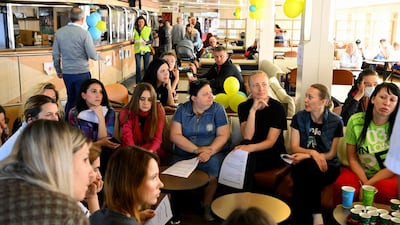
Ukrainian women attend a job-seekers' meeting aboard the 'Mediterranee' ferry, where they are living while it remains docked in Marseille, southern France. AFP -
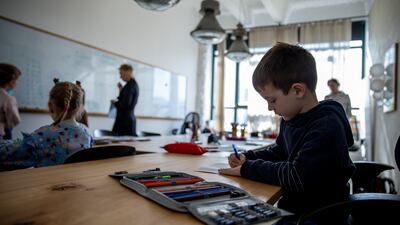
Refugee schoolchildren are given Ukrainian primary school education in Berlin, where they also have the choice of attending German schools. Getty -
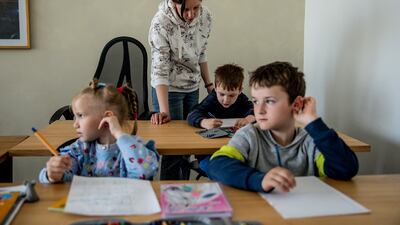
Teacher Katja with Artem, Sofia and Alexander, refugee schoolchildren who are receiving Ukrainian curriculum primary school education in Berlin, Germany. Getty -
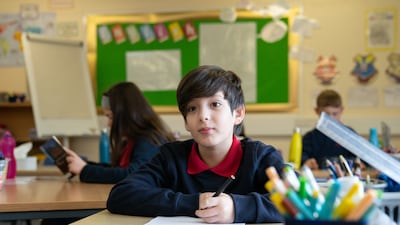
Ukrainian refugee Alikhan Yusupov, 10, on his first day at Caldecote Primary School after his family fled their home in Kharkiv and moved to Cambridgeshire, England. PA -
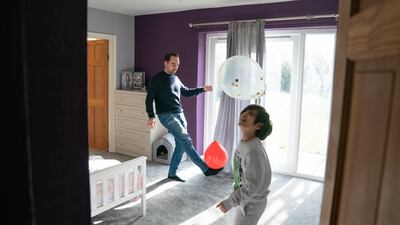
Roman Starkov plays with nephew Alikhan as they settle into their new home in Caldecote, near Cambridge, after they fled Kharkiv. PA -
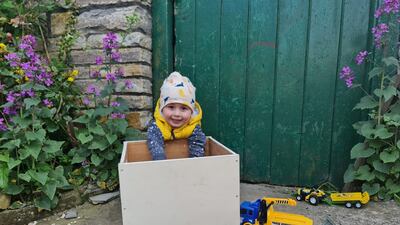
Ukrainian refugee Egor Svichkar, 3, whose family now live with a British host. PA -
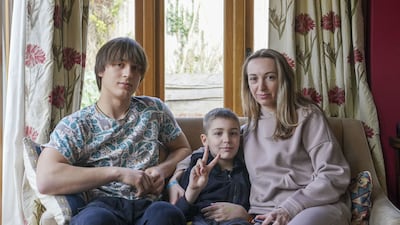
Ukrainian refugees Yaroslav Kryvoshyia and Irina Kryvoviaz, with her son Sasha as they settle into their new home in North Moreton, Oxfordshire. PA -
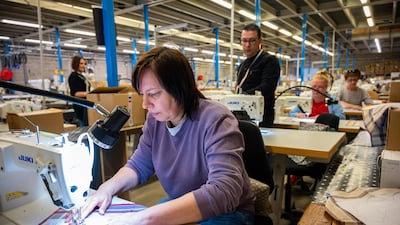
An Ukrainian refugee woman sews in Strasbourg, France, part of project for Ukrainian refugees to find jobs after fleeing the war. AFP -
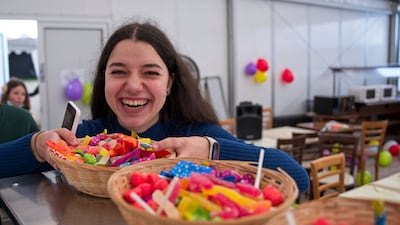
Ukranian refugee Karolina, 16, laughs as she prepares for a party at the La Ville-aux-Dames camp site, her family's temporary home in La Ville-aux-Dames, central France. AFP -
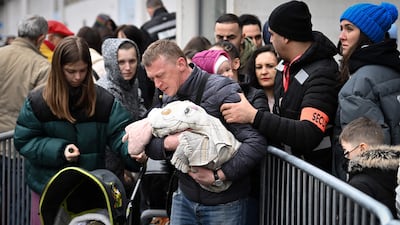
Ukrainians queue outside a refugee centre in Paris. AFP -
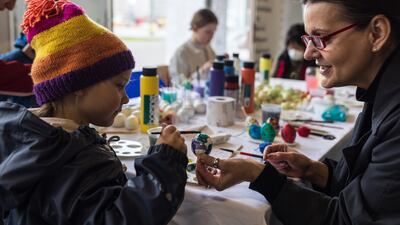
Myroslava Perevalska (R), an artist who fled Kyiv, helps a Ukrainian girl paint Easter eggs in Berlin. Getty Images -
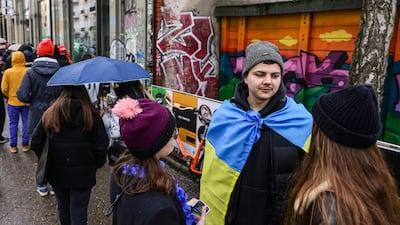
The 'Beacon of Ukraine', a gathering at Markthalle Neun in Berlin, bringing together refugees and NGOs as well as showcasing Ukrainian culture. Getty Images -
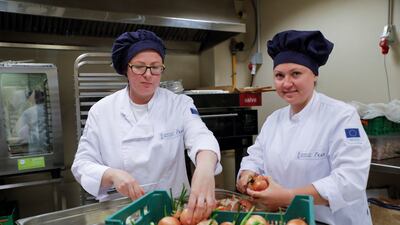
Larysa Biachenko, 40, who does not know if her house in Chernihiv is still standing, and Svitlana Lykhonos, 43, who was the owner of a hotel restaurant in Frankiusk, peel onions at a special cooking course run by the regional government to offer them a job opportunity, in Alicante, Spain. Reuters -
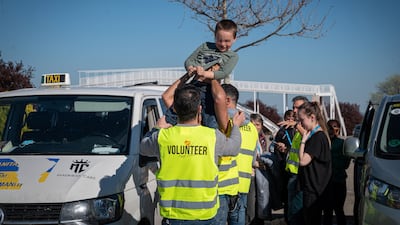
A convoy of Ukrainian refugees who left Mariupol, accompanied by 17 volunteers, arrive at Juan Carlos I park in Madrid. EPA -
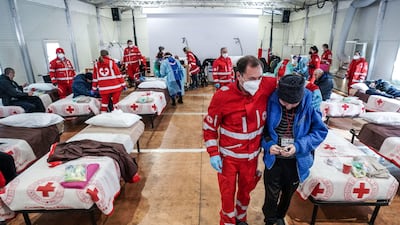
Ukrainian refugees, who arrived in Italy from Lviv after two weeks of travel, are tended to in the reception centre of the Red Cross in Settimo Torinese, near Turin. EPA


Although Ukraine changed its law last year to offer temporary residency permits to some stateless people, UN refugee agency UNHCR said only 55 people had been recognised in this way by the end of 2021.
Many people of Roma origin in Ukraine do not have passports and often lack any other paperwork linked to property or employment, meaning they struggle to obtain an official ID, the agency said.
Aid groups called on the EU to address these problems by changing its operational guidelines to member states, the 16-page document that tells them how to implement the rules.
The current document says stateless people must have a valid Ukrainian residency permit and that their families are not automatically eligible for protection, although individual countries may choose to offer this.
Activists want the guidance to be updated so that countries are encouraged to use a “margin of appreciation” to offer humanitarian protection to stateless people.
Such people should also be able to prove that they lived in Ukraine by showing other documents if they do not have a residency permit, Ms Johansson was told.
“Now is a critical moment for the European Union and its member states to put into action their international and regional commitments to protecting the rights of stateless persons,” the letter said.

