

Live updates: follow the latest news on Russia-Ukraine
Airline pilots were warned on Thursday of a heightened danger to civilian aircraft due to the war in Ukraine, including the chance of mid-air collisions in busy neutral corridors and passenger jets being misidentified as warplanes.
European Union aviation chiefs said it was “easy to see the potential” for civilian planes being hit by missiles in the “confused arena of warfare”, where both sides report having taken out hundreds of enemy aircraft.
Malaysian Airlines passenger jet MH17 was shot down over eastern Ukraine in 2014 on its way from the Netherlands to Kuala Lumpur, killing 298 people. Dutch authorities blamed that incident on Russia for allegedly supplying the fatal missile to separatists.
EU agency EASA said security risks were heightened by potential cyber attacks, the jamming of navigation equipment and the danger of civilian aircraft accidentally straying into military airspace.
But it said the risks went beyond a clumsy missile strike, also encompassing the potential effect of sanctions on the airworthiness of civilian planes.
Russia and the EU have closed their airspace to each other’s planes, forcing them into long detours, while western sanctions have restricted trade and Russia has passed a law allowing it to impound foreign jets.
Planes stranded in Russia could be cannibalised for parts without meeting proper safety standards, aviation chiefs said, while spare parts might become scarce or expensive and affect maintenance.

The airspace closures also mean pilots will have to fly routes with which they are less familiar, the six-page safety assessment said, and might become more tired due to having to avoid Russia’s vast airspace.
Experts are especially concerned about this since some pilots long kept away from the cockpit by coronavirus restrictions may find themselves “returning from furlough into a more complex operating environment” caused by the war.
The detours also mean that air crew could be exposed to more cosmic radiation, which comes from space, due to being in the air for longer hours or rerouting their trips closer to the more exposed North Pole.
On top of that, Russia’s ban from EU airspace means there is only a small sliver of the Baltic Sea, between Finnish and Estonian waters, where Russian planes can pass from the mainland to the enclave of Kaliningrad.
Flights over the neutral waters have increased significantly, increasing the workload for air traffic controllers and meaning that “unidentified aircraft using these routes can conflict with other traffic”, the document said.
-
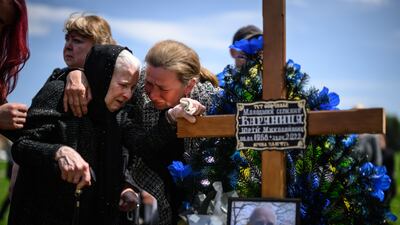
Family members mourn at the graveside of soldier Yuri Varyanytsia during the burial of three soldiers in the Field of Mars at Lychakiv cemetery in Lviv, Ukraine. Getty Images -

A pedestrian takes a picture as she walks past the wreckage of a Russian armoured vehicle outside the National Museum of Military History of Ukraine in Kyiv. AFP -
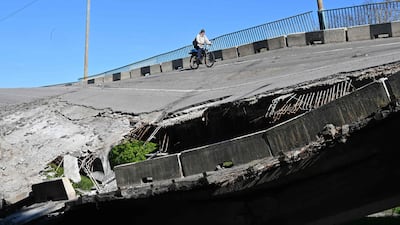
A man rides his bicycle over a heavily damaged bridge near Pechenegi village in the Kharkiv region, amid the Russian invasion of Ukraine. AFP -
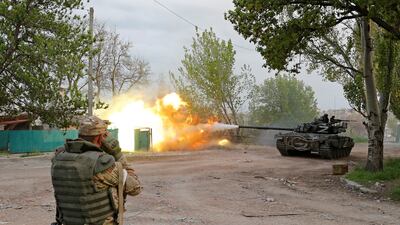
Pro-Russian troops fire from a tank near the Azovstal steel plant in Mariupol. Reuters -
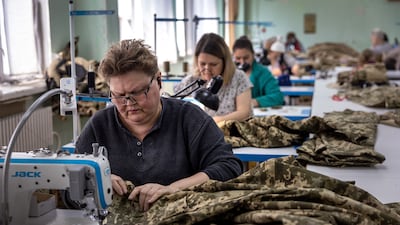
Workers sew uniforms and material for flack jackets at a military clothing factory in Kryvyi Rih, Ukraine. Getty Images -
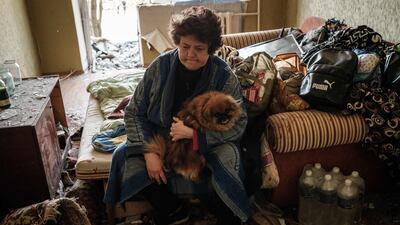
A dog provides company at a flat damaged by a missile attack in Kramatorsk, eastern Ukraine. AFP -

Patron, a dog trained by Ukrainian forces to sniff out explosives, near Kyiv. EPA -
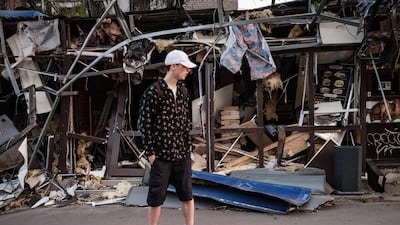
Lone skater Roman Kovalenko, 18, amid the damage at Peace Square in Kramatorsk, eastern Ukraine. All of his friends have fled. AFP -
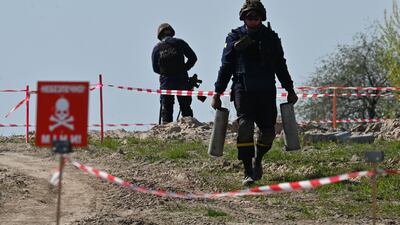
A Ukrainian sapper carries unexploded materiel during demining works at an airport in the town of Hostomel, north-west of Kyiv. AFP -
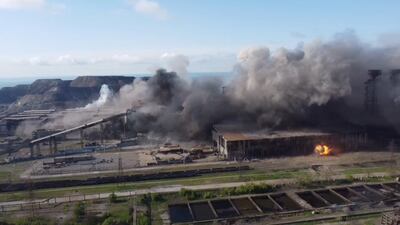
Shelling of the Azovstal steel plant complex in Mariupol. Reuters -

Violinist Irene Duval rehearses before a fundraiser to support Ukrainians arriving in the UK, at the Ukrainian Catholic Cathedral in London. PA -
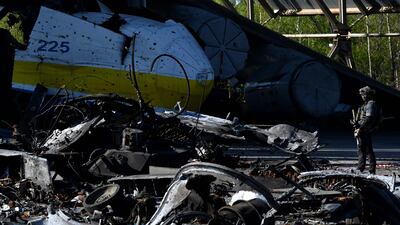
A serviceman stands guard at the destroyed Ukrainian Antonov An-225 'Mriya' cargo aircraft in Hostomel. AFP -
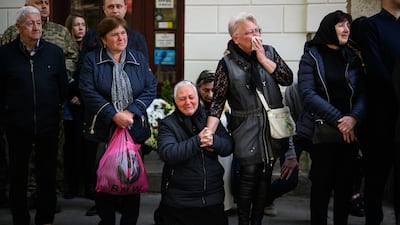
Galina Malets falls to her knees before the funeral service for her brother, fallen soldier Igor Malets, 59, in Lviv. Getty -
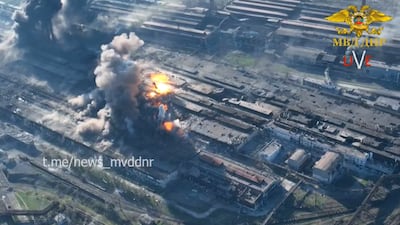
Explosions at the Azovstal steel plant in besieged Mariupol, where Ukrainian forces continue to hold out against Russian invaders. AFP -
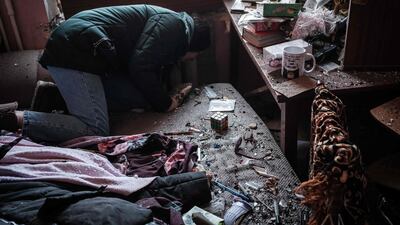
A Ukrainian woman collects her belongings after her apartment was damaged by a missile explosion in Kramatorsk, eastern Ukraine. AFP -
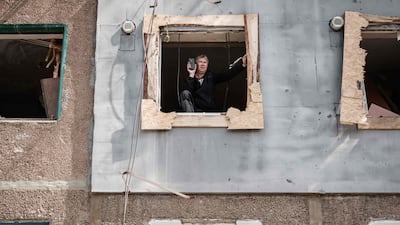
An apartment block damaged by a missile explosion in Kramatorsk, eastern Ukraine. AFP -
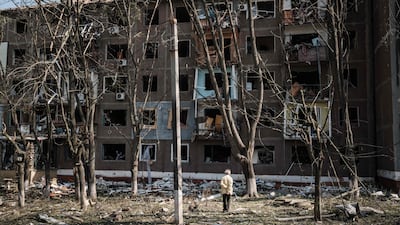
Devastation around an apartment block hit by a missile in Kramatorsk, eastern Ukraine. AFP -
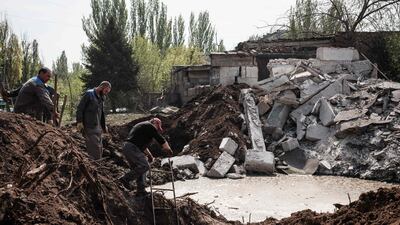
Ukrainian men at the site of a missile explosion in Kramatorsk, eastern Ukraine. AFP -
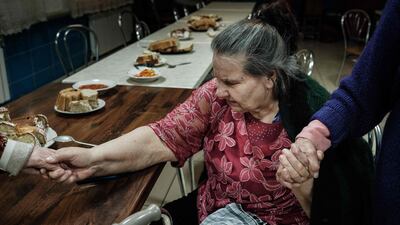
An elderly refugee from Avdiivka, eastern Ukraine, at a lunch provided by church group Awakening in Pokrovsk. AFP -
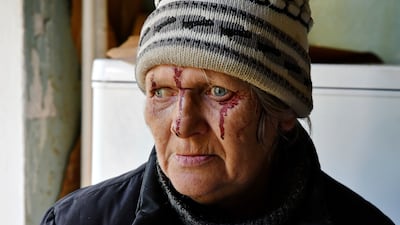
Natalia Rudneva, 59, was injured in overnight shelling in Kramatorsk, Ukraine, that put her son in hospital. AP -
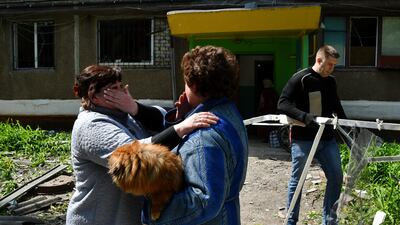
Shocked occupants of an apartment building in Kramatorsk, Donbas, that was destroyed by overnight shelling . AP -

A man outside his house in Mariupol, in territory under the government of the so-called Donetsk People's Republic, eastern Ukraine. The sign reads 'Bomb shelter, children'. AP -
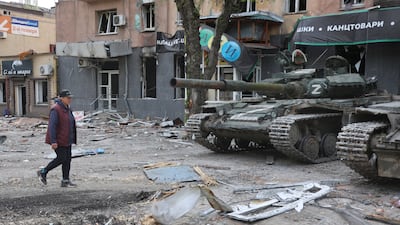
A woman passes Donetsk People's Republic militia tanks in Mariupol, eastern Ukraine. AP -
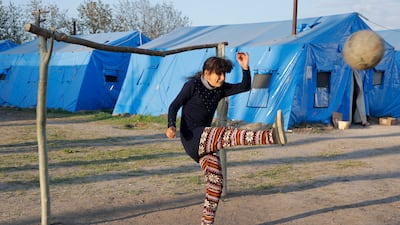
A refugee camp outside Mariupol, in territory controlled by the government of the so-called Donetsk People's Republic. AP -
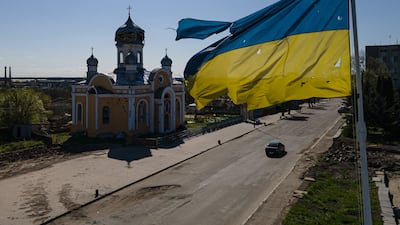
The damaged St Godmothers Cover Church next to a bullet-riddled Ukrainian flag in Malyn, Ukraine. Getty Images -
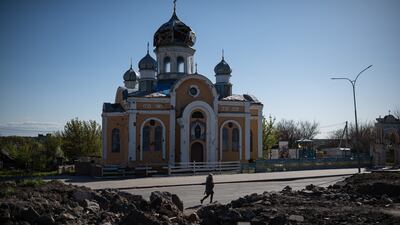
St Godmothers Cover Church, in Malyn, Ukraine. Getty Images -
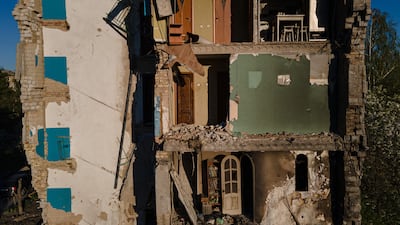
The ruins of an apartment building in Borodianka, Ukraine. Getty Images -
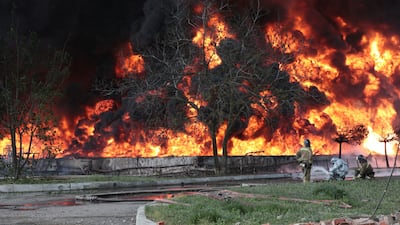
Firefighters from the self-declared Donetsk People Republic Emergency Situations Ministry battle a blaze at an oil depot after missiles struck the facility in an area controlled by Russian-backed separatist forces in Makiivka, 15 kilometres east of Donetsk, eastern Ukraine. AP -
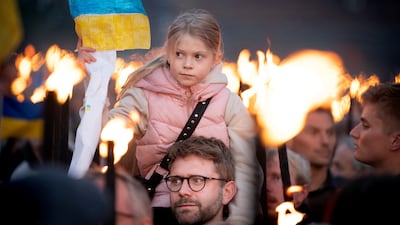
People wait for Ukrainian President Volodymyr Zelenskyy to begin a speech televised on a screen in City Hall Square in Copenhagen, Denmark. Reuters -
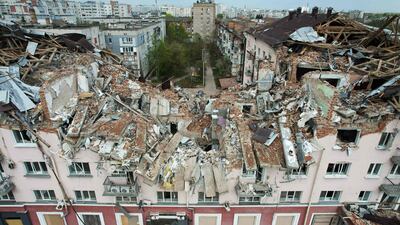
An aerial view of the destroyed Hotel Ukraine in the northern city of Chernigiv. AFP -
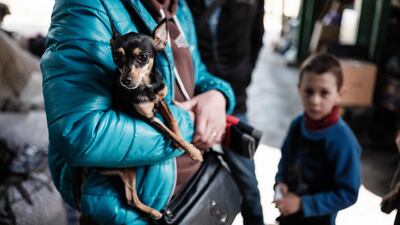
A woman who recently lost her husband arrives with her dog at a charity centre in Pokrovsk, eastern Ukraine. AFP -
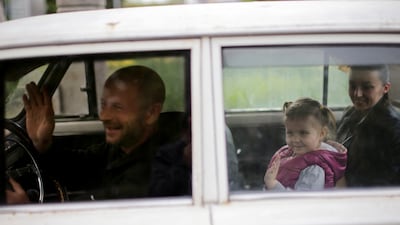
A family of Ukrainian evacuees near a donation collection point in Zaporizhzhia, Ukraine. Reuters -
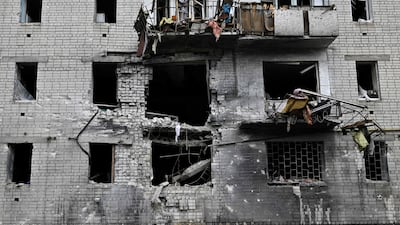
The ruins of a residential building in the northern Ukrainian city of Chernigiv, which was heavily damaged during the Russian invasion. AFP -

People pay their respects during the funeral for Ukrainian serviceman Ruslan Borovyk in St Michael's Cathedral in Kyiv. AP -
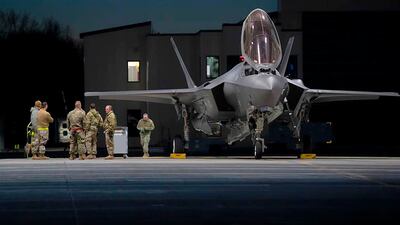
Crew chiefs and engineers with the 158th Fighter Wing meet before launching F-35A Lightning II fifth-generation aircraft at the Vermont Air National Guard Base, South Burlington, US. More than 200 Vermont air guard personnel, plus equipment and eight F-35s, are now in Europe. AP -
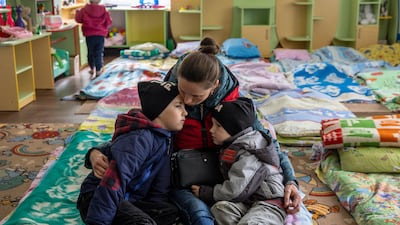
Svitlana, 36, holds her sons Artem, 7, and Kyrylo, 5, while sheltering in a kindergarten in Kryvyi Rih, Ukraine. Getty Images -
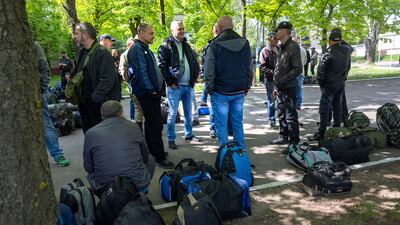
Men report to enlist in Ukrainian Territorial Defence Force units in Kryvyi Rih, Ukraine. Getty Images -
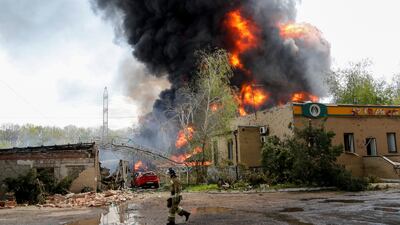
A burning oil storage unit on the outskirts of Donetsk, Ukraine. Reuters -
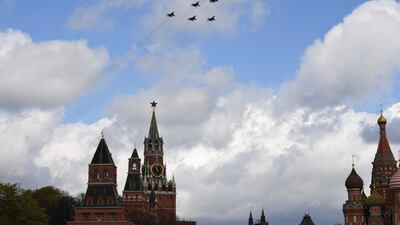
Russian MiG-29SMT jet fighters, forming the symbol Z in support of Russian military action in Ukraine, fly over Red Square in Moscow during a rehearsal for the Second World War Victory Parade on May 9, 2022. AFP -
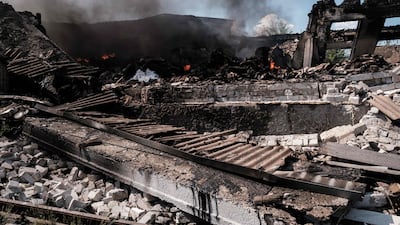
A warehouse after shelling in Severodonetsk, as fighting rages across Ukraine's east after a US warning that Moscow is preparing to formally annex eastern regions. AFP -

Katya, 11, waits for her mother's treatment to end at the Severodonetsk Hospital in Severodonetsk. AFP -
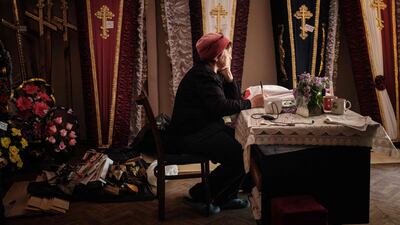
Antonina, 60, at a funeral home where she works and now lives with neighbours in Severodonetsk. AFP -
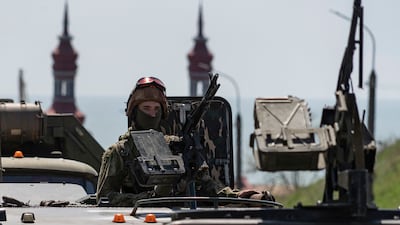
A Russian serviceman patrols a street near the sea port of Berdyansk, Ukraine. AFP -
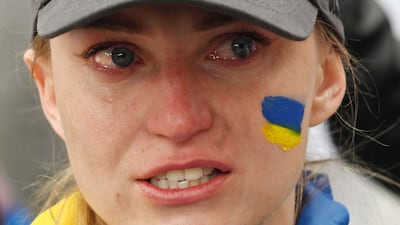
A woman during the rally in front of Ukraine President Volodymyr Zelenskyy's office in Kyiv. AFP -
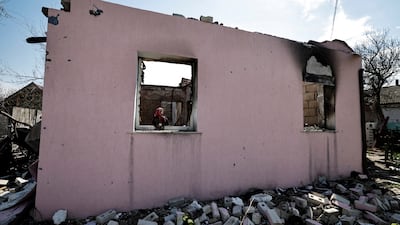
Svitlana Karpenko, 53, at what is left of her house in Sloboda, Chernihiv region, Ukraine. She said it was destroyed by shelling. Reuters -
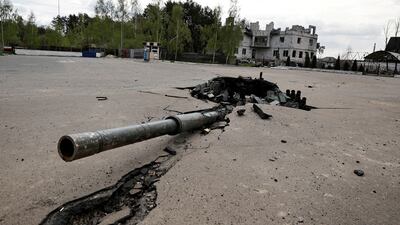
The turret from a destroyed Russian tank stuck in the ground in Zalissia, Kyiv region, Ukraine. Reuters -
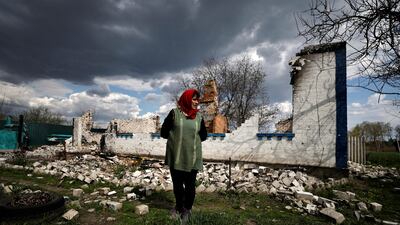
Lyubov Lenko, 61, in front of her house in Budy, Chernihiv region, Ukraine, that she says was destroyed by shelling. Reuters -
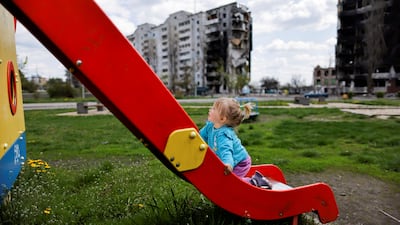
Nina Stefuryak, 2, playing in a park in front of a building destroyed by shelling in Borodianka, Kyiv region, Ukraine. Reuters -
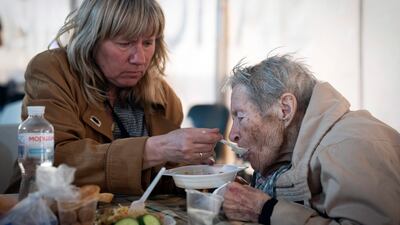
Mealtime at a centre for displaced people in Zaporizhzhia. AP -
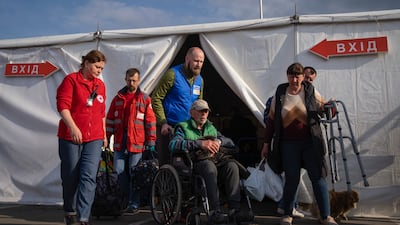
Volunteers assist a man after his arrival from Mariupol at a centre for displaced people in Zaporizhzhia. AP -
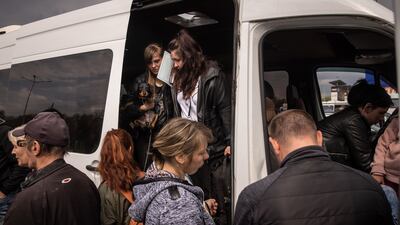
People disembark a van to be registered by police after arriving in Zaporizhzhia. Getty Images -
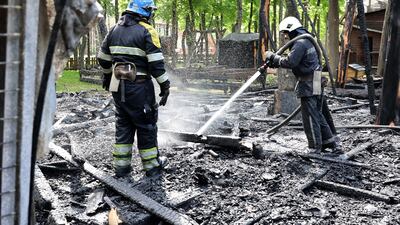
Firefighters damp down the ashes of a fire that destroyed a children's play area in Gorky Park in Kharkiv, Ukraine. EPA -

A woman touches a piano as she inspects the damage in a classroom after shelling at Kharkiv National Kotlyarevsky University of Arts. EPA -

US President Joe Biden and Lockheed Martin chief executive Jim Taiclet with Javelin anti-tank missile assembly workers during a tour of a Lockheed Martin weapons factory in Troy, Alabama, US. Reuters -
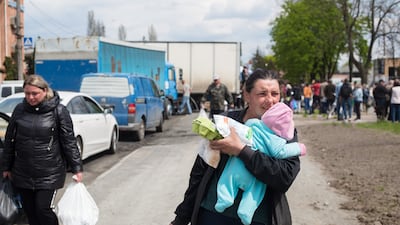
Residents collect humanitarian aid in Borodyanka, Ukraine. Getty Images


Ukraine says it has taken out 196 Russian planes, 312 drones and 155 helicopters during the conflict, while Russian generals report similar numbers of Ukrainian aircraft have been destroyed.
In another setback for air travel, German airline Lufthansa said on Thursday that ticket prices were likely to rise because of the soaring cost of energy.
The price of jet fuel is climbing “too high to be offset by additional cost reductions”, Lufthansa’s chief financial officer Remco Steenbergen told a press conference, meaning ticket prices will have to rise.
Nonetheless, chief executive Carsten Spohr said the airline was projecting a record summer for tourist activity as passengers numbers bounce back from the pandemic.

