


Illegal crossings at the European Union’s external borders have reached their highest level since 2016 in a surge mostly unrelated to the war in Ukraine, EU border agency Frontex has said.
The agency instead blamed busy migration routes in the Mediterranean, the English Channel and the Western Balkans for the 57 per cent increase in crossings since last year, when much of Europe was under coronavirus restrictions.
Ukrainians fleeing the Russian invasion are considered legal refugees because they are eligible for protection at the EU’s borders, although a small number made irregular crossings away from official border posts.
Europe’s welcoming stance towards Ukrainians has prompted criticism over less favourable treatment given to refugees fleeing conflict and poverty elsewhere in the world.
Syrians and Afghans were the main groups attempting to enter the EU via the Western Balkans, said Frontex, which has dozens of guards stationed on the territory of non-member Serbia.
About 18,300 people sought to enter the EU via that route in the first quarter of this year, the agency said, more than double the number in early 2021 and almost half of the total across Europe.
The total of 40,300 made the period from January to March “the busiest in terms of illegal border crossings at the EU’s external borders since the migratory crisis in 2016,” a Frontex statement said.
About 7,000 of them crossed the Eastern Mediterranean, mainly arriving in Cyprus, whose government accuses Turkey of encouraging refugees in the northern part of the island to cross the buffer zone.
Nigerians and Congolese people were the main nationalities on that route, Frontex said, while people from Morocco and Guinea were the main groups trying to reach Spain’s Canary Islands in the Atlantic Ocean.
The 5,900 crossings on that West African route were about 70 per cent up compared with last year, although they were down in March.
Meanwhile, the number seeking to cross the Channel from France to Britain nearly trebled to 8,900 in the first quarter — although about half of these were stopped from departing.
This roughly tallies with Britain’s figures that showed more than 5,000, representing the other half, had reached English shores as of mid-April.
The UK and France blame each other for failing to the prevent steady flow of people across the Channel. Twenty-seven people died when their boat capsized last year.
Britain last week announced plans to deter migrants on that route, saying it would send them to Rwanda if they arrive illegally. The proposals were condemned by religious and humanitarian figures, among others.
-
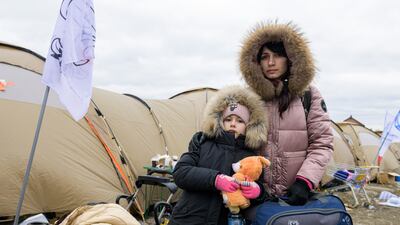
Mykhaila and her daughter from Loubny, central Ukraine, travelled by train to the Ukrainian city of Lviv then took a bus to Medyka on the Polish border, before walking across. Photo: DEC -

Women hold hands at the Medyka border crossing point, through which thousands of Ukrainian refugees have passed. Photo: DEC -
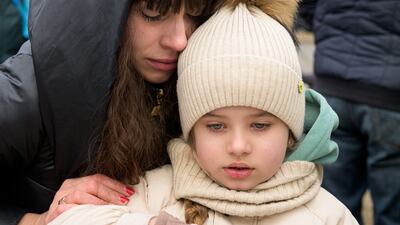
Angelika, 27, and her daughter Diana, 4, from Khmelnytskyi in Ukraine arrive at a reception centre on the outskirts of Przemysl, Poland. Photo: DEC -

Maria, 38, from Chernihiv, left Ukraine with a friend. They came to the Romanian border to wait for another friend before crossing. Photo: Panos Pictures -
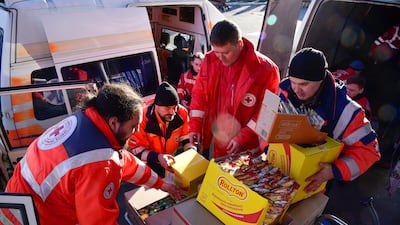
Ukrainian Red Cross staff and volunteers are providing food and other basic necessities to about 8,000 people sheltering in an underground station in Kyiv. Photo: Tebukhukhov Maksym -
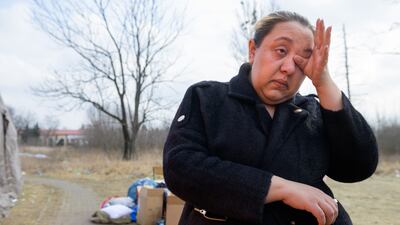
Kristina wipes away tears at Lwowska reception centre on the outskirts of Przemysl, Poland. Photo: DEC -
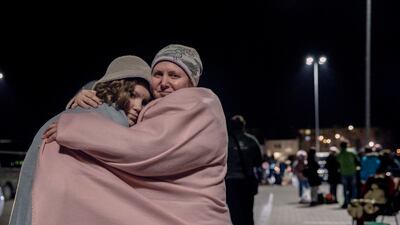
Ira, 45, and her daughter Olena, 12, outside a transit centre in Przemysl, Poland. Photo: Adrienne Surprenant -
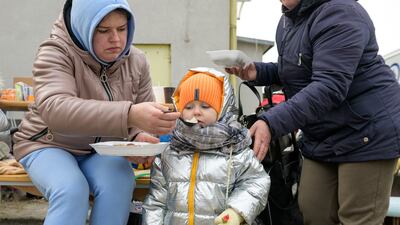
Veronika feeds her son Aleksander at the temporary refugee station in Medyka, eastern Poland. Photo: DEC



