
Live updates: follow the latest news on Russia-Ukraine
A missile hit a crowded train station in eastern Ukraine that was an evacuation point for civilians, killing dozens of people, Ukrainian authorities said on Friday after saying that they expected even worse evidence of war crimes in parts of the country previously held by Russian troops.
Ukrainian President Volodymyr Zelenskyy said that thousands of people were at the train station when the missile struck.
The Russian Defence Ministry denied hitting the station in Kramatorsk, a city in the eastern Donetsk region, but Mr Zelenskyy blamed Russia for the bodies lying in what looked like an outdoor waiting area.
“The inhuman Russians are not changing their methods. Without the strength or courage to stand up to us on the battlefield, they are cynically destroying the civilian population,” the president said on social media. “This is an evil without limits. And if it is not punished, then it will never stop.”
The US and European nations led condemnation of the strike, which killed about 50 people.
The White House decried the “horrific and devastating images”, in which blood smears as well as abandoned suitcases and backpacks littered the ground.
A Pentagon official said that the strike was carried out by Russia using a short-range ballistic missile known as an SS-21.
The US will continue to support Ukraine against Russian aggression, White House spokeswoman Kate Bedingfield told CNN.
UK Prime Minister Boris Johnson said the attack on fleeing civilians at the Kramatorsk train station was “unconscionable”, as he suggested Russian President Vladimir Putin's forces were guilty of a war crime.
-
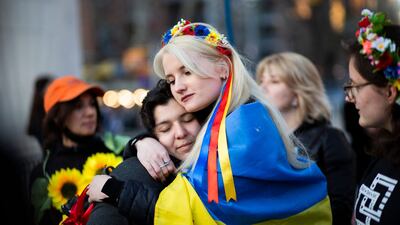
Women, wrapped in a Ukrainian flag, embrace during a flash mob protesting sexual abuse by Russian soldiers in Ukraine, at Washington Square Park in New York. AFP -
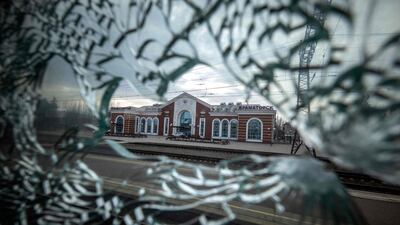
The train station, seen from a train car, after a rocket attack in Kramatorsk, eastern Ukraine. A rocket attack on the station in the eastern Ukrainian city killed 52 people as civilians raced to flee the Donbas region bracing for a feared Russian offensive. AFP -

Antonina Kaletnyk waits for the body of her son in front of a collapsed building in the town of Borodianka, north-west of Kyiv. AFP -

A vehicle drives past a hole on a damaged bridge, on the outskirts of Kyiv. AFP -

A segment of a large rocket with the words "for our children" in Russian is pictured next to the main building of the train station in Kramatorsk. EPA -
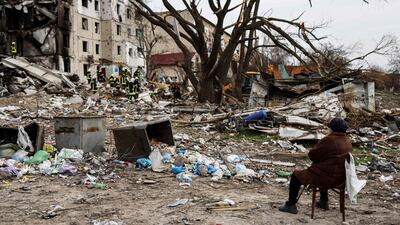
Antonina Kaletnyk waits for the body of her son in front of a collapsed building in the town of Borodianka, northwest of Kyiv. AFP -
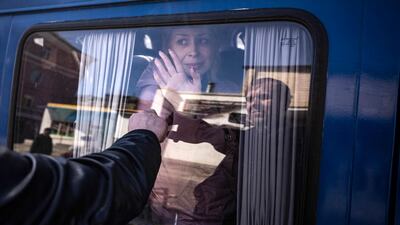
A woman waves goodbye to her husband as she leaves on a bus, a day after the rocket attack at a train station in Kramatorsk. AFP -

European Commission President Ursula von der Leyen, Ukrainian President Volodymyr Zelenskyy and EU foreign affairs envoy Josep Borrell during their meeting in Kyiv, Ukraine. EPA -
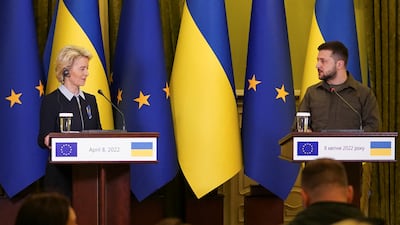
European Commission President Ursula and Ukrainian President Volodymyr Zelenskyy attend a news conference in Kyiv. Reuters -
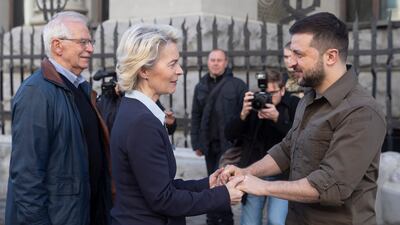
Ms von der Leyen shakes hands with President Zelenskyy as Mr Borrell looks on during their meeting in Kyiv. EPA -
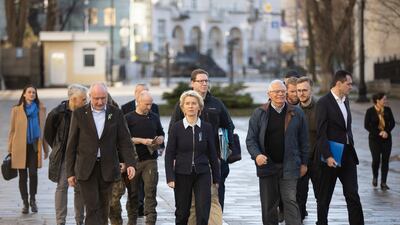
Ms von der Leyen and Mr Borrell before their meeting with President Zelenskyy in Kyiv. EPA -
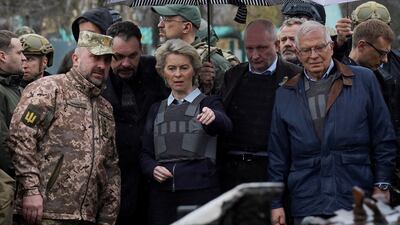
Ms von der Leyen, Mr Borrell and Ukraine's Prime Minister Denys Shmyhal visit the town of Bucha, outside of Kyiv, Ukraine. Reuters -
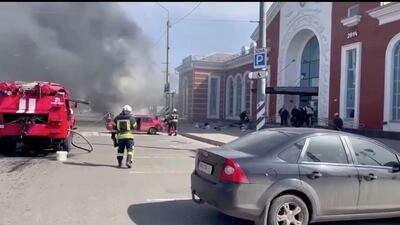
Smoke rises after Russian shelling at the railway station in Kramatorsk, in the Donbas region of Ukraine. AP -
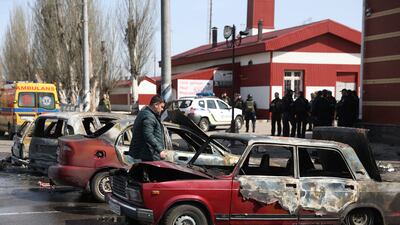
Burnt vehicles are seen in the aftermath of a rocket attack on the railway station in Kramatorsk. AFP -

Policemen at the scene in Kramatorsk. AFP -
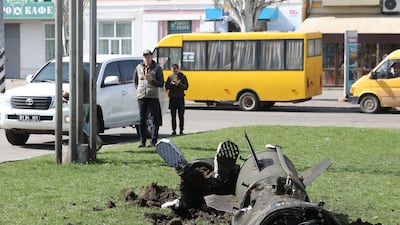
The remnants of a rocket after the deadly strike in Kramatorsk. AFP -
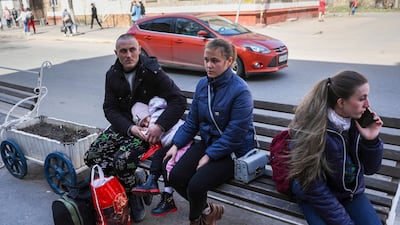
Survivors of the attack sit on a bench outside the station. AFP -
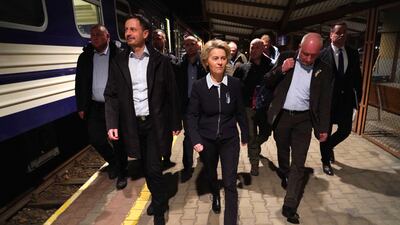
European Commission President Ursula von der Leyen departs for Kyiv in Przemysl, Poland. Reuters -

A man wheels his bicycle past a destroyed tank in Chernihiv. AP -
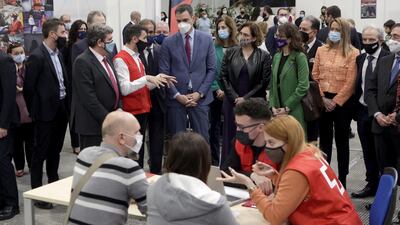
Spanish Prime Minister Pedro Sanchez and Barcelona Mayoress Ada Colau visit the refugee centre set up at Fira de Barcelona for the care, temporary reception and referral of Ukrainian citizens fleeing the war. EPA -
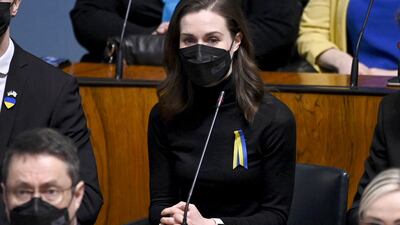
Finnish Prime Minister Sanna Marin follows the address of Ukrainian President Volodymyr Zelenskyy via video link at the Finnish Parliament in Helsinki. AFP -
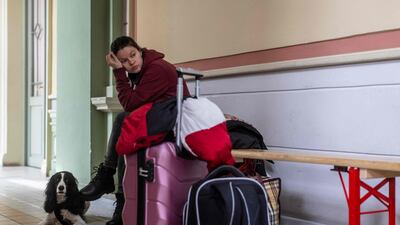
A young refugee from Ukraine and a dog wait in the ticket hall of the railwlay station in Przemysl, eastern Poland, which has become a hub for refugees from Ukraine fleeing their country due to Russia's aggression. AFP -
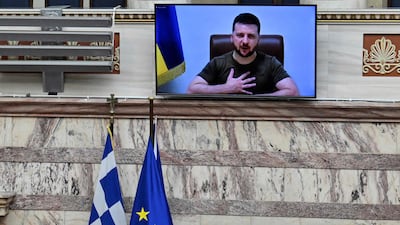
Ukraine's President Volodymyr Zelenskyy thanks MPs after his virtual address to the Greek Parliament in Athens. AFP -
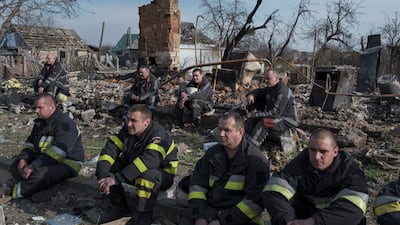
Firefighters take a rest after working at the site of buildings that were destroyed by shelling, amid Russia's invasion of Ukraine in Borodyanka, in the Kyiv region, Ukraine. Reuters -

Martin Griffiths, Under-Secretary-General for Humanitarian Affairs and Emergency Relief Coordinator, poses for a picture during an interview with The Associated Press during an interview in Kyiv, Ukraine. AP -
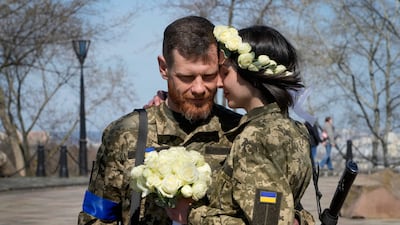
Ukrainian soldiers Anastasia and Vyacheslav embrace prior to their wedding ceremony in a city park in Kyiv, Ukraine. AP -
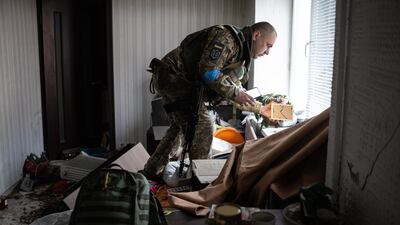
Yurii, 41, who serves in the Ukrainian military, grabs a wedding photograph from his apartment in Hostomel, Ukraine. Getty Images -
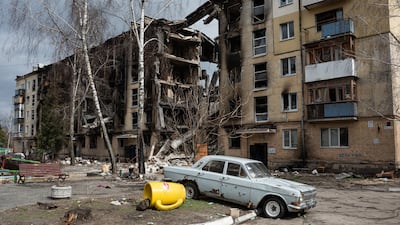
A damaged car is seen next to a heavily damaged apartment building in Hostomel, Ukraine. Getty Images -
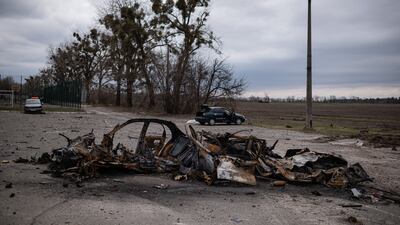
Burnt cars are seen next to a field in Hostomel, Ukraine. Getty Images -
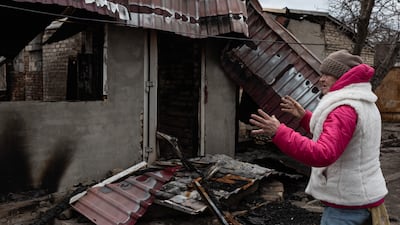
Svitlana, 62, shows a heavily damaged house in the residential area, in Hostomel, Ukraine. Getty Images -

Ukrainians, who fled to Mexico amid the Russian invasion of their homeland, enjoy the performance of a mariachi band at the Benito Juarez sports complex, set up as a shelter by the local government, after arriving in Tijuana to enter the U. S. , in Tijuana, Mexico. Reuters -
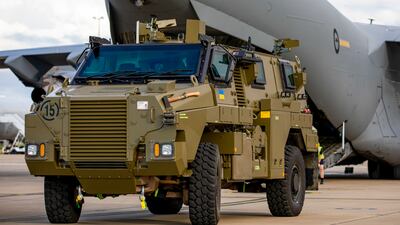
A Bushmaster protected mobility vehicle bound for Ukraine waits to be loaded onto a C-17A Globemaster III aircraft at RAAF Base Amberley, Australia. AP -
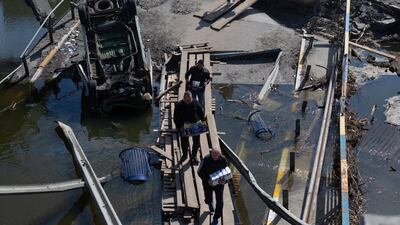
Residents and volunteers cross the destroyed bridge to the city with supplies in Irpin, Ukraine. Getty Images -
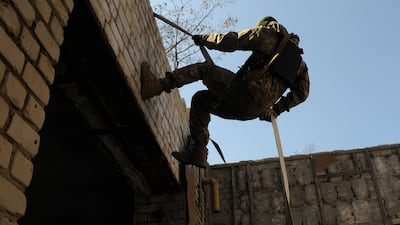
A Ukrainian serviceman attends a training session in Kharkiv outskirts, Ukraine. AP -

A Ukrainian serviceman walks on a destroyed Russian fighting vehicle in Bucha, Ukraine. AP -
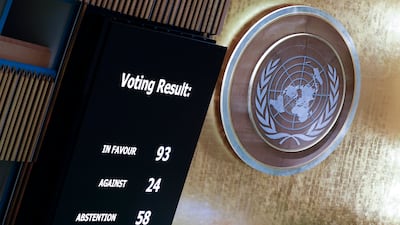
Screens show results from voting by the UN General Assembly in New York as member countries pass a resolution to suspend Russia from the Human Rights Council after Moscow's invasion of Ukraine. EPA -

The shell of a theatre destroyed in the southern Ukrainian port city of Mariupol. Reuters -
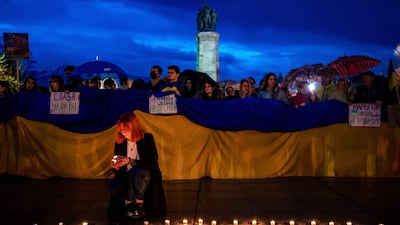
A woman lights candles during a demonstration to support Ukraine in downtown Sofia. AFP -

Territorial Defence fighters are trained near Kharkiv. EPA -
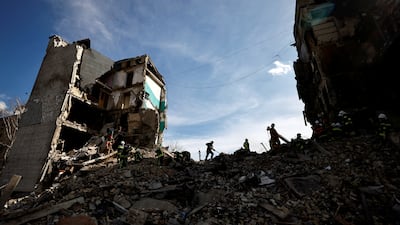
Rescuers work among remains of residential building destroyed by Russian shelling in Borodyanka, Kyiv region. Reuters -

Smoke rises over the town of Rubizhne, in the Donbas region. AFP -

Ukrainian soldiers sit on an armoured military vehicle in the city of Severodonetsk, Donbass region. AFP -
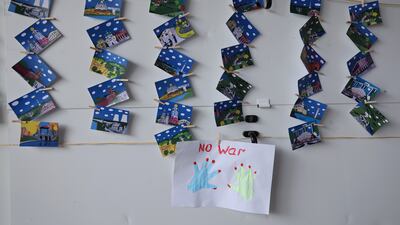
Painted pictures showing Ukrainian cities hang on a wall at "Cafe Ukraine" in Berlin, Germany. Getty -

A Ukrainian refugee's dog arrives on a train from Odesa at Przemysl Glowny train station in Poland. Reuters


“The attack at the train station in eastern Ukraine shows the depth to which Putin's once vaunted army has sunk,” he said.
“It is a war crime indiscriminately to attack civilians and Russian crimes in Ukraine will not go unnoticed or unpunished.”
France's President Emmanuel Macron denounced the “abominable” air strike on the train station, saying France would “support the investigations so that justice is done".
“Ukrainian civilians fleeing to escape the worst. Their weapons? Prams, toy dolls, baggage. This morning at the station in Kramatorsk, families who were leaving experienced horror. Deaths by the dozens, hundreds injured. Abominable,” he said on Twitter.
The EU Council chief Charles Michel directly accused Russia of carrying out the “horrifying” attack, saying “action was needed” and pointing to a fifth wave of sanctions on Russia agreed to on Friday.
“Horrifying to see Russia strike one of the main stations used by civilians evacuating the region where Russia is stepping up its attack,” Mr Michel tweeted.
The regional governor of Donetsk, Pavlo Kyrylenko, said the death toll rose to 50 from the 39 reported earlier as some of the several dozen wounded had died after being taken to hospital or medical centres.
The office of Ukraine’s prosecutor general said about 4,000 civilians were in and around the station, most of them women and children there in response to calls to leave the area before Russian forces arrived.
“The people just wanted to get away for evacuation,” Prosecutor General Iryna Venediktova said while visiting Bucha, a city north of Kyiv, Ukraine’s capital, where journalists and returning Ukrainians discovered scores of bodies on streets and in mass graves after Russian troops withdrew.
Ms Venediktova spoke as workers pulled corpses from a mass grave near a church in spitting rain. Black body bags were laid out in rows in the mud. None of the dead were Russians, she said. Most of them had been shot. The prosecutor general’s office is investigating the deaths as possible war crimes.
Russia resets its sights
After failing to take Ukraine’s capital and withdrawing from northern Ukraine, Russia has shifted its focus to the Donbas, a mostly Russian-speaking, industrial region in east Ukraine where Moscow-backed rebels have been fighting Ukrainian forces for eight years and control some areas. The train station is in government-controlled territory.
Ukrainian officials warned residents this week to leave as soon as possible for safer parts of the country and said they and Russia had agreed to establish evacuation routes in the east.
In his nightly video address, Mr Zelenskyy predicted more gruesome discoveries would be made in northern cities and towns as the Russians depart. He said horrors worse than the ones in Bucha had surfaced in Borodianka, another settlement outside the capital.
“And what will happen when the world learns the whole truth about what the Russian troops did in Mariupol?” Mr Zelenskyy said late on Thursday, referring to the besieged southern port that has endured some of the greatest suffering since Russia invaded Ukraine.
“There, on every street, is what the world saw in Bucha and other towns in the Kyiv region after the departure of the Russian troops. The same cruelty. The same terrible crimes.”
Spurred by reports that Russian forces committed atrocities in areas around the capital, Nato countries agreed to increase their supply of arms after Ukraine’s foreign minister pleaded for weapons from the alliance and other sympathetic countries to help face down an expected offensive in the east.
The mayor of Bucha, Anatoliy Fedoruk, said investigators found at least three sites of mass shootings of civilians during the Russian occupation. Most victims died from gunshots, not from shelling, he said, and some corpses with their hands tied were “dumped like firewood” into mass graves, including one at a children’s camp.
Mr Fedoruk said 320 civilians were confirmed dead as of Wednesday, but he expected more as bodies are found in the city that was home to 50,000 people. Only 3,700 remain, he said.
Ukrainian and several western leaders blame the massacres on Moscow’s troops. The weekly magazine Der Spiegel reported that Germany’s foreign intelligence agency intercepted radio messages between Russian soldiers discussing killings of civilians. Russia falsely claims that the scenes in Bucha were staged.
In a rare acknowledgement of the war’s cost to Russia, a Kremlin spokesman said on Thursday that the country had suffered major troop casualties during its six-week military operation in Ukraine.
“Yes, we have significant losses of troops and it is a huge tragedy for us,” Kremlin spokesman Dmitry Peskov told Sky News.
Mr Peskov also hinted that the fighting might be over “in the foreseeable future”, telling Sky that Russian troops were “doing their best to bring an end to that operation”.
Asked about his remarks on Friday, Mr Peskov said his reference to troop losses was based on the most recent Russian Defence Ministry numbers. The ministry reported on March 25 that 1,351 Russian troops had been killed in Ukraine.
“It is a significant number,” Mr Peskov said during his daily conference call with reporters.
displaced Ukrainian
In anticipation of intensified attacks by Russian forces, hundreds of Ukrainians fled villages in the Mykolaiv and Kherson regions that were either under attack or occupied.
Marina Morozova and her husband fled from Kherson, the first major city to fall to the Russians.
“They are waiting for a big battle. We saw shells that did not explode. It was horrifying,” she said.
Ms Morozova, 69, said only Russian television and radio was available. The Russians handed out humanitarian aid, she said, and filmed the distribution.
Anxious to keep moving away from Russian troops, the couple and others boarded a van that would take them west. Some will try to leave the country, while others will stay in quieter parts of Ukraine.
The UN refugee agency, UNHCR, said that nearly 4.4 million people, half of them children, have left Ukraine since Russia began military operations on February 24 and sparked Europe’s largest refugee crisis since the Second World War.
The International Organisation for Migration estimates that more than 12 million people are stranded in areas of Ukraine under attack.
The United Nations’ humanitarian chief told The Associated Press on Thursday that he was “not optimistic” about securing a ceasefire after meeting with officials in Kyiv and in Moscow this week, given the lack of trust between the sides.
He spoke hours after Russian Foreign Minister Sergey Lavrov accused Ukraine of backtracking on proposals it had made over Crimea and Ukraine’s military status.
Two top European Union officials and the prime minister of Slovakia travelled to Kyiv on Friday, looking to shore up the EU’s support for Ukraine. Prime Minister Eduard Heger said he, EU Commission President Ursula von der Leyen and EU foreign policy chief Josep Borrell have trade and humanitarian aid proposals for Mr Zelenskyy and his government.
Part of that, Mr Heger says, is “to offer options for transporting grains, including wheat”. Ukraine is a major world wheat supplier and Russia’s war on the country is creating shortages, notably in the Middle East.
Western nations have stepped up sanctions, and the Group of Seven major world powers said that they will keep adding punitive measures until Russian troops leave Ukraine.

