


Tatyana Schetkevich never imagined she would become a refugee.
Before Russia invaded Ukraine, she led an exciting life as a personal stylist, organising shopping trips for wealthy women to Milan, Istanbul or Paris.
“I used to put together capsule wardrobes, and now I know what to put in a go bag,” Ms Schetkevich said, wiping a speck of dust from a giant jar of pickled tomatoes as she helps out at MoldExpo centre, a retrofitted Covid hospital now taking in thousands of refugees like herself, in Chisinau, Moldova.
She is one of what the UN says are 4 million Ukrainian refugees now in Europe, most of whom are women and children, as men of fighting age must stay and protect the country from the Russian onslaught.
War is often viewed through the eyes of men — soldiers fighting on the front, while politicians battle for control of the narrative through speeches and summits — but as more and more women stream out of Ukraine, it is falling to them to tell the world how the war is unfolding inside its borders and to highlight their role in forging their country’s future.
Survivor’s guilt

In the early morning hours after the war began, Ms Schetkevich shoved important documents, money, a few changes of clothing and other essentials in a small suitcase — her "go bag" — at the urging of her husband, who then drove her to the border with Moldova, 60 kilometres away.
But as soon as she crossed, she felt more grief than relief.
“Anyone who’s been spared feels this sense of shame,” she said. “You feel ashamed that you’re safe and you feel just terribly useless.”
Watching the news reports of the carnage unfolding in cities such as Mariupol and Kharkiv only deepened that sense of helplessness.
-
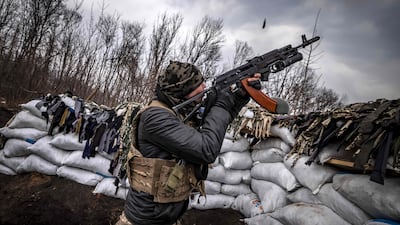
A Ukrainian soldier fires his rifle from a trench at the front east of Kharkiv in the north of Ukraine, which continues to be shelled by Russian forces. AFP -
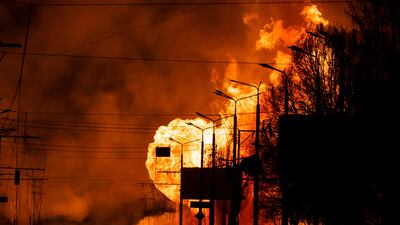
A gas station on fire in Kharkiv after Russian ttack on the northern city. AFP -
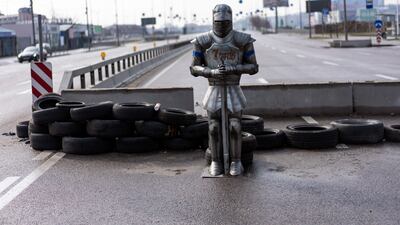
A medieval suit of armour 'stands guard' at a a Ukrainian checkpoint, on the outskirts of the capital Kyiv. AP Photo -
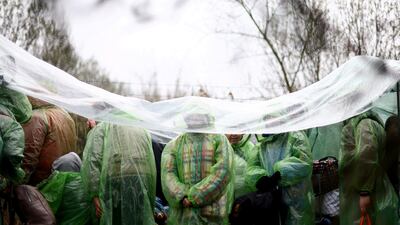
Ukrainian refugees wait in line to cross the border into Poland at Shehyni. Reuters -
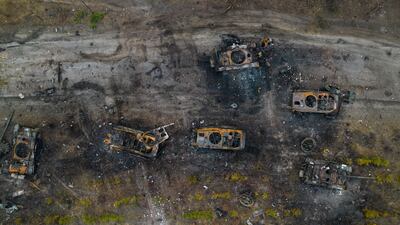
Destroyed Russian armoured vehicles on the outskirts of Kyiv. AP Photo -
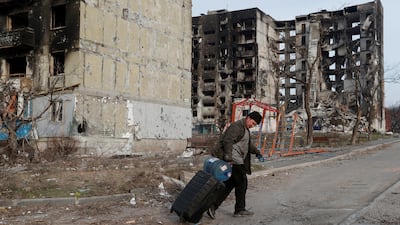
A resident passes apartment buildings destroyed by Russian attacks in the besieged southern port city of Mariupol, Ukraine. Reuters -
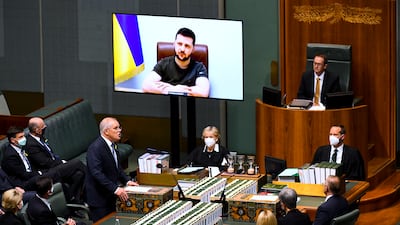
Australian Prime Minister Scott Morrison, standing, welcomes Ukrainian President Volodymyr Zelenskyy to address the House of Representatives via video link at Parliament House in Canberra. Mr Zelenskyy appealed directly to Australian legislators for more help in the war against Russia, including armoured vehicles and tougher sanctions. AP -
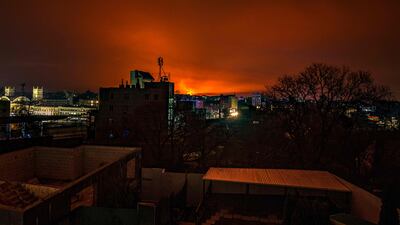
Fire lights up the sky east of Kharkiv, where Ukrainian forces pushed back Russian troops from a motorway outside the country's second-largest city. AFP -
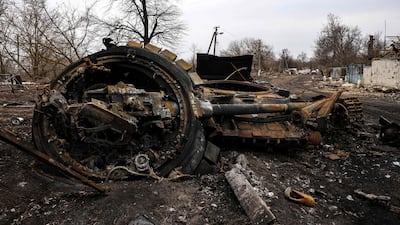
A destroyed Russian tank in the village of Lukianivka near Kyiv. AFP -
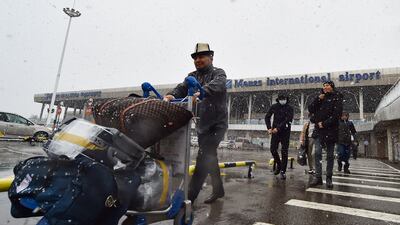
Passengers arriving from Moscow at Manas International Airport, Bishkek, Kyrgyrzstan. Hundreds of thousands of citizens of former Soviet countries in Central Asia are facing difficult choices: shrinking work opportunities in Russia and wages in the weakened rouble versus a return to the homeland where they have family homes, but even fewer job prospects. AFP -
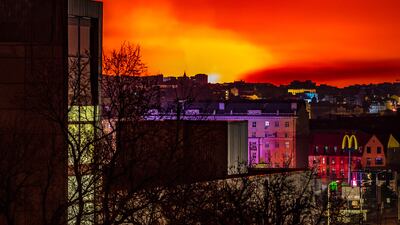
Fire and smoke light up the sky east of Kharkiv as Ukrainian forces push back Russian troops from a motorway outside the country's second-largest city. AFP -
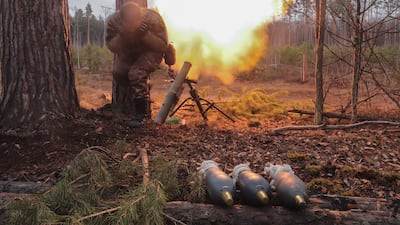
A Ukrainian soldier shoots at the Russian positions not far from the capital Kyiv. EPA -
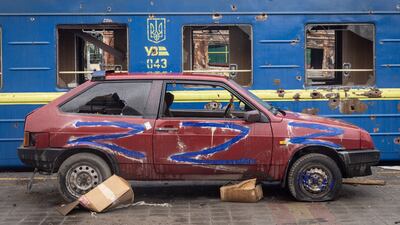
A car marked with the English letter 'Z' is found destroyed at the central Ukrainian train station that was used as a Russian base in Trostyanets. Ukrainian forces said they had retaken the north-eastern town from the Russians. Getty Images -
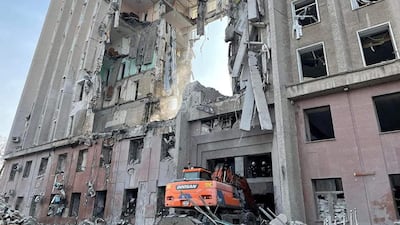
Rescue workers at the site of the regional administration building hit by Russian cruise missiles, in Mykolaiv, Ukraine. Reuters -
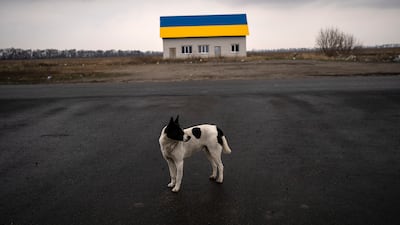
A dog looks at cars passing by on the road near a house painted with the colors of the Ukrainian flag, on the outskirts of the capital Kyiv. AP Photo -
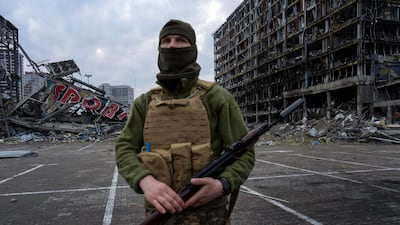
A soldier poses for the picture in Kyiv, Ukraine, while standing guard amid the destruction caused after shelling of a shopping center. AP Photo -
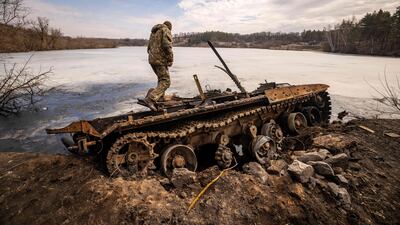
A Ukrainian serviceman stands near a destroyed Russian tank in the north-eastern city of Trostianets. AFP -
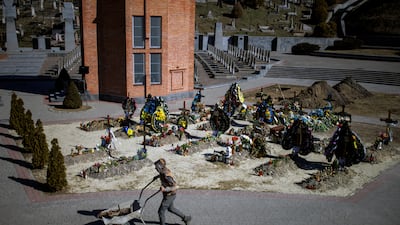
A worker pushes a cart past graves of Ukrainian soldiers who were killed in battle during Russia’s attack on Ukraine, at the Lychakiv cemetery in Lviv. Reuters -
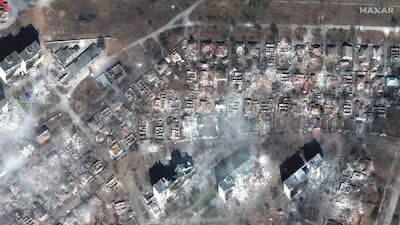
This satellite image provided by Maxar Technologies shows damaged apartment buildings and homes in Mariupol. AP -
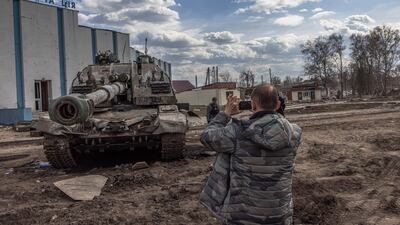
A resident takes photos of a destroyed Russian tank next to the railway station where the Russian forces were stationed, in Trostyanets, a town recaptured by the Ukrainian army. EPA -

A rescuer clears the rubble of a warehouse containing more than 50,000 tons of deep-frozen food in the town of Brovary, north of Ukrainian capital of Kyiv, after it was destroyed by Russian shelling. AFP -
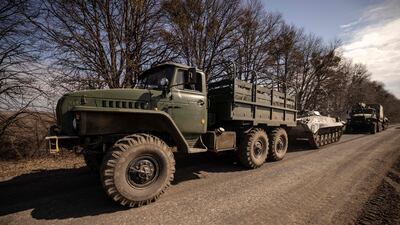
A Ukrainian army vehicle carries a Russian tank in Trostyanets. AFP -
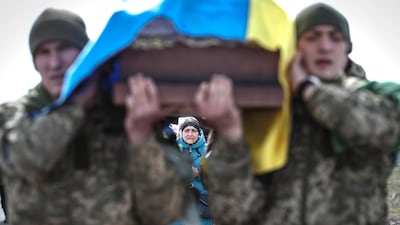
Ukrainian soldiers carry a coffin during the funeral ceremony of a comrade in Odesa. EPA -
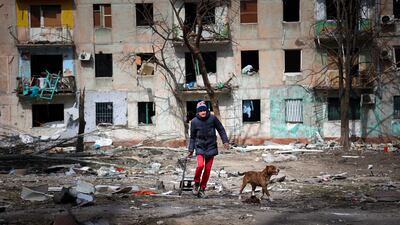
A man walks with his dog near an apartment building damaged by shelling from fighting on the outskirts of Mariupol. AP Photo -
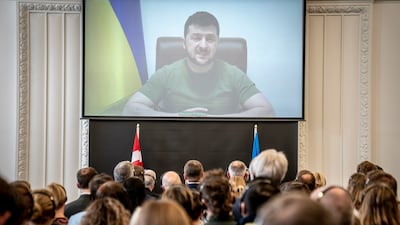
Members of the Danish Parliament attend the Ukrainian President, Volodymyr Zelensky's speech to the Danish Parliament via a video link, at the Christiansborg Castle in Copenhagen, Denmark. EPA -

A satellite image shows crowds outside a Metro grocery store in Mariupol. Reuters -
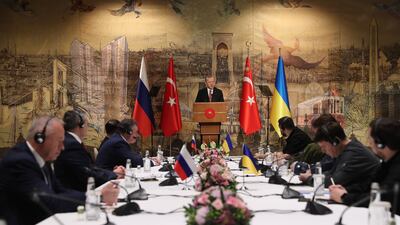
Turkish President Recep Tayyip Erdogan opens Ukrainian-Russian talks in Istanbul. President Erdogan told the delegations that "both parties have legitimate concerns." AFP -
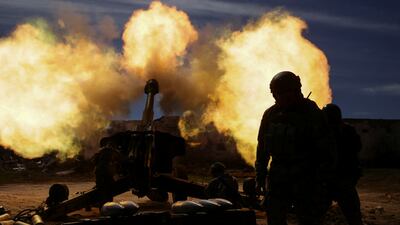
Members of the Ukrainian Volunteer Corps fire a howitzer at a position in the Zaporizhzhia region. Reuters -
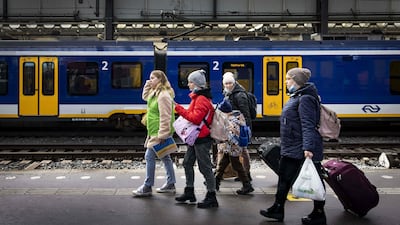
Ukrainian refugees are helped by volunteers upon their arrival at Amsterdam Central station by train from Berlin. AFP -

Ukrainian soldiers ride an armoured people carrier through the town of Trostsyanets, about 400 kilometres east of Kyiv. AP Photo -
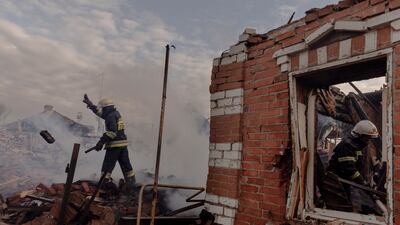
Firefighters work amid the debris of residential houses that were destroyed by Russian shelling in a settlement outside Kharkiv. Reuters -
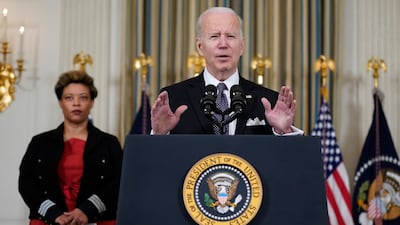
President Joe Biden said that he is not advocating for regime change in Moscow after saying Russian counterpart Vladimir Putin "cannot remain in power." AP Photo -

Firefighters work to extinguish a fire at a warehouse after it was hit by Russian shelling in Kharkiv, Ukraine. More than half of Kharkiv's 1.4 million people have fled the city since Russia's invasion on February 24. Getty Images -
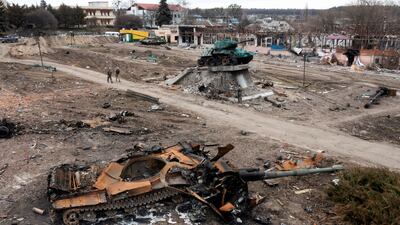
Local residents pass by a destroyed Russian tank in the town of Trostyanets, east of capital Kyiv, Ukraine. The monument to the Second World War is seen in background. AP Photo -
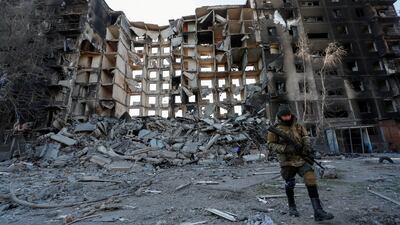
A pro-Russian troop service member walks near a destroyed apartment building in the besieged southern port city of Mariupol. Reuters -
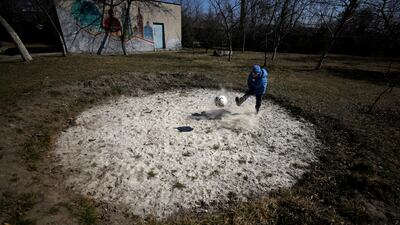
Mykhaylo, 8, who was taken away from his widowed mother along with his 9-year-old brother and 16-year-old sister, plays with a ball in the garden of a state shelter in Lviv. Reuters -

Halyna Falko, 52, talks to reporters while looking at the destruction caused after a Russian attack inside her house near Brovary, on the outskirts of Kyiv. AP Photo -
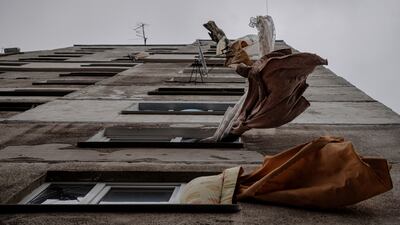
Curtains flutter in the wind at a building that was damaged by shelling in a neighbourhood that has been largely abandoned and left without water, gas and heating, as Russia's attack on Ukraine continues, in Kharkiv, Ukraine. Reuters -

People, mainly women and children, arrive at Przemysl on a train from Odesa in war-torn Ukraine in Przemysl, Poland. The Polish government has said it may spend €24 billion this year hosting refugees fleeing the war in Ukraine, and is seeking more support from the European Union. Getty Images -
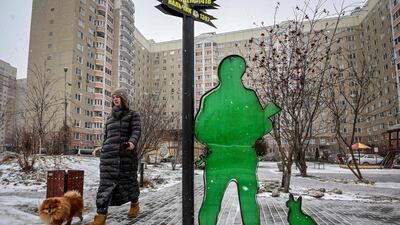
A woman walks a dog past the so-called "people's installation to a Russian soldier" nicknamed the "polite people" created by residents in the backyard of their apartment building in the town of Podolsk, outside Moscow. AFP


“These are peaceful citizens — even if you didn’t go to fight, you could just be sitting at home and you die because they’re bombing regular people. You just get this sense that any interaction with those you love could be the very last time.”
Ms Schetkevich resolved to beat back her helplessness through volunteering and sharing solidarity with other women living as refugees. She and several others who fled Ukraine volunteer at MoldExpo each day; in their time off they help provide information for those passing through.
“You don’t know Ukrainian women,” she said. “They’re so strong-willed and can stand up to any kind of challenge. Everyone is trying to help with something: sending messages or phone calls, even people who don’t know each other in real life.
“Here, there really are no strangers or outsiders. But it’s such a shame that it took this kind of tragedy to unite people.”
Changing roles, firming resolve
Katya Niporka, an English teacher in Kyiv, sees that same solidarity among those who’ve stayed in Ukraine as well.
“There’s this unique quality among Ukrainians,” she said. “We like to fight among ourselves when everything is fine at home, but as soon as there’s an outside threat, we unite quickly.”
After the siege of Kyiv began, Ms Niporka stopped teaching and signed up to volunteer with several organisations, but in many instances was turned away because of an abundance of willing helpers — a surge she attributes to a new sense of national unity that has enabled Ukrainian troops to rally against the odds.
“There’s a lot of work to be done and we feel responsible for it. If we left them alone, why should our army fight for us?” she said.
Now, Ms Niporka uses her time and digital skills to help fill in gaps where the supply chain has been interrupted, by sourcing prescription drugs from pharmacies around the city and delivering them to homebound or elderly residents.
The work has proved a useful distraction from the onslaught of bad news, particularly coming from Irpin, the Kyiv suburb where her parents live, which has come under heavy shelling and attacks on civilians.
“When you watch the news for the whole day, you feel terrible," she said. "Children die and people die and it's hard. Emotionally, it is hard to stay away from this. That's why it is important to concentrate on something you can do right now to help.”
‘No country will protect me the way my country protects me’

Though she fled for Moldova on the first day of the invasion, Viktoria Baiurska couldn’t imagine staying away from Ukraine for long. The 27-year-old data analyst from Kyiv said the war had completely shifted her view of herself and her country.
“Before the war, we kind of looked at our country and all the corruption and didn’t see a future there,” she said.
She said she’d long considered moving to an EU country and applying for citizenship in hope of pursuing a higher salary and easier travel, “but then this all happened, and you realised we just needed to be shaken awake”.
She sees an immense wave of selflessness flowing through her friends and acquaintances, people she says were primarily only concerned with themselves until the war bound them together.

“I’m looking at all my social media and the girls I follow, who up until last week only took photos of salads at restaurants, are now posting all the time: ‘We need help there' or 'come volunteer here, come weave nets for the army!’” she said.
The cohesion she sees in her generation has erased thoughts of trying to pursue citizenship elsewhere, even as a refugee.
“No country will protect me the way my country protects me.”
A heavy burden
While Ukraine’s men have stayed to protect the country's territory, its mothers have fled with their children to protect its future. This profound burden echoes the weight carried by many of their grandmothers and great grandmothers who rebuilt their homes and families — often alone — after the ravages of the Second World War.
“Our grandmothers always told us how hard it was to fight, how scary the war was,” Ms Schetkevich said. “But it’s a different experience to live through it and to live through it alone.”
Lena Ivanenko and her daughter Dasha, 3, fled their home town of Mykolaiv on Ukraine’s Black Sea coast after Russian troops pushed towards their neighbourhood in a fierce firefight. A friend had driven them through countless, tense checkpoints to the Moldovan border, she said, where they joined the queue of women and children who were fleeing in search of safety in Europe.
It was the first time she'd left the country.

Despite the cold and exhaustion, Ms Ivanenko forced herself to stay cheerful for Dasha, she said, so that the horrors of their journey wouldn’t have too much of an adverse effect.
On the long car ride from the border to Chisinau, she made up stories about all the things they would see and do when they reached Dasha’s father in Portugal, where he has been since January looking for work.
“There will be ice cream and sunshine and the sea, too” she whispered to Dasha who was growing restless.
“Will there be little girls to play with?” Dasha asked.
“Yes, bunny,” her mother replied, “so many of them.”
After nearly a week of taking trains and buses, Ms Ivanenko and Dasha reached Lisbon, where they joined her husband. She said they were grateful to be safe but a new set of struggles was settling in: trying to find work, finding Dasha a school and navigating a new language and culture.
“More than anything, we just want to go home,” she said.

