
The purge of Russian fossil fuels from Germany's energy mix will amount to a “de facto embargo” even if an immediate import ban is rejected because it could cause famine in poorer countries, senior ministers said on Tuesday.
Foreign Minister Annalena Baerbock said Germany was seeking a “complete exit” from reliance on Russian energy following the invasion of Ukraine, despite opposing an embargo in talks among the European Union’s 27 members.
Although the EU has promised to cut out Russian energy by 2030 and struck a deal with the US to replace some of its politically toxic imports from Moscow, it has not followed Washington in imposing an immediate ban.
Supporters of such an embargo, such as Poland, say Europe is effectively financing Russia’s month-long onslaught in Ukraine by buying the country’s coal, oil and gas.
But opponents fear it would trigger an economic crisis which Economy Minister Robert Habeck said could take a heavy toll in poorer countries even if wealthy countries in Europe, including its richest country Germany, can withstand it.
Speaking at a Berlin energy forum overshadowed by the crisis in Ukraine, he said the withdrawal of Russian fossil fuels from the world market could hit gas-intensive fertiliser production, exacerbating a potential food crisis caused by the war between two of the world's major wheat producers.
A loss of fertilisers “could lead to famines in certain countries, and famines are very often the cause of social unrest, or even of political turbulence,” said Mr Habeck, the minister responsible for Germany's energy security. “We have to make sure our changes in energy policy do not happen at the expense of third countries.”

The war in Ukraine comes at a time when energy prices were already high and leaders are reluctant to increase the economic pain, with an EU summit last week ending without a broad consensus on whether to intervene in the market.
The European Commission has signed a deal with the US to buy American gas in liquefied form but this will only cover about a third of the stocks it typically receives from Russia.
Mr Habeck's ministry says Germany is on course to halve its Russian oil purchases by the middle of this year after importers let contracts run out and switch to different suppliers. It plans to be free of Russian gas by 2024.
“You can call it a de facto, step-by-step national embargo, especially of oil,” said Ms Baerbock.
-
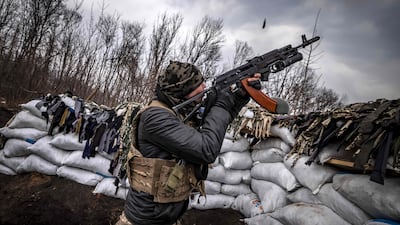
A Ukrainian soldier fires his rifle from a trench at the front east of Kharkiv in the north of Ukraine, which continues to be shelled by Russian forces. AFP -
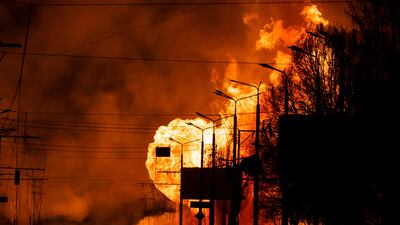
A gas station on fire in Kharkiv after Russian ttack on the northern city. AFP -
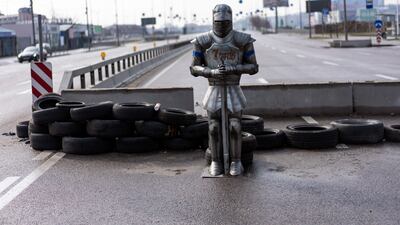
A medieval suit of armour 'stands guard' at a a Ukrainian checkpoint, on the outskirts of the capital Kyiv. AP Photo -
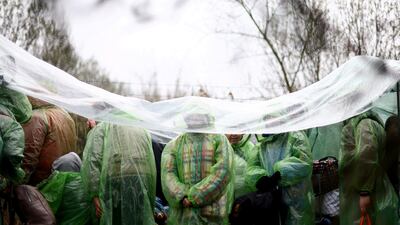
Ukrainian refugees wait in line to cross the border into Poland at Shehyni. Reuters -
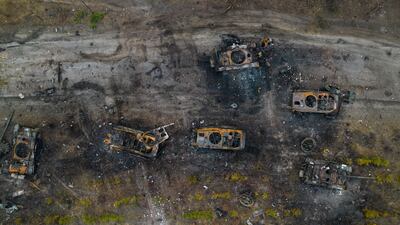
Destroyed Russian armoured vehicles on the outskirts of Kyiv. AP Photo -
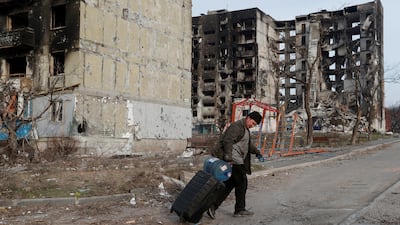
A resident passes apartment buildings destroyed by Russian attacks in the besieged southern port city of Mariupol, Ukraine. Reuters -
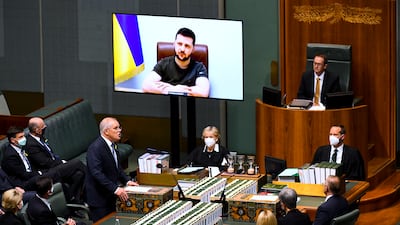
Australian Prime Minister Scott Morrison, standing, welcomes Ukrainian President Volodymyr Zelenskyy to address the House of Representatives via video link at Parliament House in Canberra. Mr Zelenskyy appealed directly to Australian legislators for more help in the war against Russia, including armoured vehicles and tougher sanctions. AP -
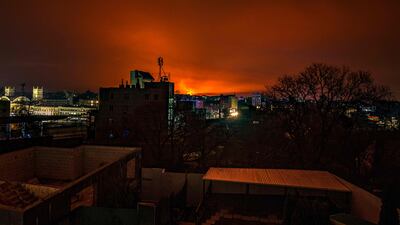
Fire lights up the sky east of Kharkiv, where Ukrainian forces pushed back Russian troops from a motorway outside the country's second-largest city. AFP -
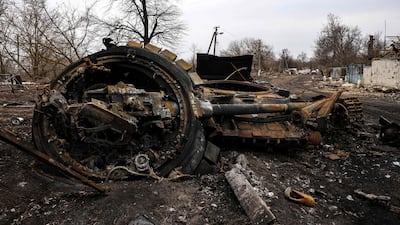
A destroyed Russian tank in the village of Lukianivka near Kyiv. AFP -
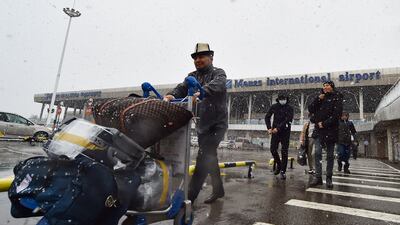
Passengers arriving from Moscow at Manas International Airport, Bishkek, Kyrgyrzstan. Hundreds of thousands of citizens of former Soviet countries in Central Asia are facing difficult choices: shrinking work opportunities in Russia and wages in the weakened rouble versus a return to the homeland where they have family homes, but even fewer job prospects. AFP -
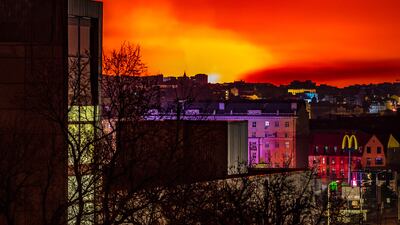
Fire and smoke light up the sky east of Kharkiv as Ukrainian forces push back Russian troops from a motorway outside the country's second-largest city. AFP -
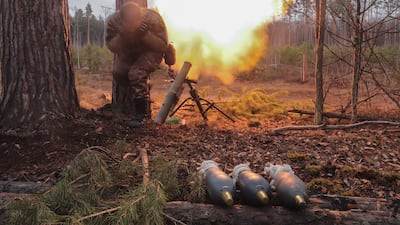
A Ukrainian soldier shoots at the Russian positions not far from the capital Kyiv. EPA -

A car marked with the English letter 'Z' is found destroyed at the central Ukrainian train station that was used as a Russian base in Trostyanets. Ukrainian forces said they had retaken the north-eastern town from the Russians. Getty Images -
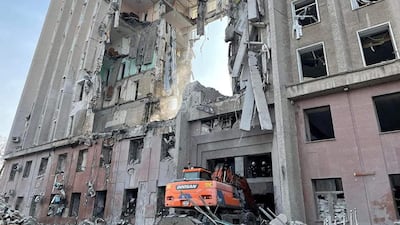
Rescue workers at the site of the regional administration building hit by Russian cruise missiles, in Mykolaiv, Ukraine. Reuters -
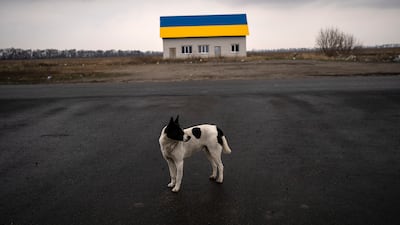
A dog looks at cars passing by on the road near a house painted with the colors of the Ukrainian flag, on the outskirts of the capital Kyiv. AP Photo -
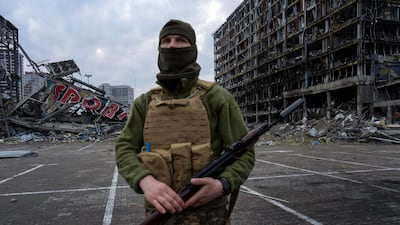
A soldier poses for the picture in Kyiv, Ukraine, while standing guard amid the destruction caused after shelling of a shopping center. AP Photo -
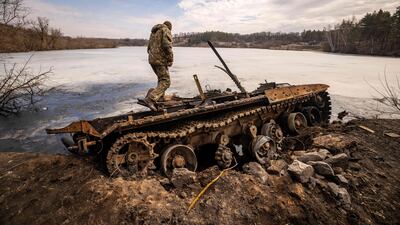
A Ukrainian serviceman stands near a destroyed Russian tank in the north-eastern city of Trostianets. AFP -
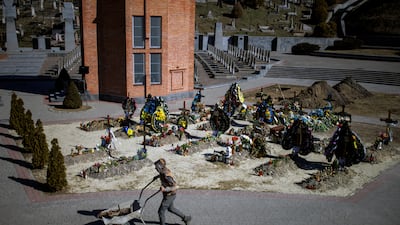
A worker pushes a cart past graves of Ukrainian soldiers who were killed in battle during Russia’s attack on Ukraine, at the Lychakiv cemetery in Lviv. Reuters -
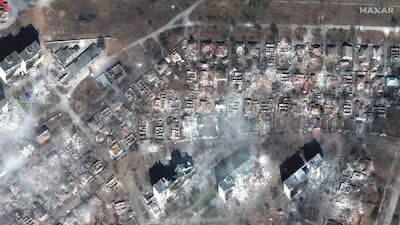
This satellite image provided by Maxar Technologies shows damaged apartment buildings and homes in Mariupol. AP -
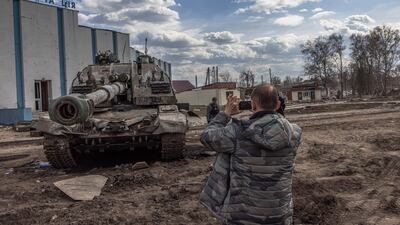
A resident takes photos of a destroyed Russian tank next to the railway station where the Russian forces were stationed, in Trostyanets, a town recaptured by the Ukrainian army. EPA -

A rescuer clears the rubble of a warehouse containing more than 50,000 tons of deep-frozen food in the town of Brovary, north of Ukrainian capital of Kyiv, after it was destroyed by Russian shelling. AFP -
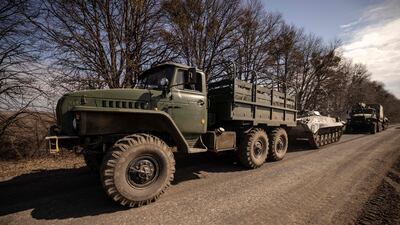
A Ukrainian army vehicle carries a Russian tank in Trostyanets. AFP -
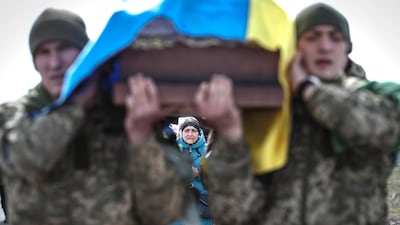
Ukrainian soldiers carry a coffin during the funeral ceremony of a comrade in Odesa. EPA -
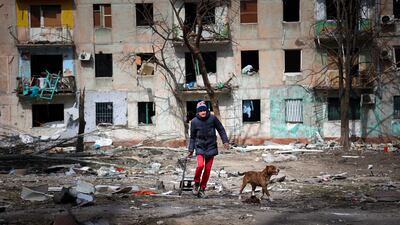
A man walks with his dog near an apartment building damaged by shelling from fighting on the outskirts of Mariupol. AP Photo -
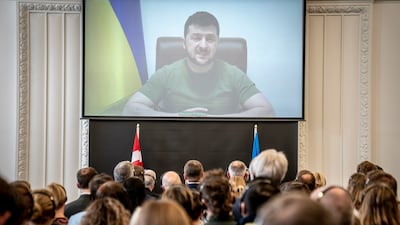
Members of the Danish Parliament attend the Ukrainian President, Volodymyr Zelensky's speech to the Danish Parliament via a video link, at the Christiansborg Castle in Copenhagen, Denmark. EPA -

A satellite image shows crowds outside a Metro grocery store in Mariupol. Reuters -
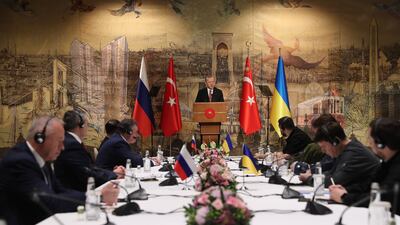
Turkish President Recep Tayyip Erdogan opens Ukrainian-Russian talks in Istanbul. President Erdogan told the delegations that "both parties have legitimate concerns." AFP -
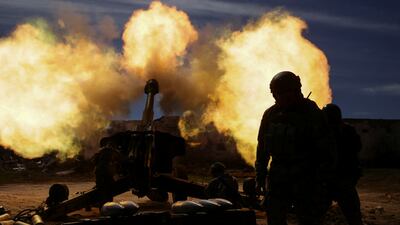
Members of the Ukrainian Volunteer Corps fire a howitzer at a position in the Zaporizhzhia region. Reuters -
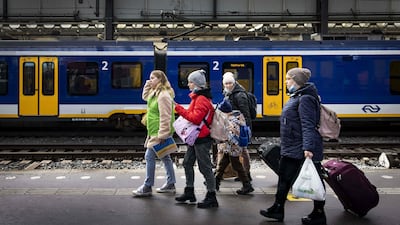
Ukrainian refugees are helped by volunteers upon their arrival at Amsterdam Central station by train from Berlin. AFP -

Ukrainian soldiers ride an armoured people carrier through the town of Trostsyanets, about 400 kilometres east of Kyiv. AP Photo -
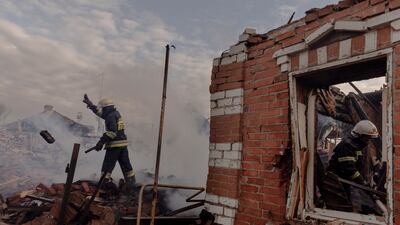
Firefighters work amid the debris of residential houses that were destroyed by Russian shelling in a settlement outside Kharkiv. Reuters -
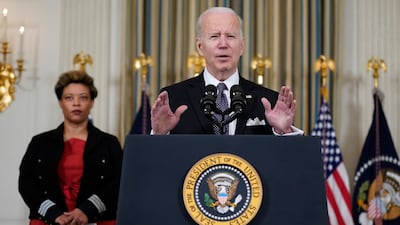
President Joe Biden said that he is not advocating for regime change in Moscow after saying Russian counterpart Vladimir Putin "cannot remain in power." AP Photo -

Firefighters work to extinguish a fire at a warehouse after it was hit by Russian shelling in Kharkiv, Ukraine. More than half of Kharkiv's 1.4 million people have fled the city since Russia's invasion on February 24. Getty Images -
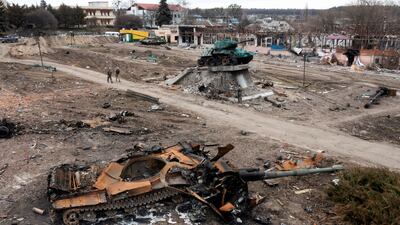
Local residents pass by a destroyed Russian tank in the town of Trostyanets, east of capital Kyiv, Ukraine. The monument to the Second World War is seen in background. AP Photo -
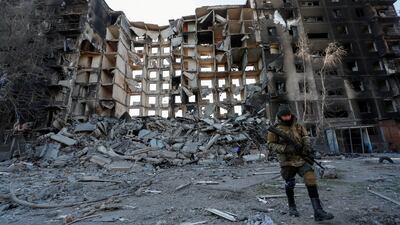
A pro-Russian troop service member walks near a destroyed apartment building in the besieged southern port city of Mariupol. Reuters -
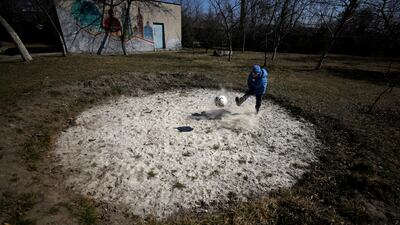
Mykhaylo, 8, who was taken away from his widowed mother along with his 9-year-old brother and 16-year-old sister, plays with a ball in the garden of a state shelter in Lviv. Reuters -

Halyna Falko, 52, talks to reporters while looking at the destruction caused after a Russian attack inside her house near Brovary, on the outskirts of Kyiv. AP Photo -
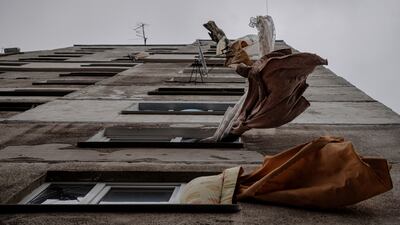
Curtains flutter in the wind at a building that was damaged by shelling in a neighbourhood that has been largely abandoned and left without water, gas and heating, as Russia's attack on Ukraine continues, in Kharkiv, Ukraine. Reuters -

People, mainly women and children, arrive at Przemysl on a train from Odesa in war-torn Ukraine in Przemysl, Poland. The Polish government has said it may spend €24 billion this year hosting refugees fleeing the war in Ukraine, and is seeking more support from the European Union. Getty Images -

A woman walks a dog past the so-called "people's installation to a Russian soldier" nicknamed the "polite people" created by residents in the backyard of their apartment building in the town of Podolsk, outside Moscow. AFP
The two ministers, both from the Green party, took office in December and criticised what they described as an ill-advised energy policy pursued by their predecessors that left Germany highly reliant on Russian energy.
They said the need to cut reliance on gas imports underlined the need to expand solar and wind energy, already a priority of the new government as it tries to put Germany on course for net zero carbon emissions by the 2040s. It plans to remove nuclear power from the energy grid this year and eliminate coal power by 2038.
UN Secretary General Antonio Guterres emphasised the climate element in brief remarks to the summit, saying the world was “far off track” in trying to reduce its net emissions to zero.
“The current crisis shows that we must accelerate, not slow, the renewable energy transition,” he said. “This is the only true path to energy security and I count on you to lead the way.”

Ten tax points to be aware of in 2026
1. Domestic VAT refund amendments: request your refund within five years
If a business does not apply for the refund on time, they lose their credit.
2. E-invoicing in the UAE
Businesses should continue preparing for the implementation of e-invoicing in the UAE, with 2026 a preparation and transition period ahead of phased mandatory adoption.
3. More tax audits
Tax authorities are increasingly using data already available across multiple filings to identify audit risks.
4. More beneficial VAT and excise tax penalty regime
Tax disputes are expected to become more frequent and more structured, with clearer administrative objection and appeal processes. The UAE has adopted a new penalty regime for VAT and excise disputes, which now mirrors the penalty regime for corporate tax.
5. Greater emphasis on statutory audit
There is a greater need for the accuracy of financial statements. The International Financial Reporting Standards standards need to be strictly adhered to and, as a result, the quality of the audits will need to increase.
6. Further transfer pricing enforcement
Transfer pricing enforcement, which refers to the practice of establishing prices for internal transactions between related entities, is expected to broaden in scope. The UAE will shortly open the possibility to negotiate advance pricing agreements, or essentially rulings for transfer pricing purposes.
7. Limited time periods for audits
Recent amendments also introduce a default five-year limitation period for tax audits and assessments, subject to specific statutory exceptions. While the standard audit and assessment period is five years, this may be extended to up to 15 years in cases involving fraud or tax evasion.
8. Pillar 2 implementation
Many multinational groups will begin to feel the practical effect of the Domestic Minimum Top-Up Tax (DMTT), the UAE's implementation of the OECD’s global minimum tax under Pillar 2. While the rules apply for financial years starting on or after January 1, 2025, it is 2026 that marks the transition to an operational phase.
9. Reduced compliance obligations for imported goods and services
Businesses that apply the reverse-charge mechanism for VAT purposes in the UAE may benefit from reduced compliance obligations.
10. Substance and CbC reporting focus
Tax authorities are expected to continue strengthening the enforcement of economic substance and Country-by-Country (CbC) reporting frameworks. In the UAE, these regimes are increasingly being used as risk-assessment tools, providing tax authorities with a comprehensive view of multinational groups’ global footprints and enabling them to assess whether profits are aligned with real economic activity.
Contributed by Thomas Vanhee and Hend Rashwan, Aurifer
Avatar: Fire and Ash
Director: James Cameron
Starring: Sam Worthington, Sigourney Weaver, Zoe Saldana
Rating: 4.5/5
Mercer, the investment consulting arm of US services company Marsh & McLennan, expects its wealth division to at least double its assets under management (AUM) in the Middle East as wealth in the region continues to grow despite economic headwinds, a company official said.
Mercer Wealth, which globally has $160 billion in AUM, plans to boost its AUM in the region to $2-$3bn in the next 2-3 years from the present $1bn, said Yasir AbuShaban, a Dubai-based principal with Mercer Wealth.
“Within the next two to three years, we are looking at reaching $2 to $3 billion as a conservative estimate and we do see an opportunity to do so,” said Mr AbuShaban.
Mercer does not directly make investments, but allocates clients’ money they have discretion to, to professional asset managers. They also provide advice to clients.
“We have buying power. We can negotiate on their (client’s) behalf with asset managers to provide them lower fees than they otherwise would have to get on their own,” he added.
Mercer Wealth’s clients include sovereign wealth funds, family offices, and insurance companies among others.
From its office in Dubai, Mercer also looks after Africa, India and Turkey, where they also see opportunity for growth.
Wealth creation in Middle East and Africa (MEA) grew 8.5 per cent to $8.1 trillion last year from $7.5tn in 2015, higher than last year’s global average of 6 per cent and the second-highest growth in a region after Asia-Pacific which grew 9.9 per cent, according to consultancy Boston Consulting Group (BCG). In the region, where wealth grew just 1.9 per cent in 2015 compared with 2014, a pickup in oil prices has helped in wealth generation.
BCG is forecasting MEA wealth will rise to $12tn by 2021, growing at an annual average of 8 per cent.
Drivers of wealth generation in the region will be split evenly between new wealth creation and growth of performance of existing assets, according to BCG.
Another general trend in the region is clients’ looking for a comprehensive approach to investing, according to Mr AbuShaban.
“Institutional investors or some of the families are seeing a slowdown in the available capital they have to invest and in that sense they are looking at optimizing the way they manage their portfolios and making sure they are not investing haphazardly and different parts of their investment are working together,” said Mr AbuShaban.
Some clients also have a higher appetite for risk, given the low interest-rate environment that does not provide enough yield for some institutional investors. These clients are keen to invest in illiquid assets, such as private equity and infrastructure.
“What we have seen is a desire for higher returns in what has been a low-return environment specifically in various fixed income or bonds,” he said.
“In this environment, we have seen a de facto increase in the risk that clients are taking in things like illiquid investments, private equity investments, infrastructure and private debt, those kind of investments were higher illiquidity results in incrementally higher returns.”
The Abu Dhabi Investment Authority, one of the largest sovereign wealth funds, said in its 2016 report that has gradually increased its exposure in direct private equity and private credit transactions, mainly in Asian markets and especially in China and India. The authority’s private equity department focused on structured equities owing to “their defensive characteristics.”
While you're here
Mustafa Alrawi: To get the 'jab' done, there must be patience and empathy
Damien McElroy: Anti-science attitudes in America are proving lethal
Editorial: What makes the UAE such a good place to test vaccines?
Editorial: The fight against Covid-19 should be guided by science
SPEC%20SHEET%3A%20APPLE%20IPAD%20PRO%20(12.9%22%2C%202022)
BUNDESLIGA FIXTURES
Friday (UAE kick-off times)
Cologne v Hoffenheim (11.30pm)
Saturday
Hertha Berlin v RB Leipzig (6.30pm)
Schalke v Fortuna Dusseldof (6.30pm)
Mainz v Union Berlin (6.30pm)
Paderborn v Augsburg (6.30pm)
Bayern Munich v Borussia Dortmund (9.30pm)
Sunday
Borussia Monchengladbach v Werder Bremen (4.30pm)
Wolfsburg v Bayer Leverkusen (6.30pm)
SC Freiburg v Eintracht Frankfurt (9on)
Electric scooters: some rules to remember
- Riders must be 14-years-old or over
- Wear a protective helmet
- Park the electric scooter in designated parking lots (if any)
- Do not leave electric scooter in locations that obstruct traffic or pedestrians
- Solo riders only, no passengers allowed
- Do not drive outside designated lanes
The Baghdad Clock
Shahad Al Rawi, Oneworld
Why it pays to compare
A comparison of sending Dh20,000 from the UAE using two different routes at the same time - the first direct from a UAE bank to a bank in Germany, and the second from the same UAE bank via an online platform to Germany - found key differences in cost and speed. The transfers were both initiated on January 30.
Route 1: bank transfer
The UAE bank charged Dh152.25 for the Dh20,000 transfer. On top of that, their exchange rate margin added a difference of around Dh415, compared with the mid-market rate.
Total cost: Dh567.25 - around 2.9 per cent of the total amount
Total received: €4,670.30
Route 2: online platform
The UAE bank’s charge for sending Dh20,000 to a UK dirham-denominated account was Dh2.10. The exchange rate margin cost was Dh60, plus a Dh12 fee.
Total cost: Dh74.10, around 0.4 per cent of the transaction
Total received: €4,756
The UAE bank transfer was far quicker – around two to three working days, while the online platform took around four to five days, but was considerably cheaper. In the online platform transfer, the funds were also exposed to currency risk during the period it took for them to arrive.
Four-day collections of TOH
Day Indian Rs (Dh)
Thursday 500.75 million (25.23m)
Friday 280.25m (14.12m)
Saturday 220.75m (11.21m)
Sunday 170.25m (8.58m)
Total 1.19bn (59.15m)
(Figures in millions, approximate)
Email sent to Uber team from chief executive Dara Khosrowshahi
From: Dara
To: Team@
Date: March 25, 2019 at 11:45pm PT
Subj: Accelerating in the Middle East
Five years ago, Uber launched in the Middle East. It was the start of an incredible journey, with millions of riders and drivers finding new ways to move and work in a dynamic region that’s become so important to Uber. Now Pakistan is one of our fastest-growing markets in the world, women are driving with Uber across Saudi Arabia, and we chose Cairo to launch our first Uber Bus product late last year.
Today we are taking the next step in this journey—well, it’s more like a leap, and a big one: in a few minutes, we’ll announce that we’ve agreed to acquire Careem. Importantly, we intend to operate Careem independently, under the leadership of co-founder and current CEO Mudassir Sheikha. I’ve gotten to know both co-founders, Mudassir and Magnus Olsson, and what they have built is truly extraordinary. They are first-class entrepreneurs who share our platform vision and, like us, have launched a wide range of products—from digital payments to food delivery—to serve consumers.
I expect many of you will ask how we arrived at this structure, meaning allowing Careem to maintain an independent brand and operate separately. After careful consideration, we decided that this framework has the advantage of letting us build new products and try new ideas across not one, but two, strong brands, with strong operators within each. Over time, by integrating parts of our networks, we can operate more efficiently, achieve even lower wait times, expand new products like high-capacity vehicles and payments, and quicken the already remarkable pace of innovation in the region.
This acquisition is subject to regulatory approval in various countries, which we don’t expect before Q1 2020. Until then, nothing changes. And since both companies will continue to largely operate separately after the acquisition, very little will change in either teams’ day-to-day operations post-close. Today’s news is a testament to the incredible business our team has worked so hard to build.
It’s a great day for the Middle East, for the region’s thriving tech sector, for Careem, and for Uber.
Uber on,
Dara
Zodi%20%26%20Tehu%3A%20Princes%20Of%20The%20Desert
Profile of Foodics
Founders: Ahmad AlZaini and Mosab AlOthmani
Based: Riyadh
Sector: Software
Employees: 150
Amount raised: $8m through seed and Series A - Series B raise ongoing
Funders: Raed Advanced Investment Co, Al-Riyadh Al Walid Investment Co, 500 Falcons, SWM Investment, AlShoaibah SPV, Faith Capital, Technology Investments Co, Savour Holding, Future Resources, Derayah Custody Co.
MATCH INFO
Uefa Champions League semi-final, second leg result:
Ajax 2-3 Tottenham
Tottenham advance on away goals rule after tie ends 3-3 on aggregate
Final: June 1, Madrid
RIVER%20SPIRIT
While you're here
'The Batman'
Stars:Robert Pattinson
Director:Matt Reeves
Rating: 5/5
White hydrogen: Naturally occurring hydrogen
Chromite: Hard, metallic mineral containing iron oxide and chromium oxide
Ultramafic rocks: Dark-coloured rocks rich in magnesium or iron with very low silica content
Ophiolite: A section of the earth’s crust, which is oceanic in nature that has since been uplifted and exposed on land
Olivine: A commonly occurring magnesium iron silicate mineral that derives its name for its olive-green yellow-green colour


