


Live updates: follow the latest news on Russia-Ukraine
Fires covering more than 10,000 hectares across the Chernobyl exclusion zone could lead to spiked radiation pollution levels in the air spreading on prevailing winds heading west, Ukrainian officials have warned.
Russian military forces are to blame for 31 forest fires, said Lyudmila Denisova, the commissioner of a Ukrainian human rights group.
Deputy Prime Minister Iryna Vereshchuk said the fires threaten Ukraine and hundreds of millions of Europeans.
“Significant fires have started in the exclusion zone, which can have very serious consequences,” Ms Vereshchuk said on Telegram.
“However, today it is impossible to control and extinguish fires in full due to the capture of the exclusion zone by the Russian occupation forces.”
She said the Russian army was “militarising” the site and storing ammunition “in close proximity” to the station.
-
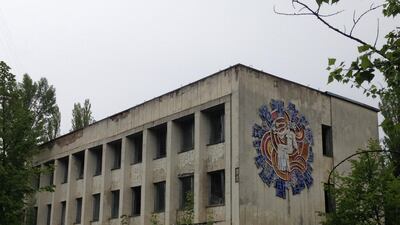
Pripyat is still a draw for visitors, not least for its Soviet-era architecture which has been frozen in time. All photos: Declan McVeigh / The National -
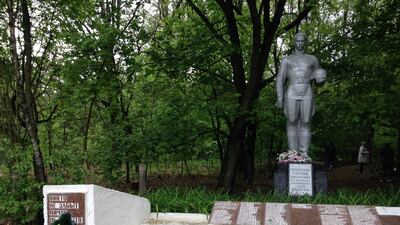
Like thousands of other Soviet towns, Pripyat had memorials to the dead of the 1941-1945 Great Patriotic War. This one is close to an abandoned nursery in the 30km 'dead zone' around Chernobyl. -
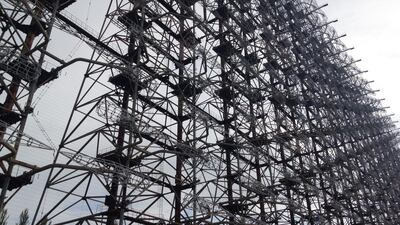
This enormous Duga-1 OTH radar array – AKA the 'Russian woodpecker' for the interference it caused on shortwave radio – dominates the skyline of this remote part of northern Ukraine near Chernobyl. -

Pripyat was once home to nearly 50,000 people; the city has been left to rot as Ukraine’s government still forbids people from living there. -

An abandoned funfair in Pripyat. -

Before the disaster more than 15,400 children lived in the city of Pripyat alone. -
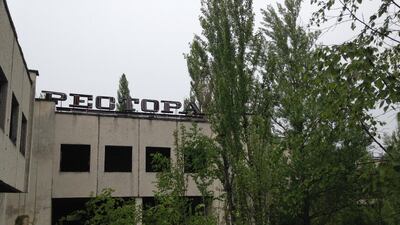
One of Pripyat’s 27 restaurants and cafes, left to the elements since 1986. -
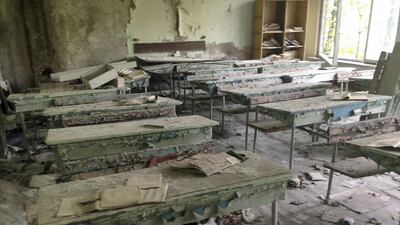
The UN says more than 6,000 cases of thyroid cancer were reported among children from Ukraine, Russia and Belarus up to 2005, 'most likely caused by radiation exposures shortly after the accident'. -
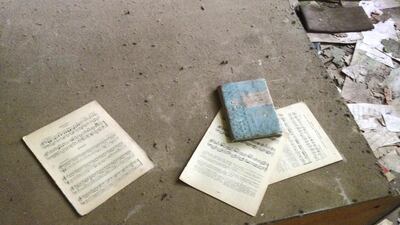
Classrooms were abandoned as the Soviet authorities ordered people to leave the Chernobyl area. Residents were told they would be leaving for three days, but officials later decided the area would remain empty. -
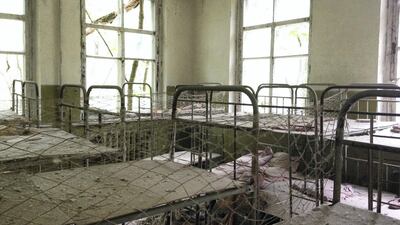
This nursery was one of 15 which educated almost 5,000 young children across the area. -
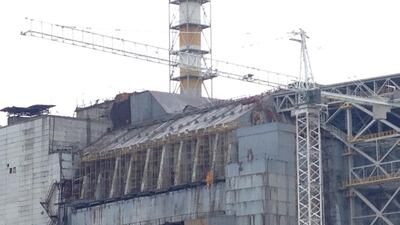
The sarcophagus over reactor number four at Chernobyl was designed and built in 1986 to keep in 740,000m3 of radioactive debris and contaminated soil. In November 2016 the sarcophagus itself was covered in the €1.5 billion ($1.49bn) Chernobyl New Safe Confinement project. -
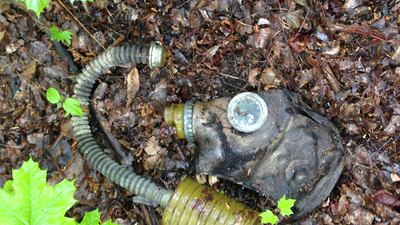
A gas mask once worn by one of thousands of Soviet 'liquidators' - a mix of civilian and military workers sent to Chernobyl after the reactor explosion. More than half a million people took part in the clean-up. -
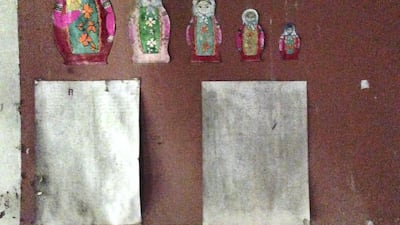
The 30km exclusion zone around the site of the blast is dotted with reminders that it was once home to thousands of people. This nursery was abandoned on April 27, 1986. -
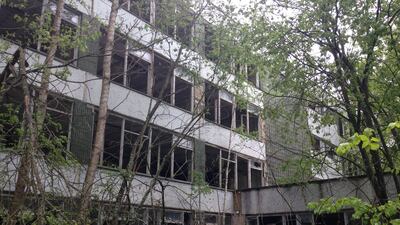
Abandoned buildings in Pripyat remain officially out of bounds, but some people – a mix of former residents, villagers, adventurers and mere loners – have returned to live inside the 30km 'dead zone'.


“It should be noted that recently Russian occupation troops have been using old and unconditional ammunition more often, which increases the risk of their detonation even when loading and transporting,” she said.
“In the context of nuclear safety, the irresponsible and unprofessional actions of Russian servicemen present a very serious threat not only to Ukraine but to hundreds of millions of Europeans”.
The International Atomic Energy Agency said on Sunday “the situation remained unchanged” in relation to safeguards at Chernobyl and other nuclear plants in Ukraine.
The UN nuclear watchdog last week said forest fires around Chernobyl did not pose a major radiological risk.
Since March 9 the International Atomic Energy Agency has not received live data from Chernobyl. It said on Sunday it was concerned about the lack of staff turnover at the plant since March 20.
The exclusion zone is an area of about 2,600 square kilometres around the nuclear plant.
Ms Denisova said dry and windy weather could make the fires harder to tackle.
“Control and suppression of fires is impossible due to the capture of the exclusion zone by Russian troops. As a result of combustion, radionuclides are released into the atmosphere, which are transported by wind over long distances.”
She warned there was a risk of “irreparable consequences not only for Ukraine but also for the whole world”.
“Catastrophic consequences can be prevented only by immediate de-occupation of the territory by Russian troops. Therefore, I call on international human rights organisations to take all possible measures to increase pressure on the Russian Federation to end military aggression against Ukraine and de-occupy high-risk areas,” Ms Denisova said.
Russian forces seized the plant on February 24, the first day of the invasion.
Chernobyl's number four reactor exploded on April 26, 1986, causing the world's worst nuclear accident. Hundreds were killed and radioactive contamination spread west across Europe.
The reactor number four building is now encased in a double sarcophagus to limit radioactive contamination.
The original sarcophagus, constructed by the Soviets, deteriorated over the years. A new one was built over it and completed in 2019.
The plant's other three reactors were gradually shut down after the disaster, the last in 2000.

