


Live updates: follow the latest news on Russia-Ukraine
US President Joe Biden announced a deal with the European Union to reinforce its energy supplies on Friday as his diplomatic marathon in Europe reached its final leg with a stop near Poland’s border with Ukraine.
In what Mr Biden called a "joint gameplan" to reduce the EU's reliance on politically toxic Russian energy imports, the US promised to speed up deliveries of liquefied natural gas to Europe - one of a battery of measures announced at back-to-back western summits to deal with the fallout of the war in Ukraine.
But the planned eight-year partnership did not resolve the more immediate issues of soaring fuel prices in Europe and the gas imports blamed for financing Russia's invasion, with nine hours of EU talks on Friday ending with several divisive issues parked for further study.
Under the US deal, Washington will arrange shipments of 15 billion cubic metres of LNG to Europe this year, and 50bn per year by 2030, covering about a third of the 155bn that typically come from Russia.
In return, Europe is expected to guarantee stable prices for US suppliers and speed up construction of the infrastructure and special shipping terminals needed to handle the low-temperature fuel.
The two powers will also work together on reducing gas consumption outright, as Europe tries to end Russia's hold over its energy grid and stop the lights going out next winter.
Mr Biden, who has already banned Russian fuel imports to the US, said Russian President Vladimir Putin had used the country's energy stocks to "coerce and manipulate its neighbours" and "used the profits to drive his war machine" in an onslaught on Ukraine that is now in its second month.
European Commission president Ursula von der Leyen said this year's US imports would replace annual LNG supplies from Russia, although most gas purchased from Moscow comes by pipeline rather than being liquefied at minus 162°C.
"We as Europeans want to diversify away from Russia towards suppliers that we trust, that are our friends, that are reliable," she said.
The deal, which a senior White House official said the two sides had been working on for some time, will be overseen by a joint White House-EU task force and comes as leaders switch their focus to energy after two days of talks on sanctions and military aid to Ukraine.
Mr Biden’s guest appearance at a European Union summit, which followed meetings of Nato and the G7 on a day of high-stakes diplomacy in Brussels, produced promises to document Russian atrocities in Ukraine and provide a combined $1.6 billion in humanitarian assistance from the EU and US.
It came after agreements by Nato to bolster military aid to Ukraine, help it prepare for a chemical or nuclear attack and to reinforce its own eastern flank, and by the G7 to work together on food security and stop Russia using gold reserves to prop up its economy.
But the show of unity when Mr Biden was in Brussels gave way to intense EU negotiations once he left for Poland, with consensus proving difficult on whether to cut off Russian imports immediately or intervene in the market to cut consumer prices.
An official close to the talks said all 27 leaders had proposed amendments to a draft text in highly technical discussions, which culminated in an agreement that the joint EU purchasing of gas - an idea supported by Ms von der Leyen - should take place on a voluntary basis.
No new sanctions were agreed, and the questions of an energy price cap and minimum gas storage levels were left open for further discussion. Another source with knowledge of the talks said it was hard for many countries to agree immediate changes to their energy systems rather than planning for the next 5 to 10 years.
-
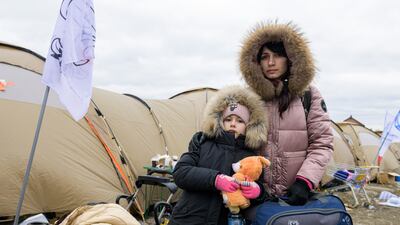
Mykhaila and her daughter from Loubny, central Ukraine, travelled by train to the Ukrainian city of Lviv then took a bus to Medyka on the Polish border, before walking across. Photo: DEC -
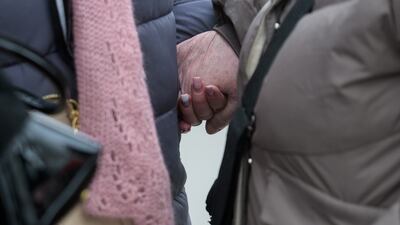
Women hold hands at the Medyka border crossing point, through which thousands of Ukrainian refugees have passed. Photo: DEC -

Angelika, 27, and her daughter Diana, 4, from Khmelnytskyi in Ukraine arrive at a reception centre on the outskirts of Przemysl, Poland. Photo: DEC -

Maria, 38, from Chernihiv, left Ukraine with a friend. They came to the Romanian border to wait for another friend before crossing. Photo: Panos Pictures -
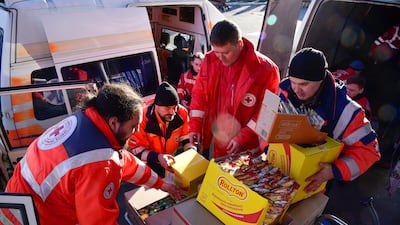
Ukrainian Red Cross staff and volunteers are providing food and other basic necessities to about 8,000 people sheltering in an underground station in Kyiv. Photo: Tebukhukhov Maksym -
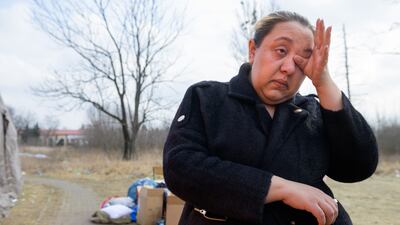
Kristina wipes away tears at Lwowska reception centre on the outskirts of Przemysl, Poland. Photo: DEC -
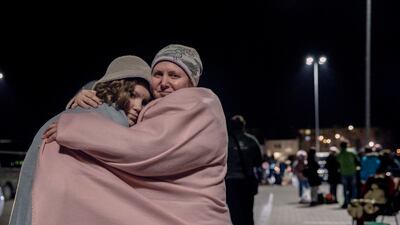
Ira, 45, and her daughter Olena, 12, outside a transit centre in Przemysl, Poland. Photo: Adrienne Surprenant -
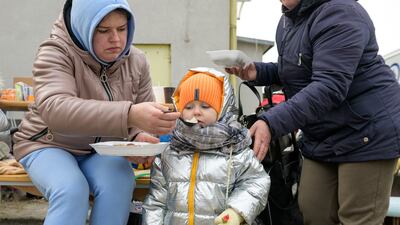
Veronika feeds her son Aleksander at the temporary refugee station in Medyka, eastern Poland. Photo: DEC


Mr Biden and his entourage left Brussels on Friday and landed in the Polish town of Rzeszow, about 80 kilometres from the border with Ukraine.
He met US troops stationed in Poland and was received a briefing on the humanitarian crisis in the country, which has taken in more than two million refugees from Ukraine.
The president promised the US would be a "major piece" of the humanitarian response to the war but said his overall stance on the war, in which Nato is reluctant to intervene directly, would not be changed by seeing the plight of refugees first hand.
But he said any use of chemical weapons by Russia against Ukraine would "trigger a response in kind" from Nato countries.
The European Council called for the establishment of a "solidarity trust fund" for Ukraine which it said should be financed by an international donor conference to add to the money pledged by the EU and Washington.
The council's discussions did not offer Ukraine any progress on its application for EU membership, instead repeating its instructions to the European Commission to give an opinion on that issue.
Ukraine's President Volodymyr Zelenskyy, making his trademark appearance by video link in a green T-shirt, acknowledged the difficulty of his push for EU membership by naming prominent countries such as Germany and the Netherlands who have rejected the idea of a fast-track application.
Energy debate
Another divisive question, how soon to cut off Russian energy imports, was left unresolved in Brussels with some countries urging an immediate embargo while others see this as impractical.
Although there is broad consensus around the aim of diversifying energy supplies by 2030, the summit came at a time when fuel prices are already high and some leaders, including German Chancellor Olaf Scholz, fear any import ban would be socially and economically unsustainable.
Hungary's Viktor Orban, who before the war was considered one of Mr Putin's closest allies in the EU, said sanctions on Russian energy “would mean that the Hungarian economy would slow down and then stop within moments.”
Those who favour an embargo, such as Polish Prime Minister Mateusz Morawiecki, say Europe is effectively financing Russia's war machine by buying its stocks of gas, oil and coal.
But even some countries that use relatively little Russian energy, such as Ireland and Sweden, said they sympathised with import-reliant neighbours and wanted to ensure that any sanctions punish Mr Putin rather than EU consumers.
Germany separately announced targets on Friday of ending its reliance on Russian coal and oil by the end of this year and on gas by 2024. The US and EU said their deal was in line with their climate change goals, although LNG is not politically uncontroversial either because it may be derived from fracking - a practice frowned upon by campaigners.
-
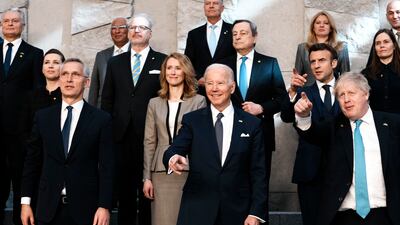
Nato Secretary General Jens Stoltenberg, front left, US President Joe Biden and British Prime Minister Boris Johnson pose for a photo during an extraordinary Nato summit in Brussels. AP Photo -
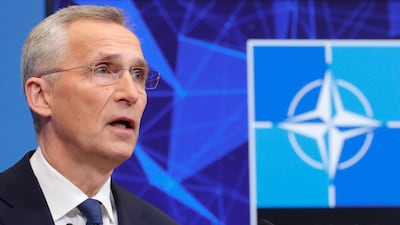
Jens Stoltenberg speaks at a press conference at the end of the summit in Brussels. EPA -
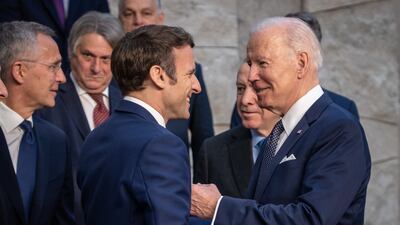
France's President Emmanuel Macron shakes hands with Mr Biden as they arrive at Nato headquarters. AFP -

The leaders gather for a photo in Brussels. AP Photo -
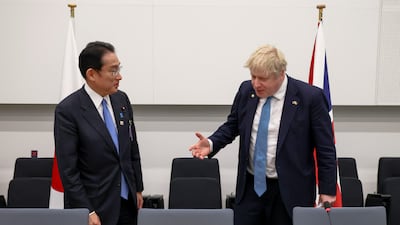
Japanese Prime Minister Fumio Kishida and Boris Johnson attend a bilateral meeting. Getty Images -
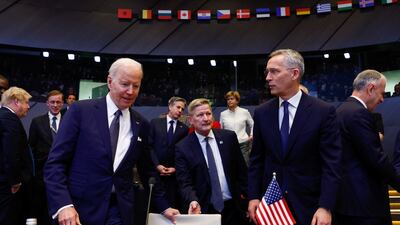
Joe Biden speaks with Jens Stoltenberg during the summit. Reuters -
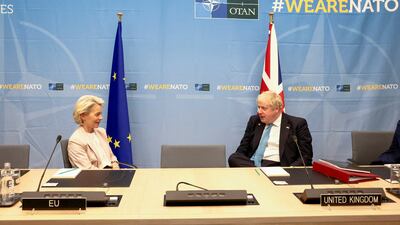
European Commission President Ursula von der Leyen and Boris Johnson. PA -
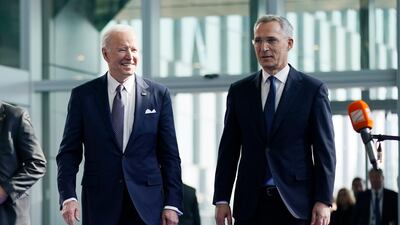
Mr Biden is greeted by Mr Stoltenberg as he arrives for meetings with Nato allies in the Belgian capital. AP Photo -
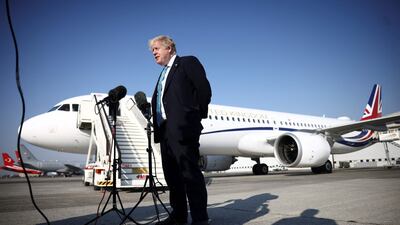
Mr Johnson addresses media representatives after he arrives in Brussels. AFP -
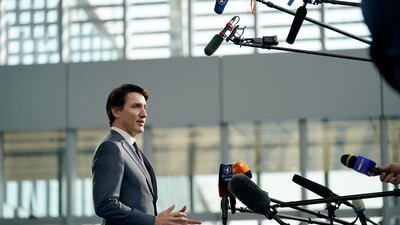
Canada's Prime Minister Justin Trudeau speaks to the press in Brussels. AFP -
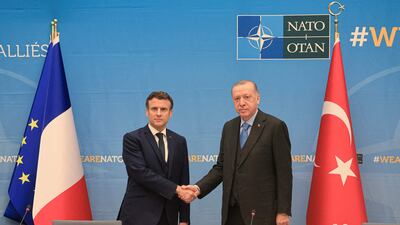
Mr Macron shakes hands with Turkish President Recep Tayyip Erdogan. AFP -
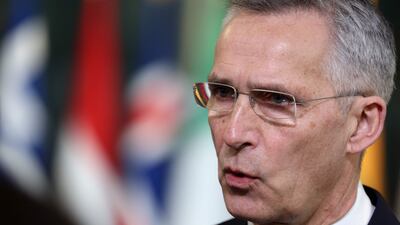
Mr Stoltenberg at Nato's headquarters in Brussels. AFP -
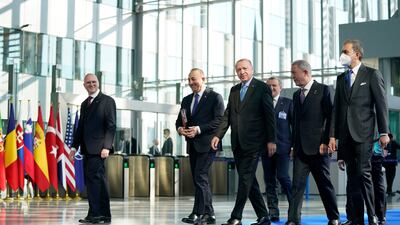
Mr Erdogan with officials including Turkey's Foreign Minister Mevlut Cavusoglu as he arrives in Brussels. AFP -
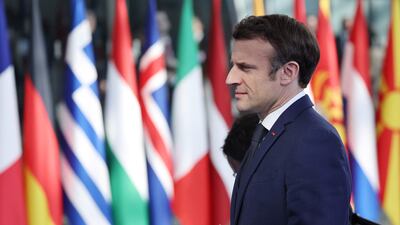
Mr Macron arriving at the summit. AFP


Any new sanctions would require consensus from all 27 countries. Baltic countries and Poland had called before the meeting for a ban on road freight from Russia, but many leaders and diplomats have shifted their tone in recent days to focus on implementing existing sanctions and curbing any Russian attempts at evasion.
A second thorny issue is whether the EU should intervene in the market to cut soaring gas prices for consumers, with Belgium supporting such a step and the Spanish government under pressure from an 11-day truck drivers' strike.
"The EU is not only about big principles, big meetings and American presidents," said Belgian Prime Minister Alexander De Croo. "Today is about the everyday issues of the people."
But diplomats from the Netherlands, known as one of the "Frugal Four" group of countries typically wary of free-spending EU intervention, said the bloc should avoid any "sweeping measures" until further studies were carried out.
This position was reflected in a set of conclusions that called for the European Commission to discuss options such as price caps with the energy industry - although Spain and Portugal will be given special clearance to intervene.
Ms von der Leyen separately pushed for joint purchasing of gas by the EU, exploiting the bloc’s economic weight in a manner compared by senior officials to the acquisition of coronavirus vaccines. The final text says this can happen on a voluntary basis and could also apply to hydrogen and LNG.
The US and EU meanwhile promised in a joint statement to "redouble our combined efforts" to ensure global food security during the war between Russia and Ukraine, two of the world's top wheat producers.
The talks came after a Nato summit that produced promises of more weapons shipments to Ukraine as well as equipment to prepare for a potential chemical, nuclear or biological attack.
Mr Biden's visit to Nato headquarters also produced an agreement on establishing four new battalions along the alliance's eastern border to guard against Russia in what diplomats say is a changed security environment.
But the bloc's leaders stopped short of granting Mr Zelenskyy's request, in another video-link intervention, that 1 per cent of Nato's tanks and planes be supplied to the country.

