Refugees, mostly women with children, arrive at the border crossing in Medyka, Poland, Saturday, March 5, 2022, after fleeing Russian invasion in Ukraine. (AP Photo / Visar Kryeziu)

Aid agencies warn of ‘crucial need’ to protect women and girls in Russia-Ukraine crisis


Soraya Ebrahimi
  • English
  • Arabic

Live updates: follow the latest news on Russia-Ukraine

There is a “crucial need” to protect women and girls who are suffering because of Russia’s invasion of Ukraine, aid agencies say.

Most of the 1.7 million people who have fled Ukraine are women and children.

Conflict, crisis and displacement puts them at increased risk of sexual and physical violence and abuse, Britain's Disasters Emergency Committee has said.

The warning comes as the world marks International Women’s Day and an estimated 80,000 women are set to give birth in the next three months in Ukraine.

This includes many women who will not be able to receive critical maternal health care and it could make childbirth a life-threatening experience, the UN Population Fund says.

“The conflict in Ukraine and resulting displacement is tearing families apart, leaving women and children who are trying to find safety exposed and vulnerable," said Suzy Madigan, Care International’s senior humanitarian adviser for gender and protection.

“Women fleeing disasters everywhere face the real risk of gender-based violence and abuse when they’re forced to leave home.

“If you become reliant on others for the basic needs of survival, exploitation becomes a real threat.”

  • Ihtisham Ullah, a student from Pakistan, who was forced to abandon his studies in Ukraine after the war broke out. All photos: Daniel Bardsley / The National
    Ihtisham Ullah, a student from Pakistan, who was forced to abandon his studies in Ukraine after the war broke out. All photos: Daniel Bardsley / The National
  • Refugees being given food near the asylum processing centre.
    Refugees being given food near the asylum processing centre.
  • Alexander Hoffman, a German Army officer who is volunteering to match newly arrived refugees with people offering rooms in their homes.
    Alexander Hoffman, a German Army officer who is volunteering to match newly arrived refugees with people offering rooms in their homes.
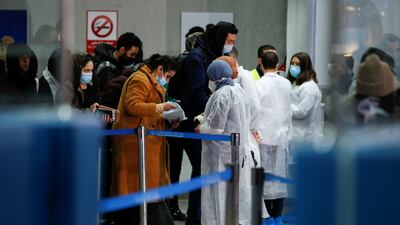
  • Refugees waiting to register at the asylum processing centre in Reinickendorf.
    Refugees waiting to register at the asylum processing centre in Reinickendorf.
  • The queue is growing longer by the day.
    The queue is growing longer by the day.
  • The former hospital in Reinickendorf near where the asylum processing centre has been set up.
    The former hospital in Reinickendorf near where the asylum processing centre has been set up.

Care International is among 15 UK-based DEC charities that are working in Ukraine and in neighbouring countries to meet the growing humanitarian need from a situation the UN describes as the fastest growing refugee crisis in Europe since the Second World War.

The DEC, which is providing women and families with food, shelter, clean water, hygiene kits, health care and child-friendly spaces, as well as psychosocial support including trauma counselling, has raised more than £100 million ($131m) in its Ukraine Humanitarian Appeal so far.

“It’s heartbreaking to think of the situation facing women and children who have fled their homes, fearing for their lives, many of them leaving family members behind who they will be desperately worried about,” said Rebecca Front, actor and British Red Cross supporter.

She urged people to give their support, saying that “donations to the DEC will ensure aid reaches those who need it, fast”.

Alexandra Parnebjork, Plan International’s gender in emergencies adviser, said most maternal deaths in the world occur in humanitarian crises.

“In these situations, women and girls know what they want and need," she said.

“We must work with them to ensure they have access to proper health care and protection from sexual and gender-based violence.”

Large numbers of women, children and young people are arriving at Ukraine’s borders with Poland, Romania, Hungary, Slovakia and Moldova, with only what they can carry.

“There are deeply concerning reports of racism against refugees of colour, including mothers with babies forced to wait longer in below-freezing temperatures with no shelter, and reports of female young students being stuck at the borders for several days without shelter and toilet facilities," said Niki Ignatiou, ActionAid UK’s humanitarian adviser.

“Women and girls arriving at the border urgently need food, water, shelter and essential items like soap, period products and underwear.

“Psychosocial support and safe spaces to prevent gender-based violence will also be vital in the coming weeks.”

The DEC is also dealing with a number of ongoing humanitarian crises around the world that put women and children at risk.

Money from previous and continuing DEC appeals is still being spent in Afghanistan, Democratic Republic of the Congo, Somalia, South Sudan, Syria, Yemen and the Rohingya refugee camps – as well as vulnerable communities affected by the coronavirus pandemic.

Tunisians and Moroccans return home from Ukraine - in pictures

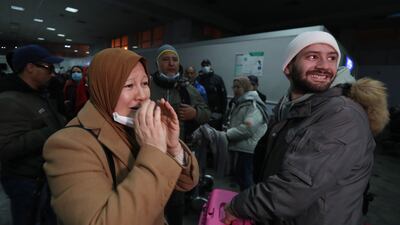
  • Tunisian citizens who fled to Poland following Russia's invasion of Ukraine are welcomed by their relatives at Tunis airport in Tunisia. Reuters
    Tunisian citizens who fled to Poland following Russia's invasion of Ukraine are welcomed by their relatives at Tunis airport in Tunisia. Reuters
  • A Tunisian arrives with his cat in Tunis. EPA
    A Tunisian arrives with his cat in Tunis. EPA
  • Tunisians leaving a plane upon their arrival at the airport. Reuters
    Tunisians leaving a plane upon their arrival at the airport. Reuters
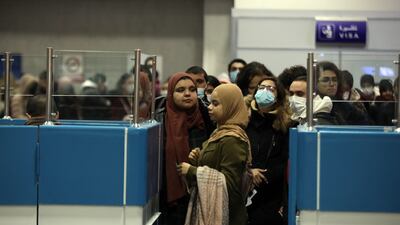
  • The foreign ministry estimates there are 1,700 Tunisians living in Ukraine, most of them students. Reuters
    The foreign ministry estimates there are 1,700 Tunisians living in Ukraine, most of them students. Reuters
  • Tunisians who took off from Bucharest after fleeing to Romania following Russia's invasion arrive in Tunis. EPA
    Tunisians who took off from Bucharest after fleeing to Romania following Russia's invasion arrive in Tunis. EPA
  • After early evacuations of several hundred students on military planes, the Tunisian government has struggled to co-ordinate with those still fleeing the war. EPA
    After early evacuations of several hundred students on military planes, the Tunisian government has struggled to co-ordinate with those still fleeing the war. EPA
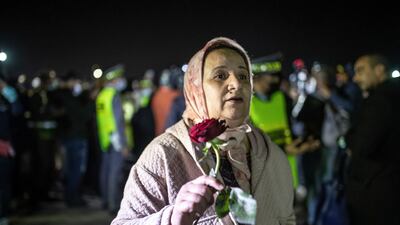
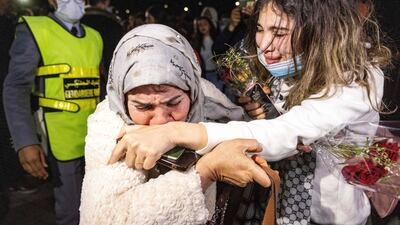
  • The mother of a Moroccan student who was studying in Ukraine holds a flower to give her as she arrives at Casablanca airport in Morocco. AP Photo
    The mother of a Moroccan student who was studying in Ukraine holds a flower to give her as she arrives at Casablanca airport in Morocco. AP Photo
  • Relatives of Moroccan students wait outside the Mohammed V airport in Casablanca. AFP
    Relatives of Moroccan students wait outside the Mohammed V airport in Casablanca. AFP
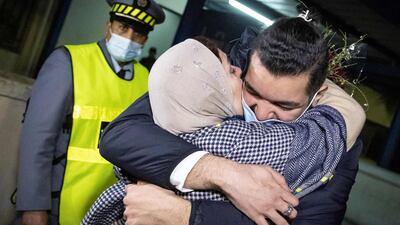
  • Moroccan students embrace their relatives after arriving at the airport. AFP
    Moroccan students embrace their relatives after arriving at the airport. AFP
  • For those who managed to flee, reunions with family and friends are joyful, but bittersweet. The uncertainty of interrupted studies, the lives and friends they leave behind, all remain ingrained in their minds. AFP
    For those who managed to flee, reunions with family and friends are joyful, but bittersweet. The uncertainty of interrupted studies, the lives and friends they leave behind, all remain ingrained in their minds. AFP
  • A Moroccan student holds his dog after arriving at Mohammed V airport. AFP
    A Moroccan student holds his dog after arriving at Mohammed V airport. AFP
Match info

Uefa Nations League Group B:

England v Spain, Saturday, 11.45pm (UAE)

How it works

Booklava works on a subscription model. On signing up you receive a free book as part of a 30-day-trial period, after which you pay US$9.99 (Dh36.70) per month to gain access to a library of books and discounts of up to 30 per cent on selected titles. You can cancel your subscription at any time. For more details go to www.booklava.com

Zidane's managerial achievements

La Liga: 2016/17
Spanish Super Cup: 2017
Uefa Champions League: 2015/16, 2016/17, 2017/18
Uefa Super Cup: 2016, 2017
Fifa Club World Cup: 2016, 2017

The stats

Ship name: MSC Bellissima

Ship class: Meraviglia Class

Delivery date: February 27, 2019

Gross tonnage: 171,598 GT

Passenger capacity: 5,686

Crew members: 1,536

Number of cabins: 2,217

Length: 315.3 metres

Maximum speed: 22.7 knots (42kph)

Indoor Cricket World Cup Dubai 2017

Venue Insportz, Dubai; Admission Free

Fixtures - Open Men 2pm: India v New Zealand, Malaysia v UAE, Singapore v South Africa, Sri Lanka v England; 8pm: Australia v Singapore, India v Sri Lanka, England v Malaysia, New Zealand v South Africa

Fixtures - Open Women Noon: New Zealand v England, UAE v Australia; 6pm: England v South Africa, New Zealand v Australia

Ten tax points to be aware of in 2026

1. Domestic VAT refund amendments: request your refund within five years

If a business does not apply for the refund on time, they lose their credit.

2. E-invoicing in the UAE

Businesses should continue preparing for the implementation of e-invoicing in the UAE, with 2026 a preparation and transition period ahead of phased mandatory adoption. 

3. More tax audits

Tax authorities are increasingly using data already available across multiple filings to identify audit risks. 

4. More beneficial VAT and excise tax penalty regime

Tax disputes are expected to become more frequent and more structured, with clearer administrative objection and appeal processes. The UAE has adopted a new penalty regime for VAT and excise disputes, which now mirrors the penalty regime for corporate tax.

5. Greater emphasis on statutory audit

There is a greater need for the accuracy of financial statements. The International Financial Reporting Standards standards need to be strictly adhered to and, as a result, the quality of the audits will need to increase.

6. Further transfer pricing enforcement

Transfer pricing enforcement, which refers to the practice of establishing prices for internal transactions between related entities, is expected to broaden in scope. The UAE will shortly open the possibility to negotiate advance pricing agreements, or essentially rulings for transfer pricing purposes. 

7. Limited time periods for audits

Recent amendments also introduce a default five-year limitation period for tax audits and assessments, subject to specific statutory exceptions. While the standard audit and assessment period is five years, this may be extended to up to 15 years in cases involving fraud or tax evasion. 

8. Pillar 2 implementation 

Many multinational groups will begin to feel the practical effect of the Domestic Minimum Top-Up Tax (DMTT), the UAE's implementation of the OECD’s global minimum tax under Pillar 2. While the rules apply for financial years starting on or after January 1, 2025, it is 2026 that marks the transition to an operational phase.

9. Reduced compliance obligations for imported goods and services

Businesses that apply the reverse-charge mechanism for VAT purposes in the UAE may benefit from reduced compliance obligations. 

10. Substance and CbC reporting focus

Tax authorities are expected to continue strengthening the enforcement of economic substance and Country-by-Country (CbC) reporting frameworks. In the UAE, these regimes are increasingly being used as risk-assessment tools, providing tax authorities with a comprehensive view of multinational groups’ global footprints and enabling them to assess whether profits are aligned with real economic activity. 

Contributed by Thomas Vanhee and Hend Rashwan, Aurifer

SCHEDULE

6.30pm Maiden Dh165,000 (Dirt) 1,400m
7.05pm: Handicap Dh170,000 (D) 1,600m
7.40pm: Maiden Dh165,000 (D) 1,600m
8.15pm: Handicap Dh210,000 (D) 1,200m
8.50pm: Handicap Dh210,000 (D) 2,000m
9.25pm:Handicap Dh185,000 (D) 1,400m
 
Amith's predicted winners:
6.30pm: Down On Da Bayou
7.05pm: Etisalat
7.40pm: Mulfit
8.15pm: Pennsylvania Dutch
8.50pm: Mudallel
9.25pm: Midnight Sands

Farage on Muslim Brotherhood

Nigel Farage told Reform's annual conference that the party will proscribe the Muslim Brotherhood if he becomes Prime Minister.
"We will stop dangerous organisations with links to terrorism operating in our country," he said. "Quite why we've been so gutless about this – both Labour and Conservative – I don't know.
“All across the Middle East, countries have banned and proscribed the Muslim Brotherhood as a dangerous organisation. We will do the very same.”
It is 10 years since a ground-breaking report into the Muslim Brotherhood by Sir John Jenkins.
Among the former diplomat's findings was an assessment that “the use of extreme violence in the pursuit of the perfect Islamic society” has “never been institutionally disowned” by the movement.
The prime minister at the time, David Cameron, who commissioned the report, said membership or association with the Muslim Brotherhood was a "possible indicator of extremism" but it would not be banned.

Updated: March 08, 2022, 7:19 AM