


Live updates: follow the latest news on Russia-Ukraine
Ukrainian President Volodymyr Zelenskyy will give a “historic address” to British MPs on Tuesday by video link, it has been announced.
Sir Lindsay Hoyle, Speaker of the UK House of Commons, said he had granted the request for Mr Zelenskyy to read a statement on the Russian crisis at 5pm.
“Every parliamentarian wants to hear directly from the president who will be speaking to us live from Ukraine, so this is an important opportunity for the House," Mr Hoyle said.
“Thanks again to our incredible staff for working at pace to make this historic address possible.”
MPs will be able to watch the speech on screens installed overnight above either side of the chamber, House officials said.
More than 500 headsets will be made available to enable the UK’s elected representatives to hear a simultaneous translation in English.
There will be no questions at the end of the address to Mr Zelenskyy, who is reportedly at risk of assassination by pro-Russian groups in Kyiv.
Reports have suggested the Ukrainian leader will call for more arms to help defend his country and renew demands for a no-fly zone to stem the Russian bombing attack.
The UK and Nato allies have consistently ruled out policing Ukraine’s skies, with concerns it could escalate and broaden the conflict.
Russian President Vladimir Putin declared that any third party involvement in a no-fly zone would be read as active participation in the battle.
-
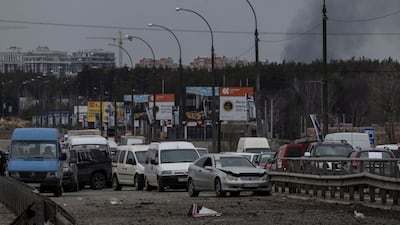
Cars are left abandoned on a road as residents flee the town of Irpin, Ukraine after days of heavy shelling. Reuters -
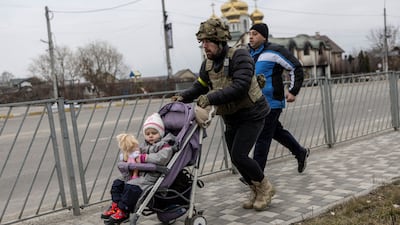
A Ukrainian soldier helps a family fleeing from Irpin. Reuters -
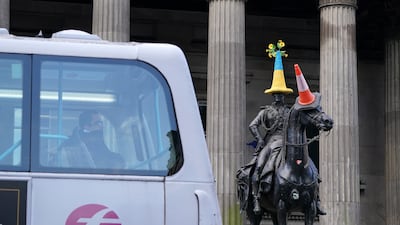
A bus passes the Duke of Wellington statue, which has a traffic cone in the colours of the flag of Ukraine placed on top of it, in Glasgow, Scotland. AP -
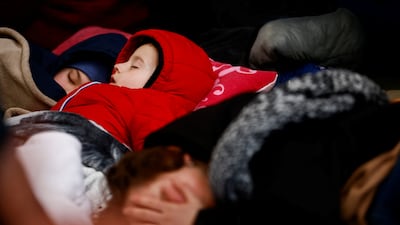
Ukrainian children sleep at the reception point at the train station in Przemysl, Poland. Reuters -
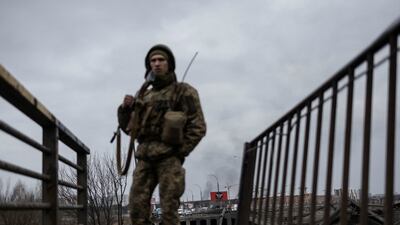
Smoke rises as a Ukrainian soldier stands by the only escape route used by locals to flee from the town of Irpin. Reuters -
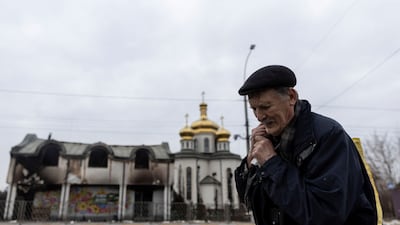
A man flees from Irpin. Reuters -
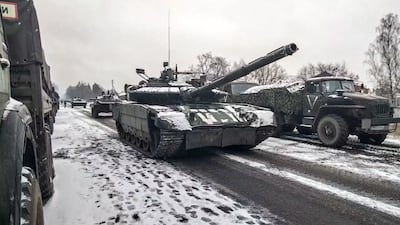
A screengrab from footage released by the Russian Defence Ministry shows a purported Russian tank unit advancement in the Kyiv region. AFP -
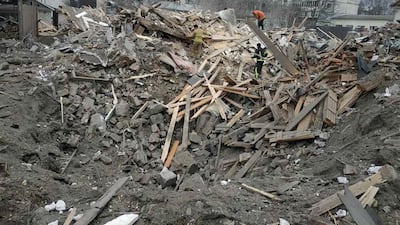
People walk on debris of residential buildings damaged by shelling in the Zhytomyr region. Reuters -

A damaged residential building after Russian multiple rocket launchers shelled the area in the southern city of Mykolaiv. AFP -
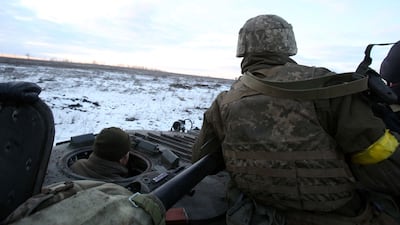
Ukrainian soldiers sit in their armoured vehicle after fighting against Russian troops and Russia-backed separatists near Zolote village, Luhansk region. AFP -
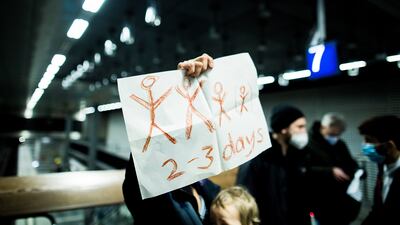
A woman offers accommodation for people fleeing Ukraine at the main railway station in Berlin, Germany. Getty Images -
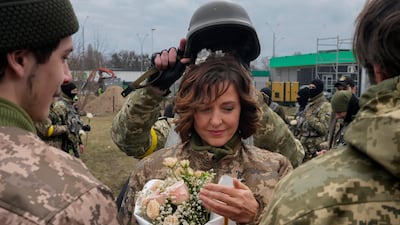
A soldier holds a helmet as a wedding crown during the ceremony for members of the Ukrainian Territorial Defence Forces Lesia Ivashchenko and Valerii Fylymonov, at a checkpoint in Kyiv. AP -
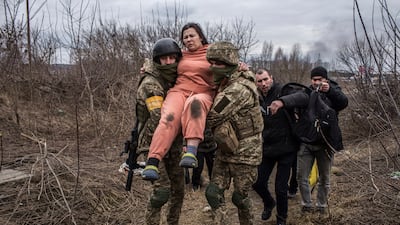
Ukrainian soldiers carry a woman fleeing the town of Irpin. AP -
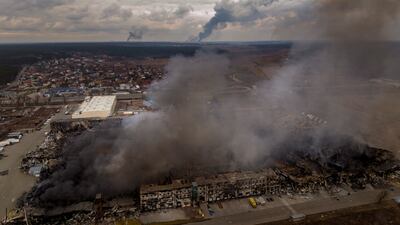
A factory and warehouse burn after being bombarded in Irpin. AP -
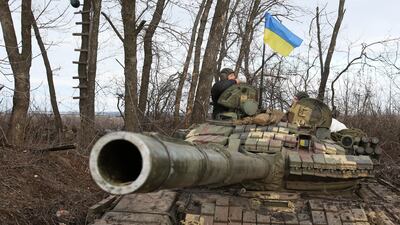
Ukrainian soldiers near Zolote. AFP -
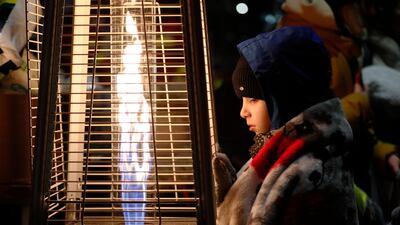
A Ukrainian refugee boy, wearing a blanket on his shoulders, warms his hands with a gas heater shortly after crossing the Siret border into northern Romania. EPA -

People demonstrate against the Russian military operation in Ukraine in Buenos Aires, Argentina. EPA -
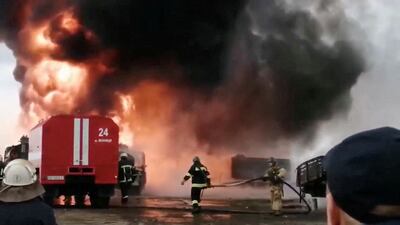
First responders work at the scene after a missile hit a building at Havryshivka Vinnytsia International Airport in Vinnytsia, Ukraine. Reuters -
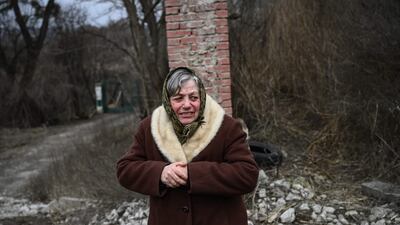
A woman at a checkpoint on the road to Kyiv after her evacuation from a nearby town. AFP -
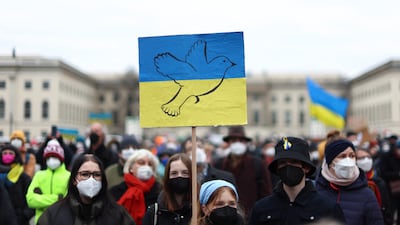
A placard in the Ukrainian colours is held up at an anti-war demonstration the Bebelplatz square in Berlin, Germany. Reuters -
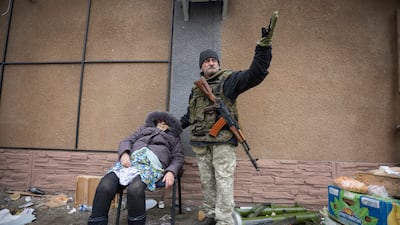
A Ukrainian serviceman helps an elderly woman in Irpin, 20 kilometres north-west of the capital Kyiv. AP Photo -
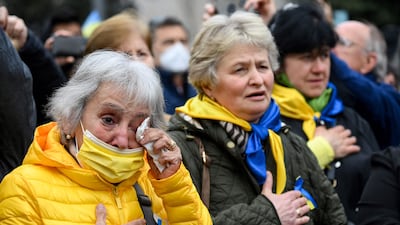
Protesters cry during a demonstration in support of Ukraine at the Plaza Catalunya square in Barcelona. AFP -
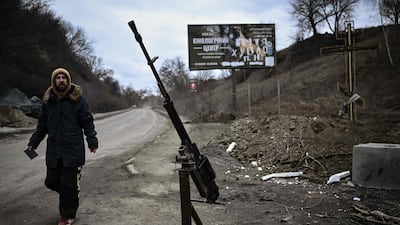
A man walks past a machine gun at a checkpoint next to the last bridge on the road that connects the town of Stoyanka to the outskirts of Ukraine's capital Kyiv. AFP -
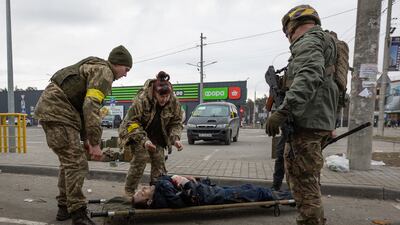
Ukrainian servicemen put a wounded man on a stretcher in Irpin. AP Photo -

People board a train to return to Ukraine after getting supplies in Zahony, Hungary. AP Photo -
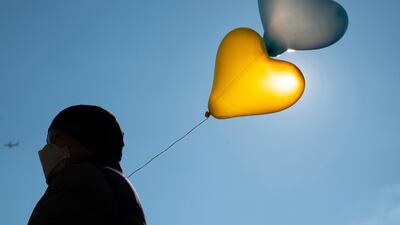
Balloons in the colors of Ukraine during a demonstration against the Russian attack on Ukraine, in Mainz, Germany. AP -
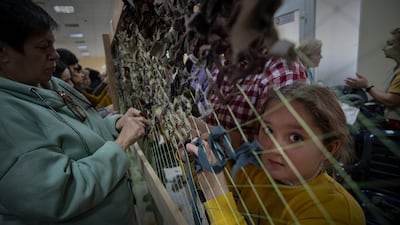
A Ukrainian girl helps to weave a camouflage net for the Ukrainian army, in Odesa. EPA -
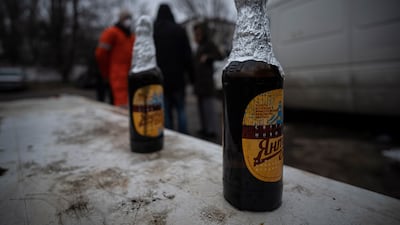
Molotov cocktails prepared by a group of volunteers in Odesa. Hundreds are made every day. EPA -

Ukrainian servicemen assist people fleeing the town of Irpin after crossing the Irpin River on an improvised path under a bridge that was destroyed by a Russian air strike. AP Photo -
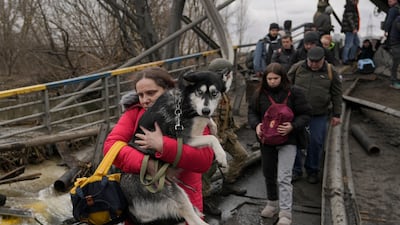
A woman holds a dog while crossing the Irpin River on an improvised path under a bridge that was destroyed by a Russian airstrike, while assisting people fleeing the town of Irpin, Ukraine. AP Photo -
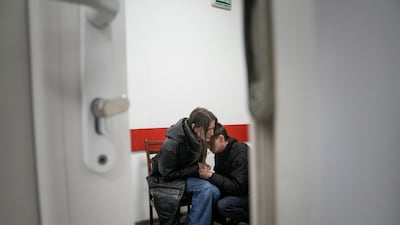
Marina Yatsko and her boyfriend Fedor comfort each other at a hospital in Mariupol after her 18-month-old son Kirill was killed by shelling. AP Photo -
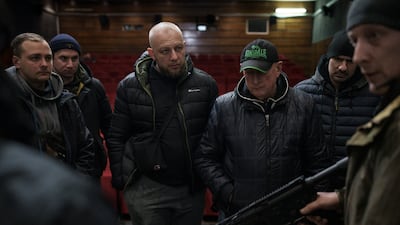
Ukrainian civilians receive weapons training in a cinema in Lviv, western Ukraine. AP Photo -
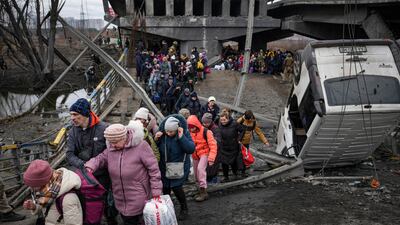
Residents flee the town of Irpin, near Kyiv, Ukraine. AP Photo -
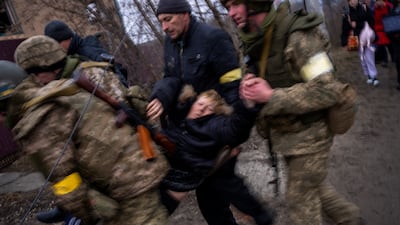
Ukrainian soldiers carry a sick woman as civilians flee Irpin, on the outskirts of Kyiv, after Russian attacks. AP Photo -

Captured Russian soldiers at a press conference in the Interfax news agency in Kyiv, Ukraine. AP Photo -
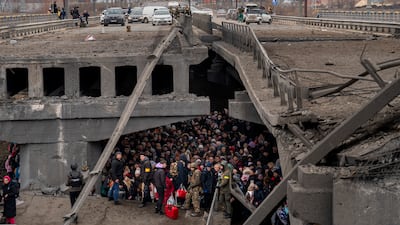
Ukrainians beneath a destroyed bridge in Irpin. AP Photo -
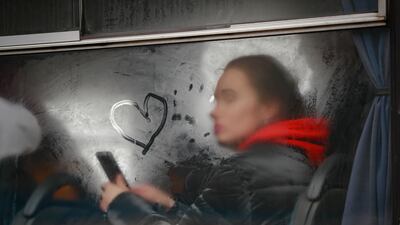
A woman fleeing Ukraine on a bus near the border crossing in Korczowa, Poland. AP Photo -
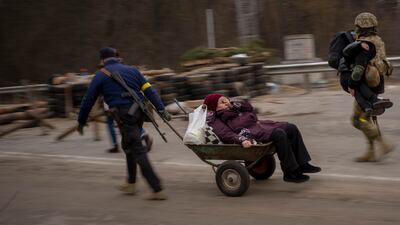
A Ukrainian soldier and a militia man help a fleeing family on the outskirts of Kyiv, Ukraine, on March 5, 2022. AP Photo -
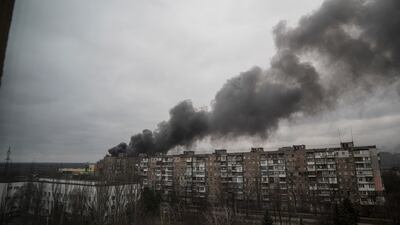
Smoke rises after shelling by Russian forces in Mariupol. AP Photo -
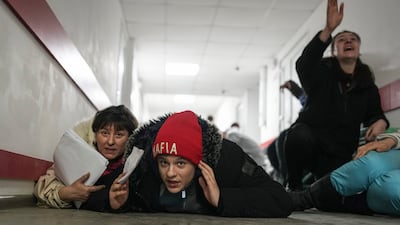
People at a hospital during shelling by Russian forces in Mariupol. AP Photo -
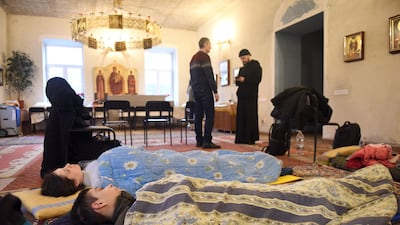
Displaced Ukrainians at the Resurrection New Athos Monastery in the western Ukrainian city of Lviv. AFP


During diplomatic meetings on Monday, British Prime Minister Boris Johnson agreed with allies that more defensive support must be given to Ukraine.
Mr Johnson met Dutch Prime Minister Mark Rutte at Downing Street, with No 10 saying they agreed to “continue to support Ukraine economically, diplomatically and with defensive equipment”.
In later discussions with US President Joe Biden, French President Emmanuel Macron and German Chancellor Olaf Scholz, he stressed that the “goal must be ensuring Putin’s failure in this act of aggression”.
The allies agreed to continue to “isolate” Mr Putin, Downing Street said.
Mr Zelenskyy addressed members of the European Parliament last week and on Saturday gave a video message to the US Senate as his country’s defence against the incursion continues.
The confirmation of the president’s address comes as western focus turns to what more can be done to weaken Russia’s economy in a bid to force Moscow to withdraw from the conflict.
Announcing a further £175 million ($229m) of UK aid for Ukraine, Mr Johnson said Kyiv’s friends must create a “coalition” of support – humanitarian, economic and military – to ensure Mr Putin’s “brutal” invasion fails.
“The president of Russia is plainly doubling down,” he said.
“He has decided that he is going to continue with an all-out onslaught on centres of habitation in a way that we think is utterly repugnant. It’s clear that we’re going to have to do more.”
To tighten the squeeze on the Kremlin’s war chest, Mr Johnson said European countries would have to secure other sources of energy supply if they are to ban Russian oil and gas imports.
US Secretary of State Antony Blinken said at the weekend that Washington was in “very active discussions” with European allies over energy sanctions amid calls from Mr Zelensky for tougher action.
His comments saw gas prices surge by more than 70 per cent to a new all-time high, while the cost of oil reached its highest level for 14 years.
But after talks in Downing Street with Mr Rutte and Canadian Prime Minister Justin Trudeau, the British leader called for a “step by step” approach as European countries weaned themselves off Russian hydrocarbons.
In the UK, he said ministers were looking at the possibility of using more oil and gas from British sources – although he insisted this did not mean abandoning its commitment to reducing carbon emissions.
“It is completely the right thing to do to move away from dependence on Russian hydrocarbons, but we have to do it step by step,” Mr Johnson said alongside Mr Trudeau and Mr Rutte.
“We have got to make sure we have substitute supply. One of the things we are looking at is the possibility of using more of our own hydrocarbons.
“That doesn’t mean we are in any way abandoning our commitment to reducing carbon dioxide, but we have got to reflect the reality that there is a crunch on at the moment. We need to increase our self-reliance.”
Mr Rutte said that if countries moved too quickly to ban Russian oil and gas, it could backfire with “enormous consequences”.
He said the West should be wary of generating “unmanageable risks to energy supply”, including in Ukraine.
Meanwhile, ministers were pushing a new Economic Crime Bill through the Commons on Monday to quickly enable them to impose sanctions on oligarchs.
The government has faced criticism for refusing to open its borders to Ukrainians, but Mr Johnson insisted on Monday that the UK would welcome those fleeing the fighting, with thousands of visa applications being processed.
The Home Office revealed that only “around 50” visas had been granted under the Ukraine Family Scheme as of 10am on Sunday, but Mr Johnson said that thousands of applications were being processed.

