



Live updates: follow the latest news on Russia-Ukraine
Ihtisham Ullah left Bacha Khan University in his native Pakistan in 2016, after four terrorists entered the premises and opened fire on students and staff, killing more than 20.
Last week, following Russia’s attacks on Ukraine, he was again forced to flee university because of violence, abandoning his language studies in the capital, Kyiv,, and going to Germany.
The 28-year-old spent the past six months learning Ukrainian, and intended to stay to study for higher degrees in sociology. His plans are now in tatters and he faces having to restart his studies in a new country.
“I came to complete my master’s and doctorate in Ukraine because it was peaceful … But it also came under attack,” he said.
“The situation was so horrible. We came from Kyiv at about 6am when they attacked. It was a terrible situation in Kyiv and Ukraine.”
On the way to Germany, “the Polish people helped us a lot” and a woman bought Mr Ullah a train ticket so that he could reach Berlin. Two days after arriving in the German capital, he joined the lengthy queue of refugees at an arrival centre for asylum seekers in the grounds of a former hospital in the suburb of Reinickendorf in the north-west of the city.
As well as the processing centre, a short walk away are portable buildings offering temporary accommodation and, close to them, the State Office for Refugee Affairs in Berlin provides hot food and drinks ― especially welcome when temperatures are only a few degrees above freezing.
Larissa Ivanova, 51, a construction project manager from Kyiv, came to register along with her mother, Tanya, 84, and daughter, Oxana, 31. They fled Ukraine by car.
“Every day was boom, boom,” said Mrs Ivanova, whose husband had to remain in Ukraine to look after his bed-ridden mother.
-
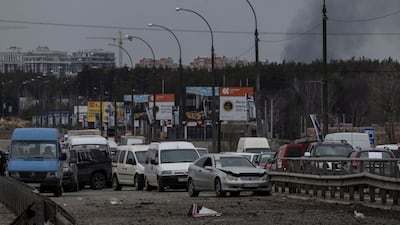
Cars are left abandoned on a road as residents flee the town of Irpin, Ukraine after days of heavy shelling. Reuters -
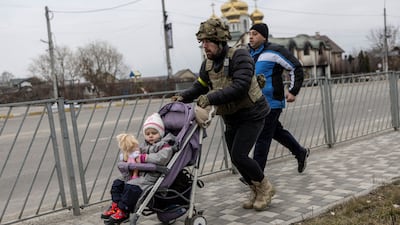
A Ukrainian soldier helps a family fleeing from Irpin. Reuters -

A bus passes the Duke of Wellington statue, which has a traffic cone in the colours of the flag of Ukraine placed on top of it, in Glasgow, Scotland. AP -
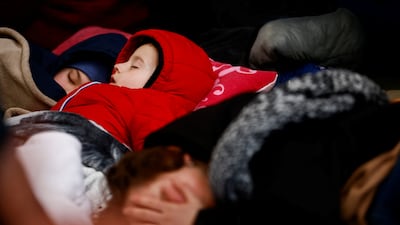
Ukrainian children sleep at the reception point at the train station in Przemysl, Poland. Reuters -
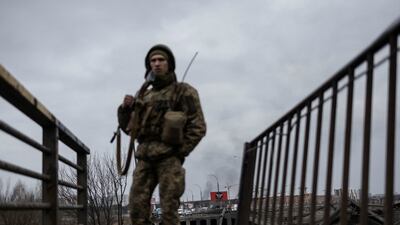
Smoke rises as a Ukrainian soldier stands by the only escape route used by locals to flee from the town of Irpin. Reuters -
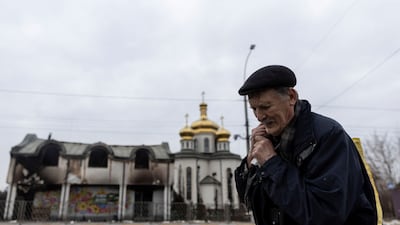
A man flees from Irpin. Reuters -
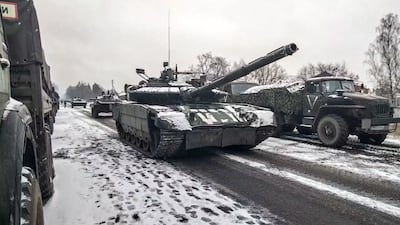
A screengrab from footage released by the Russian Defence Ministry shows a purported Russian tank unit advancement in the Kyiv region. AFP -
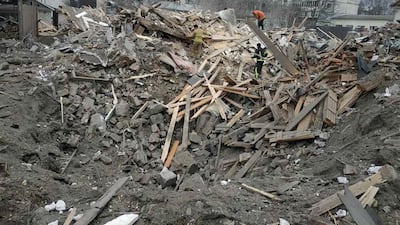
People walk on debris of residential buildings damaged by shelling in the Zhytomyr region. Reuters -

A damaged residential building after Russian multiple rocket launchers shelled the area in the southern city of Mykolaiv. AFP -
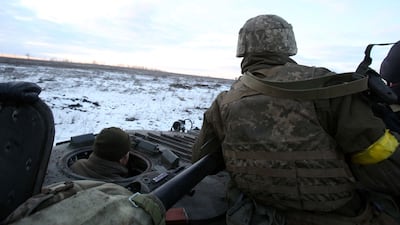
Ukrainian soldiers sit in their armoured vehicle after fighting against Russian troops and Russia-backed separatists near Zolote village, Luhansk region. AFP -
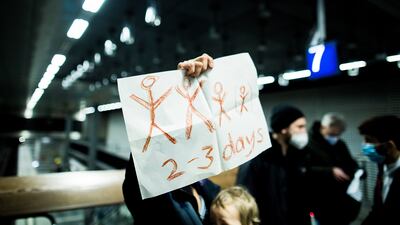
A woman offers accommodation for people fleeing Ukraine at the main railway station in Berlin, Germany. Getty Images -
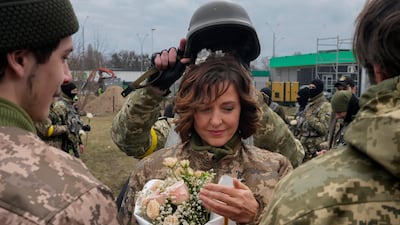
A soldier holds a helmet as a wedding crown during the ceremony for members of the Ukrainian Territorial Defence Forces Lesia Ivashchenko and Valerii Fylymonov, at a checkpoint in Kyiv. AP -
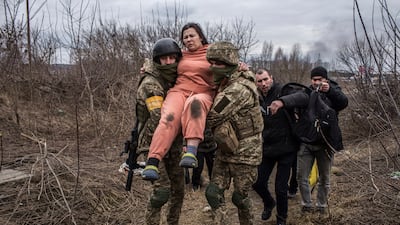
Ukrainian soldiers carry a woman fleeing the town of Irpin. AP -
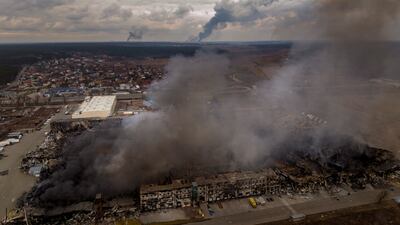
A factory and warehouse burn after being bombarded in Irpin. AP -
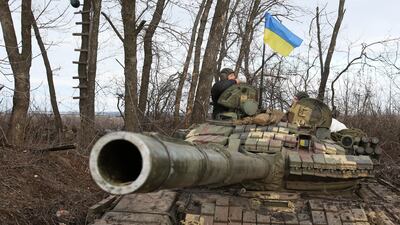
Ukrainian soldiers near Zolote. AFP -
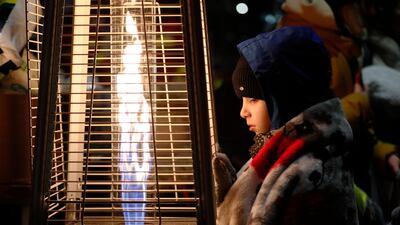
A Ukrainian refugee boy, wearing a blanket on his shoulders, warms his hands with a gas heater shortly after crossing the Siret border into northern Romania. EPA -

People demonstrate against the Russian military operation in Ukraine in Buenos Aires, Argentina. EPA -
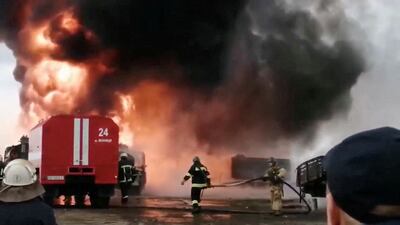
First responders work at the scene after a missile hit a building at Havryshivka Vinnytsia International Airport in Vinnytsia, Ukraine. Reuters -
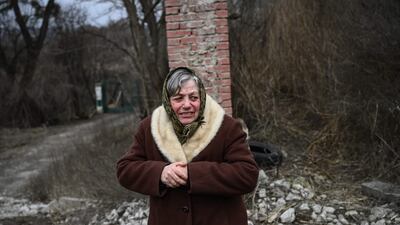
A woman at a checkpoint on the road to Kyiv after her evacuation from a nearby town. AFP -
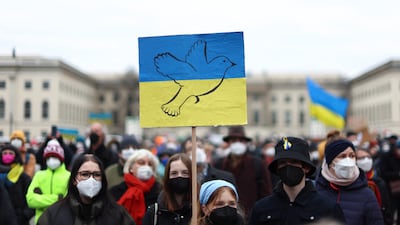
A placard in the Ukrainian colours is held up at an anti-war demonstration the Bebelplatz square in Berlin, Germany. Reuters -
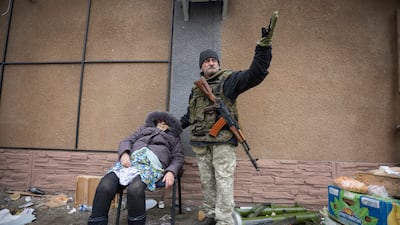
A Ukrainian serviceman helps an elderly woman in Irpin, 20 kilometres north-west of the capital Kyiv. AP Photo -
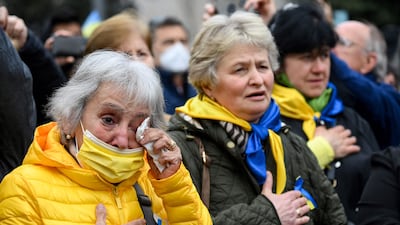
Protesters cry during a demonstration in support of Ukraine at the Plaza Catalunya square in Barcelona. AFP -
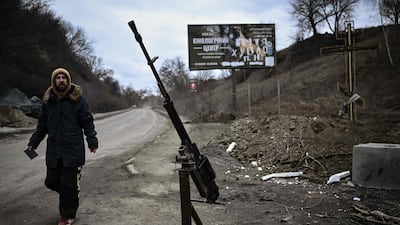
A man walks past a machine gun at a checkpoint next to the last bridge on the road that connects the town of Stoyanka to the outskirts of Ukraine's capital Kyiv. AFP -
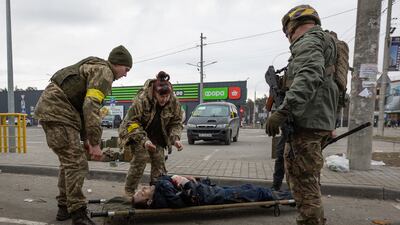
Ukrainian servicemen put a wounded man on a stretcher in Irpin. AP Photo -

People board a train to return to Ukraine after getting supplies in Zahony, Hungary. AP Photo -
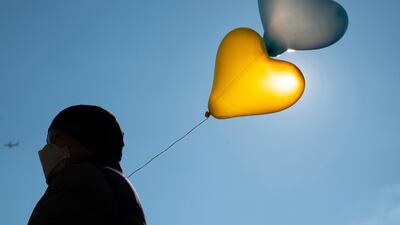
Balloons in the colors of Ukraine during a demonstration against the Russian attack on Ukraine, in Mainz, Germany. AP -
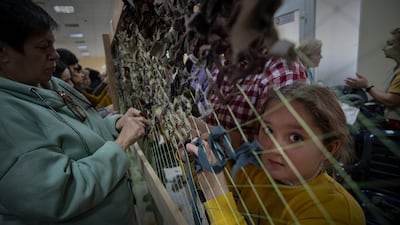
A Ukrainian girl helps to weave a camouflage net for the Ukrainian army, in Odesa. EPA -
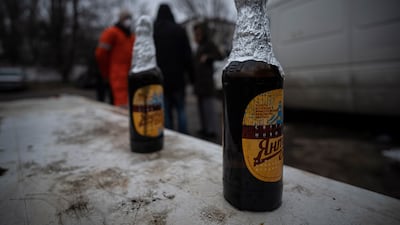
Molotov cocktails prepared by a group of volunteers in Odesa. Hundreds are made every day. EPA -

Ukrainian servicemen assist people fleeing the town of Irpin after crossing the Irpin River on an improvised path under a bridge that was destroyed by a Russian air strike. AP Photo -
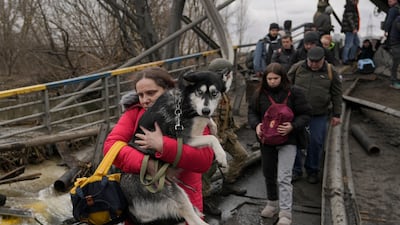
A woman holds a dog while crossing the Irpin River on an improvised path under a bridge that was destroyed by a Russian airstrike, while assisting people fleeing the town of Irpin, Ukraine. AP Photo -
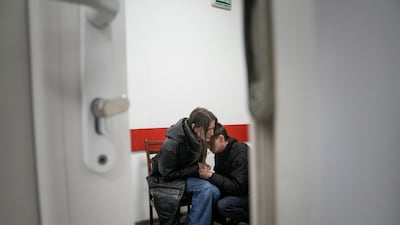
Marina Yatsko and her boyfriend Fedor comfort each other at a hospital in Mariupol after her 18-month-old son Kirill was killed by shelling. AP Photo -
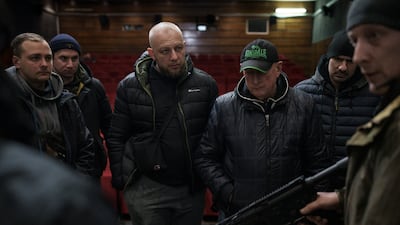
Ukrainian civilians receive weapons training in a cinema in Lviv, western Ukraine. AP Photo -
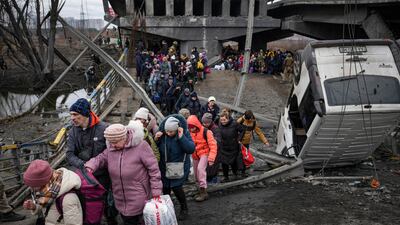
Residents flee the town of Irpin, near Kyiv, Ukraine. AP Photo -
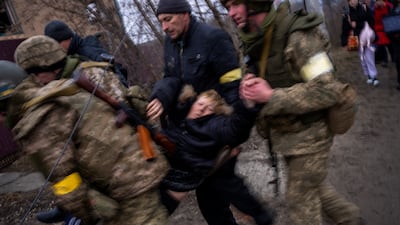
Ukrainian soldiers carry a sick woman as civilians flee Irpin, on the outskirts of Kyiv, after Russian attacks. AP Photo -

Captured Russian soldiers at a press conference in the Interfax news agency in Kyiv, Ukraine. AP Photo -
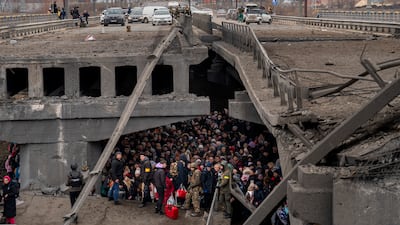
Ukrainians beneath a destroyed bridge in Irpin. AP Photo -
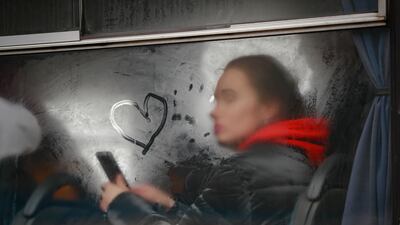
A woman fleeing Ukraine on a bus near the border crossing in Korczowa, Poland. AP Photo -
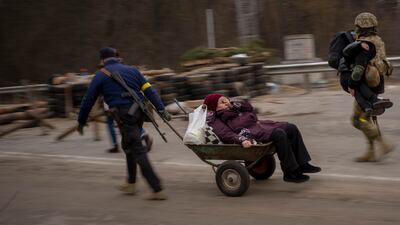
A Ukrainian soldier and a militia man help a fleeing family on the outskirts of Kyiv, Ukraine, on March 5, 2022. AP Photo -
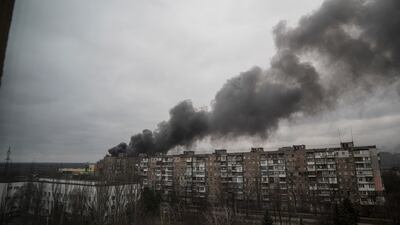
Smoke rises after shelling by Russian forces in Mariupol. AP Photo -
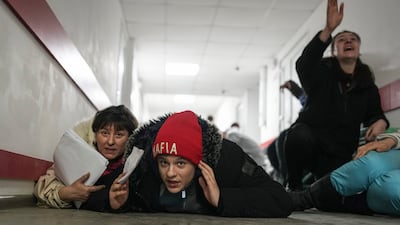
People at a hospital during shelling by Russian forces in Mariupol. AP Photo -
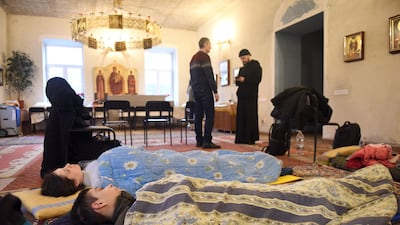
Displaced Ukrainians at the Resurrection New Athos Monastery in the western Ukrainian city of Lviv. AFP


“We started to realise that products had run out – in shops around us it was very expensive, you couldn’t buy food.”
The “very traumatic” journey took four days. They came with their two Chihuahua dogs, Mickey and Bobby, who shivered in the cold as they were held by Mrs Ivanova and her daughter.
The family are among hundreds of thousands of people whose lives were turned upside down after Russia's President Vladimir Putin ordered a military operation in the neighbouring country.
In some cases, Ukrainian refugees are being assisted in Reinickendorf by German people who let them stay in their own homes. Claudia, a company chief executive in Berlin who declined to give her full name, was hosting a Ukrainian boy, Rostik, 14, and his elderly grandmother, Galina, after they fled the city of Dnipro in south-east Ukraine.
Claudia said Galina in particular was traumatised after seeing large numbers of dead Russian soldiers during the journey out of the country. “They saw [them] on the way,” said Claudia.
“They’re very young and there were really many, many of them … It’s bad to talk about. They’re very young – they’re 18, 19.”
Claudia was particularly keen to look after the two fleeing Ukrainians because members of her own family had been forced to flee Poland for Germany in 1945.
“I never expected it to be like this,” she said.
“I grew up with the Cold War. After [former Soviet Union leader Mikhail] Gorbachev, everybody thought, ‘That’s it.’ We never expected it to be like this again.”
Among the other Germans volunteering to help arrivals was Alexander Hoffman, 44, a German army officer who is part of an online group that formed to arrange accommodation for refugees in the homes of local residents.
When refugees arrive at a stand the group has set up near the food stalls in Reinickendorf, he and his fellow volunteers call the locals who have offered accommodation. The hosts then arrive to collect the people they have been matched with.
“People see the kind of terror in Ukraine from the Russian army,” he said. “We think it’s important to help the people. The war is very terrible. The people are innocent. We must help.” He will keep volunteering, he said, “as long as help is needed”.
On Sunday, the United Nations High Commissioner for Refugees, Filippo Grandi, estimated that 1.5 million people had fled Ukraine since Russia invaded, which he described as the fastest mass departure in Europe since the Second World War.
The expectation is that millions more will leave. Poland has taken about half of those who have left so far, and significant numbers of arrivals there have headed on to Germany, which has also been a destination for refugees fleeing through other countries after escaping the terror in Ukraine.
German media reported on Sunday that about 30,000 refugees had arrived in the country. As part of an emergency plan drawn up last week, the EU says Ukrainians will be allowed to live and work in its 27 member countries for up to three years.
In comments made to a German Sunday newspaper, Bild am Sonntag, Nancy Faeser, Germany’s interior minister, promised simplified asylum procedures for refugees fleeing the conflict and said non-Ukrainians who had permanent residence rights in Ukraine “bring this status with them” to Germany.
Ukraine’s large international student population includes many citizens of countries in Africa, Asia and the Middle East, a key reason why a significant number of refugees from the war are not Ukrainian passport holders.
One, Amer Lefdawe, 20, originally from Nablus in the Israeli-occupied West Bank, had to abandon his architecture studies in Kharkiv in north-east Ukraine.
“I lived so normal,” he said of his life in Ukraine.
“Everything was perfect. [But] after the war I couldn’t stay there. I cannot go home because of the war in Palestine.” Sabina Kovalevska, 46, her 14-year-old daughter, Palina, and her 70-year-old mother, Ilina, also fled Kharkiv.
They left after an attack last Tuesday on a nearby military facility blew the windows out of Mrs Kovalevska’s flat. They struggled to get on board packed trains and endured a 20-hour journey during which there was standing room only, before eventually reaching the Czech Republic and going on to Berlin.
“[It is] a real nightmare,” said Mrs Kovalevska, who worked as an administrator in a languages institute.
“In our country … I have work. Enough to live and be good. We want to go back, but we understand some is destroyed. We love our country. It’s very beautiful.”
But, amid the upheaval, on the way to Germany and once they arrived, she and her family have met with much kindness, with free transport and food. “I want to thank all the people,” she said.
Refugees fleeing Ukraine to Berlin – in pictures
-

Laura Lange, 32, said she, her partner and their two-year-old daughter have a “comparatively large flat” and are happy to offer a room to a family in need of shelter. All photos: Daniel Bardsley for The National -

Jonas Herzer, left, is offering accommodation to Marouane Assila, centre, and Ilias Elhayani. -

Kristina Eberhartz, 73, and her husband, Wolfgang, 75, have taken in Halyra Yaremchuk, 37, her husband, Daniel Gerongo Zamara, 28, and the couple’s children, Nattia, 3, and Nicholas, four months. -

Signs at Berlin's main strain station offer help and accommodation for refugees fleeing Ukraine. Passengers said trains from Ukraine were packed with people trying to leave the country. -

Volunteers are offering free food, transport and accommodation for families of all nationalities. -

Berliners hold up signs offering arrivals a place to stay. -

A free market offers goods, basic meals and snacks. -

Refugees fleeing Ukraine are being given accommodation in Berlin.



