

French President Emmanuel Macron has formally announced that he will run for a second term in April’s election, for which he is already leading in the polls.
In a “letter to the French” published on media websites, Mr Macron said: “I am seeking your trust again.
“I am a candidate to invent with you, faced with the century’s challenges, a French and European singular response.”
Mr Macron, 44, had long indicated that he wanted to run in the election, due to be held in two rounds on April 10 and April 24, without formally announcing it until now.
But his initial campaign plans have changed since the start of the Ukraine crisis.
In the past weeks, the centrist president has dedicated most of his time to diplomatic talks with world leaders and co-ordination with European and other western allies.
Conservative candidate Valerie Pecresse and two far-right figures, Marine Le Pen and Eric Zemmour, are expected to be his main challengers.
Left-wing candidates run divided in the race, none of them appearing in a position to qualify for the run-off.
Christiane Taubira, a champion of minority groups, dropped out of the race this week because she did not have enough support.
-
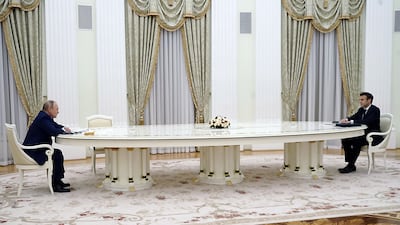
Russian President Vladimir Putin, left, and French President Emmanuel Macron meet in the Kremlin in Moscow. EPA -
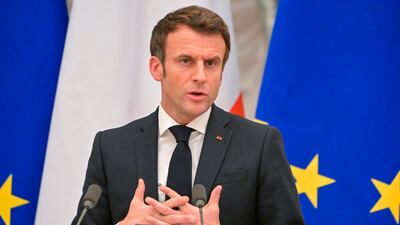
Mr Macron at a joint news conference with Mr Putin after five hours of talks. AP -

Mr Putin said proposals put forward by the French leader during their discussion could form a basis for moving forwards. The crisis was sparked by Russia's massing of troops on its border with Ukraine. EPA -
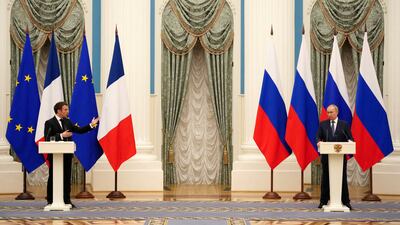
Mr Putin denied that Russia was acting aggressively towards Ukraine or the West. Reuters -

The Russian leader said Ukrainian authorities were to blame for the conflict in the east of the former Soviet state. Reuters -

Mr Macron said the discussion could "make a start in the direction in which we need to go, which is towards a de-escalation". AFP -
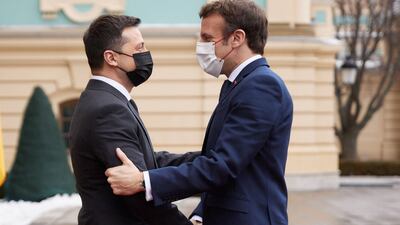
Mr Macron also travelled to Kiev to meet Ukrainian President Volodymyr Zelensky, left. AFP -
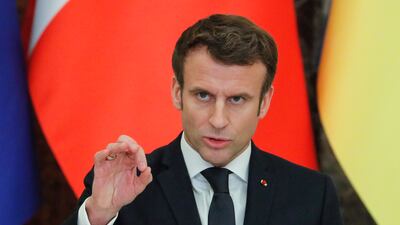
Mr Macron at a joint press conference with his Ukrainian counterpart following their meeting. EPA


Henri Wallard, chairman of the French polling firm Ipsos, said that Mr Macron’s candidacy was boosted by his being in office.
Mr Wallard said 21 million viewers watched his address to the nation this week, which was centred on the Ukraine crisis and its consequences.
“That’s after he spoke nine times to the French during the Covid crisis," the pollster said.
“So he doesn’t play on the same team as the other candidates, because he is already in charge and dealing with a crisis."
Mr Macron’s popularity in recent months has remained relatively stable, with an approval rating hovering at about 40 per cent, depending on which polls.
That is higher than his predecessors Francois Hollande and Nicolas Sarkozy had after nearly five years in office.
Even without a formal candidacy announcement, Mr Macron was the first to receive the legally required 500 endorsements from elected officials.
The rule is intended to limit the number of people running for president.
Mr Macron said in his letter that the Ukraine crisis would prevent him from campaigning “as I would have liked”.
Campaign events will be limited to the minimum for now, French presidency officials said.
Mr Macron want to perform his duties as president at a key time for the European continent not to be disrupted by his candidacy, they said.
France holds the rotating presidency of the EU Council, giving him a key role in organising the 27-nation bloc’s response to Russia’s actions.
When Mr Macron was elected in May 2017 on a pro-business, pro-European platform, he had little political experience.
A former investment banker, he had been economy minister from 2014 to 2016 under Socialist president Mr Hollande.
Mr Macron drew French voters by promising to bring fresh air into politics, managing to attract support from the centre-left and the centre-right.
Almost five year later, he said that “rarely has France faced such an accumulation of crises”, listing extremist attacks, the Covid-19 pandemic and the battle in Ukraine.
-

Sheikh Mohamed bin Zayed, Crown Prince and Deputy Supreme Commander of the Armed Forces, is received by French President Emmanuel Macron at Fontainebleau Palace, near Paris. Photos: Ministry of Presidential Affairs -
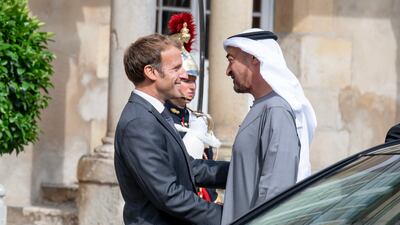
Sheikh Mohamed held talks with the French President on Wednesday. -

The two men spoke about their countries' close ties and opportunities for future development, state news agency Wam reported. -

Sheikh Mohamed conveyed to Mr Macron greetings from the President, Sheikh Khalifa. -

President Macron accompanied Sheikh Mohamed on a tour of Sheikh Khalifa bin Zayed Al Nahyan Theatre, at Fontainebleau Palace. -

Sheikh Mohamed and President Macron pose for a photograph wearing Expo 2020 Dubai wristbands. -

Sheikh Mohamed is received by President Macron at the palace. -

Sheikh Mohamed is received by President Macron at the palace. -

Sheikh Mohamed is received by President Macron, third from left, at the palace. To their left is Ali bin Hammad Al Shamsi, Deputy Secretary General of the UAE Supreme National Security Council. -

President Macron receives Khaldoon Al Mubarak, chief executive and managing director of Mubadala, chairman of Abu Dhabi Executive Affairs Authority and Abu Dhabi Executive Council member. They are with Sheikh Mohamed bin Zayed. -

Hend Al Otaiba, UAE Ambassador to France, greets President Macron at Fontainebleau Palace as Sheikh Mohamed bin Zayed looks on. -

Sheikh Mohammed bin Hamad bin Tahnoon, Chairman of Abu Dhabi Airports, greets President Macron as Sheikh Mohamed bin Zayed looks on. -

A fond farewell.


Mr Macron made changes to the economy to boost job creation and cut taxes on businesses. He notably eased rules to hire and fire workers and to make it harder to get unemployment benefits.
Critics say his policies threaten the French welfare state.
He faced the first major crisis of his term when the anti-government yellow vest protest movement broke out at the end of 2018.
Named after the vests French drivers must keep in their cars for emergencies, it started with demonstrations against a planned fuel tax rise and quickly spread into a broader movement against economic injustice.
For months, weekly protests across the country often degenerated into scattered violence.
In 2020, the Covid-19 pandemic led Mr Macron to declare the country “at war” against the virus.
After a lockdown-fuelled recession, his government focused on supporting the economy with a €100 billion ($110.6bn) recovery plan.
The pandemic forced Mr Macron to delay some economic reforms, including a difficult overhauling of France’s pension system that he had promised to push through.
“We did not succeed in everything,” Mr Macron acknowledged in his letter.
“Thanks to reforms, our industry created jobs again for the first time and unemployment has reached its lowest level in 15 years."
The unemployment rate recently reached 7.4 per cent, down from more than 10 per cent when he came into power.
“I’m a candidate to continue preparing the future of our children and our grandchildren,” Mr Macron said.

