



At 7.30am local time, the Munich Security Conference began its official, but closed-door, programme, with a series of breakfasts tackling issues of security, diplomacy and how to mitigate the many risks facing the world.
However, it will be at 1.30pm that the public programme and official opening kicks off, with a session entitled “International Co-operation in a time of mounting crises and meeting global challenges”.
While the session includes the UN Secretary General Antonio Guterres as the main representative of “international co-operation”, it is dominated by Europe and the US, with their global viewpoints.
German Minister for Foreign Affairs Annalena Baerbock and US Secretary of State Anthony Blinken will address the conference, followed by US Vice President Kamala Harris.
There is a sense of change across the board in Munich this year.
A new German government is taking the helm and its key actors, including the chancellor, foreign and defence ministers, are speaking on stage and holding a multitude of meetings to unveil their policies and approach to global affairs.
It is also the meeting in which Wolfgang Ischinger, chairman of the Munich Security Conference, will hand over the leadership of the conference after 14 years.
Christoph Heusgen, who has often been described as former German chancellor Angela Merkel’s closest diplomatic and security adviser, takes the helm at this conference and gives a sense of continuity that many who cherished Ms Merkel’s approach will appreciate.
A notable absence this year will be the security and foreign policy situation in Afghanistan after last summer's withdrawal of US and Nato forces from the country. While a handful of sessions at this year's summit will address the issue of militancy, there are no dedicated sessions on the Afghanistan and little attention being paid. No representative from the country will be in attendance either.
Twenty years after the invasion of Afghanistan, it appears the policy and security leaders in Europe and America would rather step away from probing the disastrous withdrawal, to heal transatlantic rifts and disagreements.
Of course, the unifying factor is the shadow of a possible war in Ukraine.
-
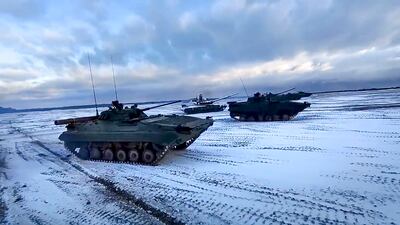
Russian and Belarus troops held joint combat training at firing ranges in Belarus as tensions remain high under the looming threat of war with Ukraine. AP Photo -
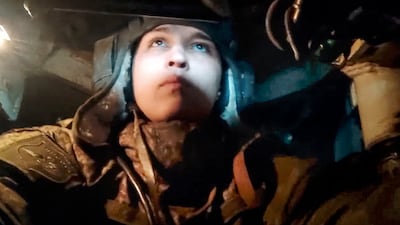
A soldier drives an armoured vehicle at Brestsky firing range, Belarus. AP Photo -
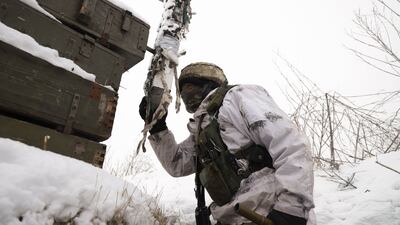
A Ukrainian serviceman carries out checks not far from the pro-Russian militant-controlled city of Donetsk, Ukraine. EPA -
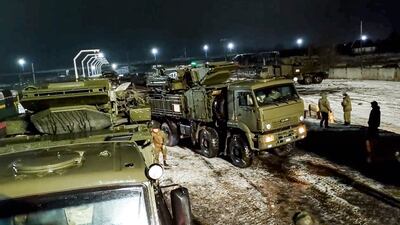
A Russian military vehicle drives off a railway platform after arriving in Belarus. AP Photo -
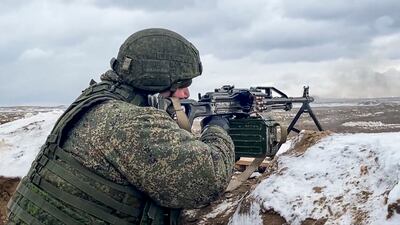
A soldier takes aim during a Russian and Belarusian military drill at Brestsky firing range. AP Photo -

A Ukrainian serviceman repairs a shelter near Donetsk, Ukraine. EPA -
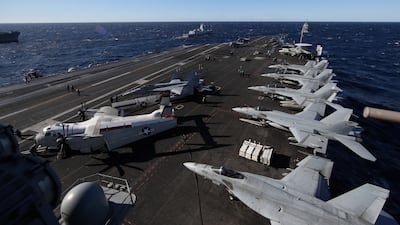
Aircraft are lined up on 'USS Harry S Truman' in the Adriatic Sea. The Truman strike group is operating under Nato command and control along with several other Nato allies for co-ordinated maritime manoeuvres, anti-submarine warfare training and long-range training. Reuters -
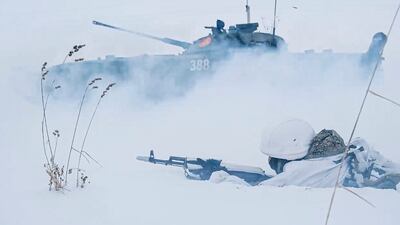
Russian soldiers attend the Yurginsky training ground in the Kemerovo region, Russia. AP Photo -
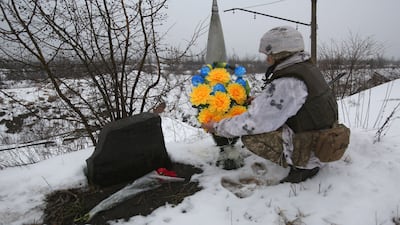
A Ukrainian serviceman lays flowers where one of his friends was killed in 2017 near Avdiivka. Anatolii Stepanov / AFP -

A Ukrainian serviceman stands guard in a dugout on the frontline with the Russia-backed separatists near Avdiivka. AFP -
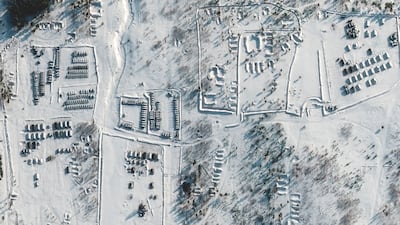
This satellite image shows troops gathered at a training ground in Pogonovo, Russia. AP Photo


There is a marked absence of Russian officials and diplomats from the event, with a multitude of side meetings and discussions on how to deal with Russia and the possibility of war.
Ukrainian President Volodymyr Zelensky is among a number of Ukrainians attending the conference.
The question of “will Russian President Vladimir Putin invade?” is hanging over the event, with a wider question of how Europe and Nato will emerge from this current crisis, having not yet dealt with the ramifications of the Afghanistan withdrawal six months ago.
The issues of climate, the Sahel and the possibility of a nuclear deal with Iran are expected to be tackled, but are in many ways secondary to Ukraine discussions and developments.
Of course, one major change at the Munich Security Conference this year is the effect of the Covid-19 pandemic.
-

A German police officer receives a dose of AstraZeneca's vaccine in Mainz, Germany. Reuters -

German Chancellor Angela Merkel wears a face mask as she attends a session of German parliament Bundestag in Berlin. AP Photo -

A nurse vaccinates an elderly local resident at a mobile vaccination center in Bannewitz, Germany. Getty Images -
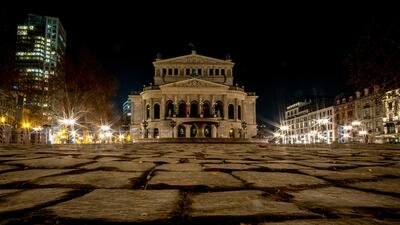
The square in front of the Old Opera is seen empty in central Frankfurt. AP Photo -

A laboratory assistant works on antigen rapid tests in Flensburg, Germany. The B117 variant of coronavirus is now accounting for the vast majority of new infections in Flensburg. Getty Images -

A health worker tests a person at a free of charge Covid-19 test center in Naumburg in the Burgenland region. AFP -

People walk at the banks of the river Spree during sunny weather in a quiet Berlin. EPA -

A volunteer dishes out food at a soup kitchen for the needy and homeless in the Holy Cross church in Berlin's Kreuzberg district. AFP


Delegates attending the conference began to congregate on Thursday, with many trying to figure out the intricate and detailed instructions given by the organisers about Covid-19 measures.
In addition to daily Covid-19 testing and the need for proof of vaccination, the organisers have initiated a system of daily colour-coded wristbands and face masks to quell any Covid-19 cases.
Without a negative PCR test result in the past 24 hours, no delegate can attend the conference – and there are no exceptions.
One thing this event does not want to be remembered for is as a super-spreader event. If it can succeed in bringing hundreds of people together in close contact, it could end up setting a precedent for how international gatherings can happen in the current climate.
Even more importantly, it does not want to be remembered as the event where western leaders gathered to talk as Mr Putin acted on the ground.

