


Russia handed Britain a diplomatic rebuke on Friday as it described relations between the two countries as "close to zero, and about to cross the zero meridian and go into negative".
The remarks by Defence Minister Sergei Shoigu came despite two ministerial visits from Britain in two days aimed at defusing the crisis in Ukraine.
After a week of frenzied diplomacy, western leaders were due to huddle on Friday afternoon in a call between US President Joe Biden and the heads of Nato, the EU and European governments.
UK Defence Secretary Ben Wallace, who was in Moscow for talks on Friday, said he had told Mr Shoigu about the "tragic consequences" that any invasion of Ukraine would have.
He said "took seriously" Moscow's claim that it is not planning an invasion, and was open to giving Russia reassurances to address what he called its misconceptions about Nato.
But Britain endured a second day of taunts after testy exchanges on Thursday between Foreign Secretary Liz Truss and Russia's Sergey Lavrov.
"The military and political situation in Europe is becoming increasingly tense. And it is not our fault at all," Mr Shoigu told Russian news agencies.
Mr Wallace travelled to Moscow armed with the threat of tougher sanctions if Russia invades Ukraine, after the British government gave itself wider powers to punish people and businesses linked to the Kremlin.
Asked about Mr Lavrov's description of his talks with Ms Truss as being like a conversation between "deaf and dumb", Mr Wallace said he believed his own discussions had improved the atmosphere.
"I think minister Lavrov is a master at these types of engagements and making those types of comments," he said. “In our discussion there was absolutely no deafness or blindness."
-
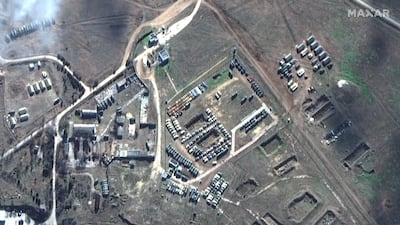
A satellite image shows new deployments and military equipment in Novoozernoye, Crimea. Reuters -
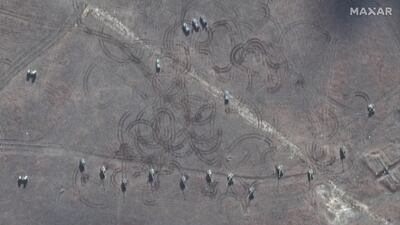
Multiple rocket launchers and self-propelled artillery training. Reuters -

New deployments in Novoozernoye. Reuters -
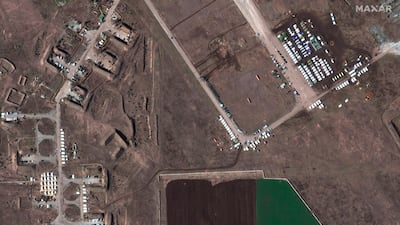
An overview of a camp and equipment at Oktyabrskoye airfield. AP Photo -

Troop deployments at the airfield. AFP -

A new military deployment and armoured vehicles. Reuters -
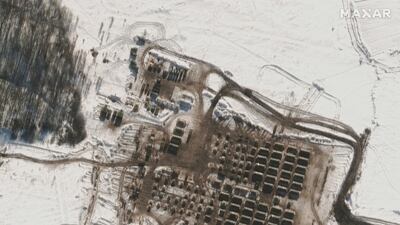
Tents and troop housing area in Kursk Training Area, Russia. Reuters -
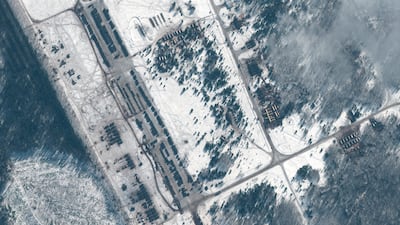
An overview of deployments at Zyabrovka airfield in Gomel, less than 25 kilometres from Ukraine-Belarus border. AP Photo -
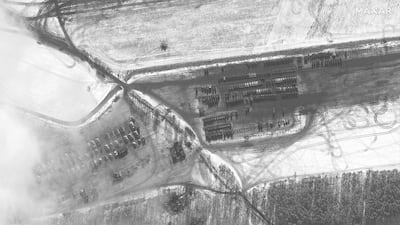
A troop housing area and battle group vehicles at park rechitsa in Belarus. AFP


Russian drills
Russia is pressing ahead with military drills close to the sensitive border, with 400 troops taking part in a tactical exercise on Friday in a region near Ukraine.
The drills were expected involve 70 military vehicles, grenade launchers and unmanned aerial equipment, the Russian Defence Ministry said.
The ministry separately said the Russian Black Sea Fleet had held exercises including training on "searching and destroying ships of a mock enemy". War games with its ally Belarus are set to run until February 20.
New satellite images taken this week appeared to show further Russian movements in Crimea, Belarus and near Ukraine, after the build-up of more than 100,000 troops had led to fears of an invasion.
Keen to avoid a war, diplomats and heads of government have criss-crossed Europe this week in the hope of persuading Russia to back down, even though Moscow denies intentions to invade Ukraine.
UK Prime Minister Boris Johnson weighed in with a visit to Poland and Nato headquarters on Thursday, after France’s Emmanuel Macron and Germany’s Olaf Scholz made headline visits to Moscow and Washington earlier in the week.
Mr Wallace, who laid a wreath at a Moscow war memorial on Friday, said relations with Russia were above zero but that progress was slow.
Western powers have repeatedly told Russia it would face severe costs if it invades Ukraine but have kept details vague on what those sanctions might be.
Britain moved to toughen those sanctions this week by widening the pool of potential targets, to include businesses of strategic significance to the Kremlin.

These could include the defence, chemical, mineral extraction, communications and financial service industries, the UK Foreign Office said.
The order came into effect before being scrutinised by MPs, who now have 28 days to approve the changes – a manoeuvre criticised by some opposition figures.
“It is completely autocratic for the government to publish legislation without any opportunity for anybody to scrutinise it,” Labour MP Chris Bryant said.
Western powers reject Russia’s demands that any further eastward expansion of Nato should be prevented. Alliance leaders say this is none of Moscow’s business.

