• Prof Thomas Perlmann, secretary general for the Nobel Assembly and Nobel Committee, announces the winners of the 2021 Nobel Prize in Physiology or Medicine at the Karolinska Institute in Stockholm, Sweden. Photo: AP
    Prof Thomas Perlmann, secretary general for the Nobel Assembly and Nobel Committee, announces the winners of the 2021 Nobel Prize in Physiology or Medicine at the Karolinska Institute in Stockholm, Sweden. Photo: AP
  • Nobel Committee member Prof Patrik Ernfors, right, talks about this year’s prize. Photo: AP
    Nobel Committee member Prof Patrik Ernfors, right, talks about this year’s prize. Photo: AP
  • Nobel Committee member Prof Patrik Ernfors, right, talks about this year’s prize. Photo: AP
    Nobel Committee member Prof Patrik Ernfors, right, talks about this year’s prize. Photo: AP
  • Prof Ernfors explains the research field of the winners of the 2021 Nobel Prize in Physiology or Medicine, David Julius and Ardem Patapoutian. Photo: AP
    Prof Ernfors explains the research field of the winners of the 2021 Nobel Prize in Physiology or Medicine, David Julius and Ardem Patapoutian. Photo: AP
  • Prof Ernfors explains the research field of the winners of the 2021 Nobel Prize in Physiology or Medicine, David Julius and Ardem Patapoutian. Photo: AFP
    Prof Ernfors explains the research field of the winners of the 2021 Nobel Prize in Physiology or Medicine, David Julius and Ardem Patapoutian. Photo: AFP

Nobel Prize for Medicine awarded to US scientists David Julius and Ardem Patapoutian


Tim Stickings
  • English
  • Arabic

Two scientists who made landmark discoveries about human senses have won the Nobel Prize for Medicine, beating vaccine pioneers to the prestigious award.

The two Americans, David Julius and Lebanon-born Ardem Patapoutian, were named the winners on Monday after making breakthrough findings on how people sense heat, cold and touch.

Announcing the winners after balloting behind closed doors on Monday, the Nobel jury said the US duo had broken open a "fundamental unsolved question" about human biology.

"This really unlocks one of the secrets of nature," said Thomas Perlmann, the secretary of the Nobel Committee.

"It's actually something that is crucial for our survival, so it's a very important and profound discovery."

The winners were informed early on Monday. "They were incredibly happy, and as far as I could tell, they were very surprised," Mr Perlmann said. Nominees are not told that they are under consideration.

Mr Perlmann could not initially reach Dr Patapoutian in the early hours of the California morning. But Nobel organisers managed to track down the scientist's 92-year-old father, who passed on the message.

"I heard it from him, which was very special," said Dr Patapoutian.

The coveted award comes with a gold medal and 10 million Swedish krona ($1.14m), which is drawn from a bequest by Swedish industrialist Alfred Nobel in 1895.

Chili pepper breakthrough

Dr Julius, 65, is a professor at the University of California, San Francisco who used a pungent substance found in chili peppers to find a sensor in the skin that detects heat. His research stretches back to the 1990s.

He identified a single protein that makes people react to the chemical and to other painful sensations. His laboratory has used chemicals from horseradish and wasabi and toxins from snakes and tarantulas.

"David’s work epitomises the creativity, scientific rigour, and courage needed to pursue the major unsolved mysteries of biology," said university chancellor Sam Hawgood.

Dr Patapoutian, who was born in Lebanon in 1967 and moved to the US as a young man, works at Scripps Research in La Jolla, California. He identified genes that control sensitivity to touch.

The proteins he discovered also play a role in how people sense motion and how the body deals with blood pressure, respiration and bladder control.

He said his research had shone light on fundamental human behaviour which many people rarely question. "In science, many times, it’s the things that we take for granted that are of high interest," he said.

"Being in the field of sensing touch and pain, this was kind of the big elephant in the room... it was a difficult question to answer."

The findings made by the two scientists are being used to develop treatments for a range of ailments, including chronic pain, the Nobel jurors said.

Abdel El Manira, a member of the Nobel committee, said the receptors discovered by the two scientists helped people to avert danger.

"If we put our hand in a burning fire, these receptors send information to our brain and tell us to avoid touching a burning place," he said.

Nobel nominations are kept secret for 50 years, meaning there is no word on who else was considered for the prize.

Nobel season begins

Vaccine scientists won other prestigious awards this year, fuelling speculation that they would be in line for the Nobel after helping to turn the tide against Covid-19.

The fact they were overlooked this year does not mean they cannot win in the future. Scientists sometimes win a Nobel many years after their discovery.

The other Nobel Prizes, which honour outstanding work in the fields of physics, chemistry, literature and peace, will be handed out later this week.

A prize for economics, which was not one of the original awards created by Alfred Nobel, was added in 1968. The winner will be named next week.

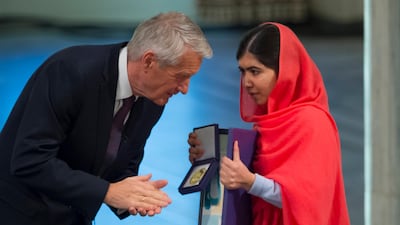
  • Malala Yousafzai became the youngest person to receive this prize in 2014. Getty Images
    Malala Yousafzai became the youngest person to receive this prize in 2014. Getty Images
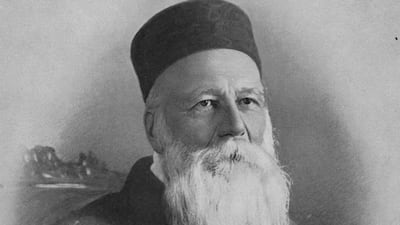
  • Swiss philanthropist Jean Henri Dunant was one of the first to receive the Nobel Peace Prize in 1901 for his role in the founding of the International Red Cross. Getty Images
    Swiss philanthropist Jean Henri Dunant was one of the first to receive the Nobel Peace Prize in 1901 for his role in the founding of the International Red Cross. Getty Images
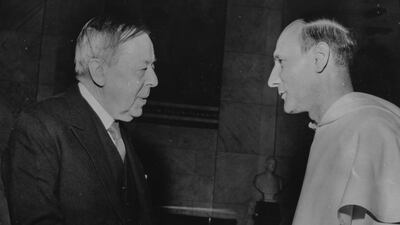
  • Belgian Dominican friar Dominique Pire's (right) work helping refugees in post-World War II Europe saw him receive the Nobel Peace Prize in 1958. Getty Images
    Belgian Dominican friar Dominique Pire's (right) work helping refugees in post-World War II Europe saw him receive the Nobel Peace Prize in 1958. Getty Images
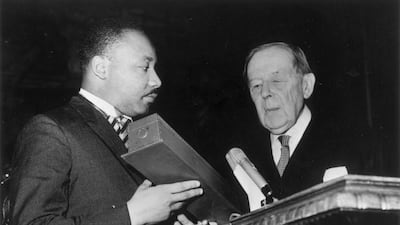
  • American civil rights leader Martin Luther King, Jr., left, announced that he would turn over the prize money to the furtherance of the civil rights movement. Getty Images
    American civil rights leader Martin Luther King, Jr., left, announced that he would turn over the prize money to the furtherance of the civil rights movement. Getty Images
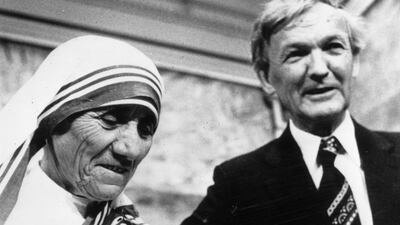
  • Mother Teresa was awarded the Nobel Peace Prize for her humanitarian work with the poor in 1979. Getty Images
    Mother Teresa was awarded the Nobel Peace Prize for her humanitarian work with the poor in 1979. Getty Images
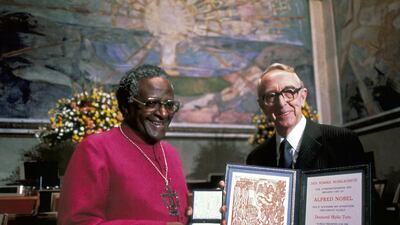
  • South African Archbishop Mgr Desmond Tutu, left, was honored with the Peace Prize for his opposition to apartheid. AFP
    South African Archbishop Mgr Desmond Tutu, left, was honored with the Peace Prize for his opposition to apartheid. AFP
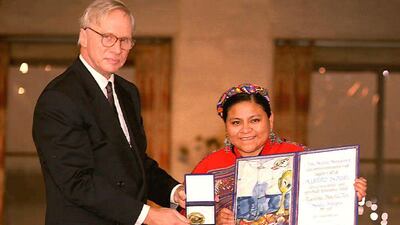
  • Guatemalan Indian activist Rigoberta Menchu, right, was the ninth woman to win the award. AFP
    Guatemalan Indian activist Rigoberta Menchu, right, was the ninth woman to win the award. AFP
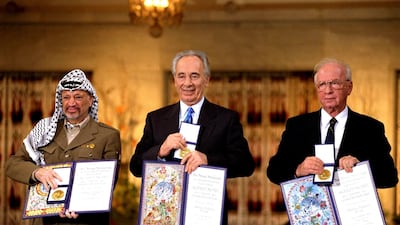
  • From left: Palestinian leader Yaser Arafat, Israeli Foreign Minister Shimon Peres and Israeli Prime Minister Yitzak Rabin are the joint Nobel Peace Prize winners for 1994 for their efforts to create peace in the Middle East. Getty Images
    From left: Palestinian leader Yaser Arafat, Israeli Foreign Minister Shimon Peres and Israeli Prime Minister Yitzak Rabin are the joint Nobel Peace Prize winners for 1994 for their efforts to create peace in the Middle East. Getty Images
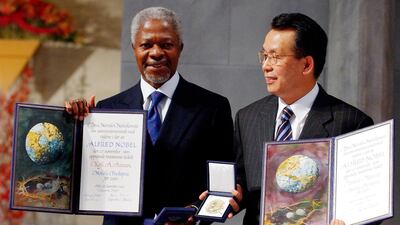
  • President of the UN General Assembly, South Korean Foreign Minister Han Seung-soo, right, looks at Secretary-General of the United Nations Kofi Annan at the Nobel Peace Awards in 2001. The prize was awarded to Annan for his work as secretary-general and the UN represented by Han Seung-soo. AFP
    President of the UN General Assembly, South Korean Foreign Minister Han Seung-soo, right, looks at Secretary-General of the United Nations Kofi Annan at the Nobel Peace Awards in 2001. The prize was awarded to Annan for his work as secretary-general and the UN represented by Han Seung-soo. AFP
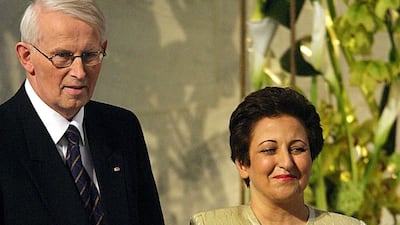
  • Iranian lawyer and human rights activist Shirin Ebadi, right, receives the 2003 Nobel Peace Prize for her democracy-building efforts and her work to improve human rights in Iran, making her the first Muslim woman to receive the award. AFP
    Iranian lawyer and human rights activist Shirin Ebadi, right, receives the 2003 Nobel Peace Prize for her democracy-building efforts and her work to improve human rights in Iran, making her the first Muslim woman to receive the award. AFP
  • Mohamed ElBaradei, director general of the International Atomic Energy Agency, left, and Yukiya Amano, chairman of its board of governors, received the 2005 Nobel Peace Prize at a ceremony for their efforts to halt the spread of nuclear weapons. AFP
    Mohamed ElBaradei, director general of the International Atomic Energy Agency, left, and Yukiya Amano, chairman of its board of governors, received the 2005 Nobel Peace Prize at a ceremony for their efforts to halt the spread of nuclear weapons. AFP
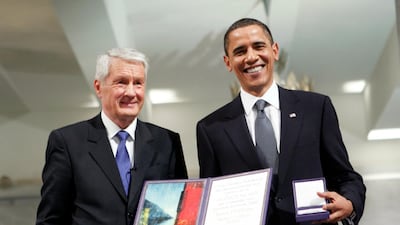
  • US President Barack Obama was awarded the 2009 Nobel Peace Prize "for his extraordinary efforts to strengthen international diplomacy and cooperation between peoples." AFP
    US President Barack Obama was awarded the 2009 Nobel Peace Prize "for his extraordinary efforts to strengthen international diplomacy and cooperation between peoples." AFP
  • Dr. Denis Mukwege and Nadia Murad have been jointly awarded the 2018 Nobel peace prize in recognition for their efforts to end the use of sexual violence as a weapon in war. Getty Images
    Dr. Denis Mukwege and Nadia Murad have been jointly awarded the 2018 Nobel peace prize in recognition for their efforts to end the use of sexual violence as a weapon in war. Getty Images

Mercer, the investment consulting arm of US services company Marsh & McLennan, expects its wealth division to at least double its assets under management (AUM) in the Middle East as wealth in the region continues to grow despite economic headwinds, a company official said.

Mercer Wealth, which globally has $160 billion in AUM, plans to boost its AUM in the region to $2-$3bn in the next 2-3 years from the present $1bn, said Yasir AbuShaban, a Dubai-based principal with Mercer Wealth.

Within the next two to three years, we are looking at reaching $2 to $3 billion as a conservative estimate and we do see an opportunity to do so,” said Mr AbuShaban.

Mercer does not directly make investments, but allocates clients’ money they have discretion to, to professional asset managers. They also provide advice to clients.

“We have buying power. We can negotiate on their (client’s) behalf with asset managers to provide them lower fees than they otherwise would have to get on their own,” he added.

Mercer Wealth’s clients include sovereign wealth funds, family offices, and insurance companies among others.

From its office in Dubai, Mercer also looks after Africa, India and Turkey, where they also see opportunity for growth.

Wealth creation in Middle East and Africa (MEA) grew 8.5 per cent to $8.1 trillion last year from $7.5tn in 2015, higher than last year’s global average of 6 per cent and the second-highest growth in a region after Asia-Pacific which grew 9.9 per cent, according to consultancy Boston Consulting Group (BCG). In the region, where wealth grew just 1.9 per cent in 2015 compared with 2014, a pickup in oil prices has helped in wealth generation.

BCG is forecasting MEA wealth will rise to $12tn by 2021, growing at an annual average of 8 per cent.

Drivers of wealth generation in the region will be split evenly between new wealth creation and growth of performance of existing assets, according to BCG.

Another general trend in the region is clients’ looking for a comprehensive approach to investing, according to Mr AbuShaban.

“Institutional investors or some of the families are seeing a slowdown in the available capital they have to invest and in that sense they are looking at optimizing the way they manage their portfolios and making sure they are not investing haphazardly and different parts of their investment are working together,” said Mr AbuShaban.

Some clients also have a higher appetite for risk, given the low interest-rate environment that does not provide enough yield for some institutional investors. These clients are keen to invest in illiquid assets, such as private equity and infrastructure.

“What we have seen is a desire for higher returns in what has been a low-return environment specifically in various fixed income or bonds,” he said.

“In this environment, we have seen a de facto increase in the risk that clients are taking in things like illiquid investments, private equity investments, infrastructure and private debt, those kind of investments were higher illiquidity results in incrementally higher returns.”

The Abu Dhabi Investment Authority, one of the largest sovereign wealth funds, said in its 2016 report that has gradually increased its exposure in direct private equity and private credit transactions, mainly in Asian markets and especially in China and India. The authority’s private equity department focused on structured equities owing to “their defensive characteristics.”

Men’s singles 
Group A:
Son Wan-ho (Kor), Lee Chong Wei (Mas), Ng Long Angus (HK), Chen Long (Chn)
Group B: Kidambi Srikanth (Ind), Shi Yugi (Chn), Chou Tien Chen (Tpe), Viktor Axelsen (Den)

Women’s Singles 
Group A:
Akane Yamaguchi (Jpn), Pusarla Sindhu (Ind), Sayaka Sato (Jpn), He Bingjiao (Chn)
Group B: Tai Tzu Ying (Tpe), Sung Hi-hyun (Kor), Ratchanok Intanon (Tha), Chen Yufei (Chn)

Updated: October 08, 2021, 1:04 PM