
Lava continued to flow on Monday after a volcano erupted on Spain’s La Palma island, forcing the relocation of 5,000 people, including about 500 tourists.
In the town of Los Llanos de Aridane, mayor Noelia García said people had been moved from houses all the way down to the shoreline.
La Palma, with a population of 85,000, is one of eight volcanic islands in Spain’s Canary Islands archipelago off Africa’s western coast. At their nearest point to Africa, the islands are about 100 kilometres from Morocco.
On the island, lava was flowing toward the sea, moving at 700 metres per hour, the Canary Islands Volcanology Institute said. It destroyed about 120 homes
The volcano, Cumbre Vieja, had been dormant for 50 years.
Huge plumes of black-and-white smoke shot out from a point in the volcanic ridge where scientists were monitoring the accumulation of molten lava below the surface.
Tinges of red could be seen at the bottom of the black jets that shot rocks into the air.
Small fires could also be seen from material coming into contact with the lava. New eruptions continued into the night.
Spanish prime minister, Pedro Sanchez arrived in La Palma on Sunday night - after cancelling his trip to New York to attend the UN General Assembly - to assess the situation and provide assistance to local authorities.
Speaking briefly at a news conference, Mr Sanchez advised that they were monitoring for any possible damage caused by the eruption, and they would send the Civil Guard, National Police and fire fighters.
-

Lava flows behind houses following the eruption of a volcano on the Canary Island of La Palma, in Spain. The eruption forced the relocation of 5,000 people. Cumbre Vieja had been dormant for 50 years. Photo: Reuters -
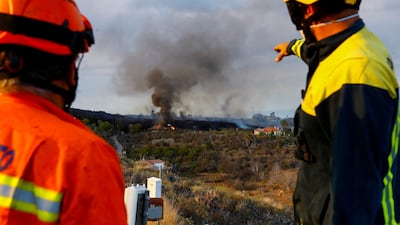
A member of La Palma's Civil Protection team and a firefighter watch as a house burns in the Cumbre Vieja National Park. Photo: Reuters -

A 4.2-magnitude earthquake was recorded before the volcanic eruption, which took place in an area known as Cabeza de Vaca. Photo: Reuters -
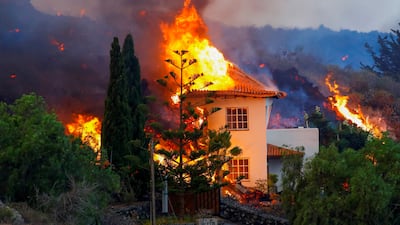
A house catches fire in La Palma as lava flows from the eruption. Photo: Reuters -

Lava reaches a house in La Palma's Cumbre Vieja National Park. Photo: Reuters -

As the eruptions continued, at least two openings spewed bright-red magma that flowed in tight streams down the mountain slope. Photo: AP -

A destroyed house is seen following the eruption. The last eruption on La Palma 50 years ago lasted slightly more than three weeks. Photo: Reuters -

The last eruption on La Palma 50 years ago lasted slightly over three weeks. Photo: Reuters -

Members of the media work in La Palma as smoke rises following the eruption. Reuters -
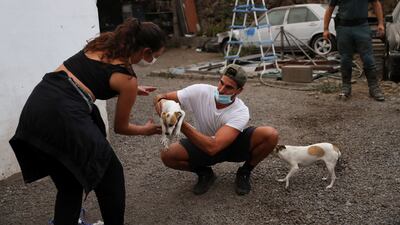
A man hands a dog to a woman as people are evacuated. Reuters -

Spanish Prime Minister Pedro Sanchez during his visit to the area affected by the volcanic eruption. EPA -
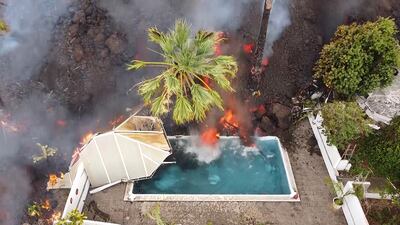
Hot lava reaches a swimming pool on the island of La Palma. AP Photo


After days of what scientists called “an earthquake swarm”, authorities on La Palma started to move residents with reduced mobility on Sunday shortly before ground broke open.
A 4.2-magnitude quake was recorded before the volcanic eruption, which took place in an area known as Cabeza de Vaca on the western slope as the ridge descends to the coast.
As the eruptions continued, at least two open mouths spewed bright red magma that flowed in tight streams down the mountain slope.
Shortly after the initial explosion rocked the area, one black lava flow with a burning tip immediately slid towards houses in the village of El Paso.
By Monday, the lava was moving in two streams through a mostly unpopulated area.
Mariano Hernandez, the major of the town of Cabildo, asked people to stay away from the eruption.
“People should not come near the eruption site where the lava is flowing. We are having serious problems with the evacuation because the roads are jammed with people who are trying to get close enough to see it,” he said.
A group of 360 tourists were taken to the nearby island of Tenerife by ferry on Monday morning, said Fred Olsen, a spokesperson for the ferry operator. Another 180 tourists were moved as a precaution from a resort in Puerto Naos, he added.
The scientific committee of the Volcano Risk Prevention Plan said part of the island’s south-west coast was at risk for landslides and rock falls.
The last eruption on La Palma 50 years ago lasted slightly over three weeks.
The last eruption on all the Canary Islands occurred underwater off the coast of El Hierro island in 2011. It lasted five months.

