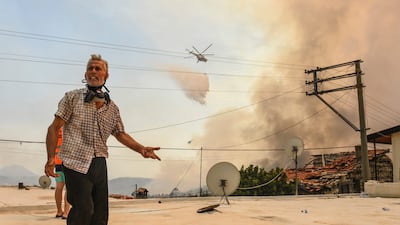
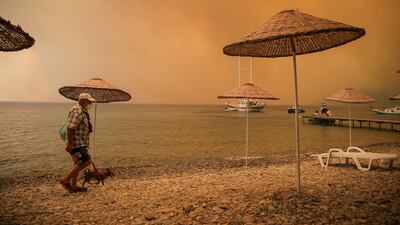
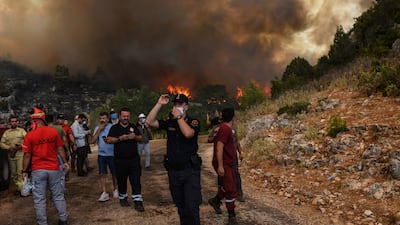
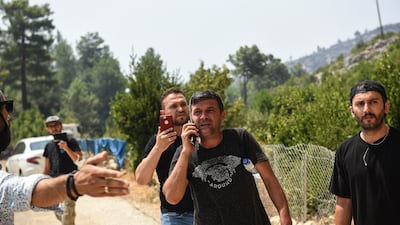
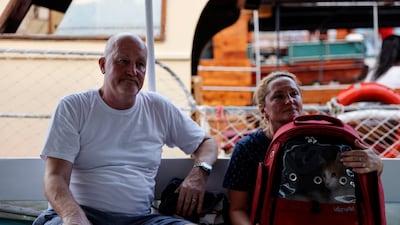
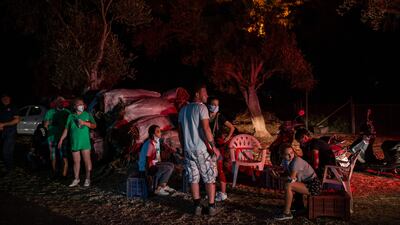
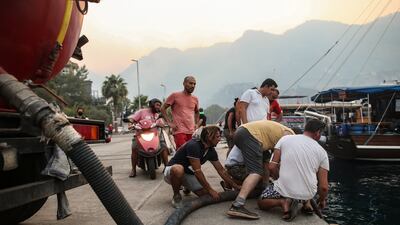
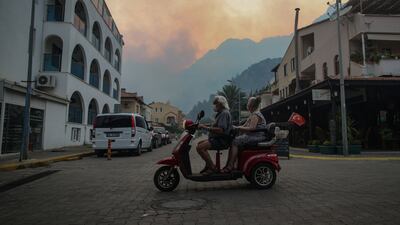
In Antalya’s fire-damaged forests, blackened remains lie almost unrecognisable among the soot: a hoof, a bone, what was probably a stomach.
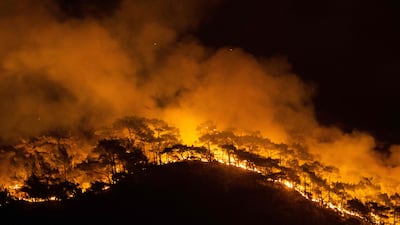
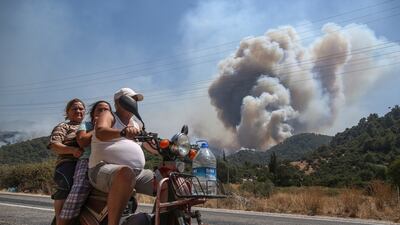
They are the remains of some of the thousands of animals thought to have died in Turkey’s most deadly and destructive fires in living memory, which have ripped through 100,000 hectares of land along the country’s southern coast.
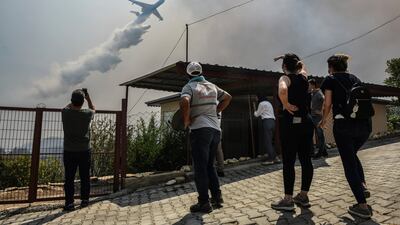
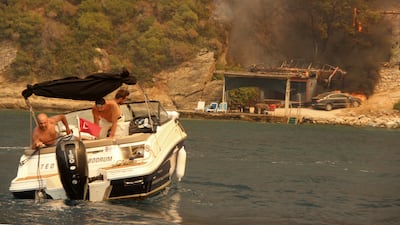
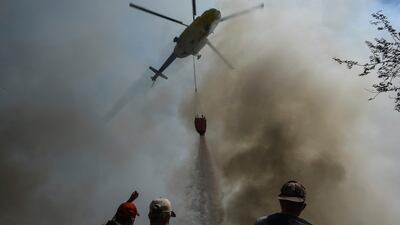
Despite the arrival of water-dropping planes from the EU on Monday – adding to those from Azerbaijan, Russia, Ukraine and Iran – the fires continue for the eighth day straight. Once the call comes to say your village is next, there is no time to take anything, not even your pets.
“When the fire comes, it comes really quickly, so people panic and forget about everything,” said Erkin Erdogdu, 35, a computer programmer from Ankara who founded animal rescue community Paw Guard with vet Doruk Demirci.
Mr Erdogdu said the group is mobilising its network of more than 100,000 volunteers to rescue dogs, cats, livestock and strays left behind when humans flee.
“People try to evacuate the animals, but sometimes it’s very difficult when things are on fire,” he said.
Videos of anguished farmers trying to direct their flocks towards beaches for safety have been shared widely on social media as others appeal for help to rescue them by road.
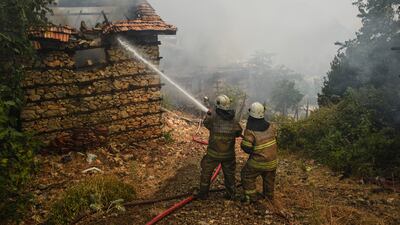
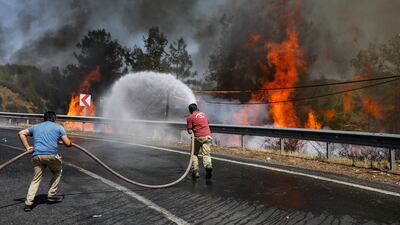
With fire-fighting resources scarce, water bottles and garden hoses have become weapons to try to keep the flames off. Anger has grown over the government’s handling of the bushfires, which happen annually but have not been this intense before.
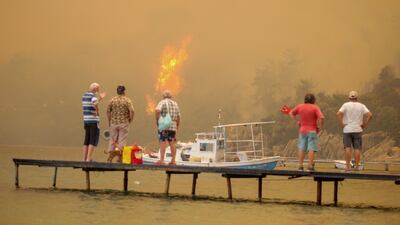
Eight people, including two firefighters, have been killed. Thousands have fled their homes, and holiday resorts – already harmed by the pandemic – have been evacuated.
Strong winds, months of severe drought and temperatures well above the average means the country is struggling to contain the problem, which many believe will become increasingly common in Turkey as the effects of climate change become hard to ignore.
Agriculture and Forestry Minister Bekir Pakdemirli said on Friday that 3,320 cattle have died in the fires, but no data has been given on the number of forest animals killed. Images of charred tortoises stirred emotions online.
In Manavgat, the most fire-stricken district of the holiday hub Antalya, Paw Group braves the lines of fire that snake nearby hillsides to drive from village to village, sweeping for animals that could starve, or even be burnt alive. But moving panicked pets is tricky in heat of well over 40°C, as chaotic scenes unfold and smoke thickens the air.
As they arrive at the remote village of Gondulmus, rescuers head for a scared, skinny donkey tied to a tree. They move on to a family of stray dogs whose mother has a hurt foot. As the echo of sirens over the hills grows, a kitten is found with a badly infected eye.
Paw Guard has been running for only eight months, and already has more than 400,000 followers on Instagram. Mr Erdogdu, who has seven dogs himself, said he realised there was a lot of help made available for humans who were suffering through lockdown, but nothing for animals.
Usually feeding strays in cities around the country, this is the first time it has provided help during a disaster.
“On Monday, I posted on Instagram to say ‘We are here. Do you need any help with your animals?’ It had 7,000 shares and now, whenever a village is burning people call and say ‘Come, help us’.”
The group has attracted so much interest that it was contacted by a group of vets from Brazil who wanted to come and help.
“We message Paris Hilton with our posts and she shares them,” said Mr Erdogdu. He showed The National a trail of private messages with the hotel heiress.
He posts videos of animals volunteers pick up as they travel between rescues – a box of three unbearably cute puppies found in a ditch, a small boy with a smug-looking black cat – and shows, proudly, that one image has received 232 likes in only seven seconds.
Activists as well as volunteers, Mr Erdogdu and Dr Demirci have campaigned for years for Turkish law to offer stronger protection for animals. They started a campaign and went to Parliament, and in early July a new law was approved that made animal abuse a crime punishable by six months to four years in prison.
The team move on as the fires begin to grow and close in and there is a risk they could get cut off. The nearby forests glow a ghastly orange as the ground ignites by the side of the road, and a call comes in about a dog with severe burns to its leg. A rescuer’s work is never done.

Aston martin DBX specs
Engine: 4.0-litre twin-turbo V8
Transmission: nine-speed automatic
Power: 542bhp
Torque: 700Nm
Top speed: 291kph
Price: Dh848,000
On sale: Q2, 2020
The specs: 2018 Nissan 370Z Nismo
Price, base / as tested: Dh182,178
Engine: 3.7-litre V6
Power: 350hp @ 7,400rpm
Torque: 374Nm @ 5,200rpm
Transmission: Seven-speed automatic
Fuel consumption, combined: 10.5L / 100km
Mercer, the investment consulting arm of US services company Marsh & McLennan, expects its wealth division to at least double its assets under management (AUM) in the Middle East as wealth in the region continues to grow despite economic headwinds, a company official said.
Mercer Wealth, which globally has $160 billion in AUM, plans to boost its AUM in the region to $2-$3bn in the next 2-3 years from the present $1bn, said Yasir AbuShaban, a Dubai-based principal with Mercer Wealth.
“Within the next two to three years, we are looking at reaching $2 to $3 billion as a conservative estimate and we do see an opportunity to do so,” said Mr AbuShaban.
Mercer does not directly make investments, but allocates clients’ money they have discretion to, to professional asset managers. They also provide advice to clients.
“We have buying power. We can negotiate on their (client’s) behalf with asset managers to provide them lower fees than they otherwise would have to get on their own,” he added.
Mercer Wealth’s clients include sovereign wealth funds, family offices, and insurance companies among others.
From its office in Dubai, Mercer also looks after Africa, India and Turkey, where they also see opportunity for growth.
Wealth creation in Middle East and Africa (MEA) grew 8.5 per cent to $8.1 trillion last year from $7.5tn in 2015, higher than last year’s global average of 6 per cent and the second-highest growth in a region after Asia-Pacific which grew 9.9 per cent, according to consultancy Boston Consulting Group (BCG). In the region, where wealth grew just 1.9 per cent in 2015 compared with 2014, a pickup in oil prices has helped in wealth generation.
BCG is forecasting MEA wealth will rise to $12tn by 2021, growing at an annual average of 8 per cent.
Drivers of wealth generation in the region will be split evenly between new wealth creation and growth of performance of existing assets, according to BCG.
Another general trend in the region is clients’ looking for a comprehensive approach to investing, according to Mr AbuShaban.
“Institutional investors or some of the families are seeing a slowdown in the available capital they have to invest and in that sense they are looking at optimizing the way they manage their portfolios and making sure they are not investing haphazardly and different parts of their investment are working together,” said Mr AbuShaban.
Some clients also have a higher appetite for risk, given the low interest-rate environment that does not provide enough yield for some institutional investors. These clients are keen to invest in illiquid assets, such as private equity and infrastructure.
“What we have seen is a desire for higher returns in what has been a low-return environment specifically in various fixed income or bonds,” he said.
“In this environment, we have seen a de facto increase in the risk that clients are taking in things like illiquid investments, private equity investments, infrastructure and private debt, those kind of investments were higher illiquidity results in incrementally higher returns.”
The Abu Dhabi Investment Authority, one of the largest sovereign wealth funds, said in its 2016 report that has gradually increased its exposure in direct private equity and private credit transactions, mainly in Asian markets and especially in China and India. The authority’s private equity department focused on structured equities owing to “their defensive characteristics.”
The specs
- Engine: 3.9-litre twin-turbo V8
- Power: 640hp
- Torque: 760nm
- On sale: 2026
- Price: Not announced yet
Rebel%20Moon%20-%20Part%20One%3A%20A%20Child%20of%20Fire
%3Cp%3E%3Cstrong%3EDirector%3A%20%3C%2Fstrong%3EZack%20Snyder%3Cbr%3E%3Cstrong%3EStars%3A%20%3C%2Fstrong%3ESofia%20Boutella%2C%20Djimon%20Hounsou%2C%20Ed%20Skrein%2C%20Michiel%20Huisman%2C%20Charlie%20Hunnam%3Cbr%3E%3Cstrong%3ERating%3A%20%3C%2Fstrong%3E2%2F5%3C%2Fp%3E%0A
KILLING OF QASSEM SULEIMANI
Singham Again
Director: Rohit Shetty
Stars: Ajay Devgn, Kareena Kapoor Khan, Ranveer Singh, Akshay Kumar, Tiger Shroff, Deepika Padukone
Rating: 3/5
The Gandhi Murder
- 71 - Years since the death of MK Gandhi, also christened India's Father of the Nation
- 34 - Nationalities featured in the film The Gandhi Murder
- 7 - million dollars, the film's budget
Teaching your child to save
Pre-school (three - five years)
You can’t yet talk about investing or borrowing, but introduce a “classic” money bank and start putting gifts and allowances away. When the child wants a specific toy, have them save for it and help them track their progress.
Early childhood (six - eight years)
Replace the money bank with three jars labelled ‘saving’, ‘spending’ and ‘sharing’. Have the child divide their allowance into the three jars each week and explain their choices in splitting their pocket money. A guide could be 25 per cent saving, 50 per cent spending, 25 per cent for charity and gift-giving.
Middle childhood (nine - 11 years)
Open a bank savings account and help your child establish a budget and set a savings goal. Introduce the notion of ‘paying yourself first’ by putting away savings as soon as your allowance is paid.
Young teens (12 - 14 years)
Change your child’s allowance from weekly to monthly and help them pinpoint long-range goals such as a trip, so they can start longer-term saving and find new ways to increase their saving.
Teenage (15 - 18 years)
Discuss mutual expectations about university costs and identify what they can help fund and set goals. Don’t pay for everything, so they can experience the pride of contributing.
Young adulthood (19 - 22 years)
Discuss post-graduation plans and future life goals, quantify expenses such as first apartment, work wardrobe, holidays and help them continue to save towards these goals.
* JP Morgan Private Bank
The%20specs
%3Cp%3E%3Cstrong%3EEngine%3A%20%3C%2Fstrong%3E4.0-litre%20twin-turbo%20V8%0D%3Cbr%3E%3Cstrong%3EPower%3A%20%3C%2Fstrong%3E640hp%20at%206%2C000rpm%0D%3Cbr%3E%3Cstrong%3ETorque%3A%20%3C%2Fstrong%3E850Nm%20from%202%2C300-4%2C500rpm%0D%3Cbr%3E%3Cstrong%3ETransmission%3A%20%3C%2Fstrong%3E8-speed%20auto%0D%3Cbr%3E%3Cstrong%3EFuel%20consumption%3A%20%3C%2Fstrong%3E11.9L%2F100km%0D%3Cbr%3E%3Cstrong%3EPrice%3A%20%3C%2Fstrong%3EDh749%2C800%0D%3Cbr%3E%3Cstrong%3EOn%20sale%3A%20%3C%2Fstrong%3Enow%3C%2Fp%3E%0A
Profile
Co-founders of the company: Vilhelm Hedberg and Ravi Bhusari
Launch year: In 2016 ekar launched and signed an agreement with Etihad Airways in Abu Dhabi. In January 2017 ekar launched in Dubai in a partnership with the RTA.
Number of employees: Over 50
Financing stage: Series B currently being finalised
Investors: Series A - Audacia Capital
Sector of operation: Transport
The drill
Recharge as needed, says Mat Dryden: “We try to make it a rule that every two to three months, even if it’s for four days, we get away, get some time together, recharge, refresh.” The couple take an hour a day to check into their businesses and that’s it.
Stick to the schedule, says Mike Addo: “We have an entire wall known as ‘The Lab,’ covered with colour-coded Post-it notes dedicated to our joint weekly planner, content board, marketing strategy, trends, ideas and upcoming meetings.”
Be a team, suggests Addo: “When training together, you have to trust in each other’s abilities. Otherwise working out together very quickly becomes one person training the other.”
Pull your weight, says Thuymi Do: “To do what we do, there definitely can be no lazy member of the team.”
Dr Amal Khalid Alias revealed a recent case of a woman with daughters, who specifically wanted a boy.
A semen analysis of the father showed abnormal sperm so the couple required IVF.
Out of 21 eggs collected, six were unused leaving 15 suitable for IVF.
A specific procedure was used, called intracytoplasmic sperm injection where a single sperm cell is inserted into the egg.
On day three of the process, 14 embryos were biopsied for gender selection.
The next day, a pre-implantation genetic report revealed four normal male embryos, three female and seven abnormal samples.
Day five of the treatment saw two male embryos transferred to the patient.
The woman recorded a positive pregnancy test two weeks later.
Key findings of Jenkins report
- Founder of the Muslim Brotherhood, Hassan al Banna, "accepted the political utility of violence"
- Views of key Muslim Brotherhood ideologue, Sayyid Qutb, have “consistently been understood” as permitting “the use of extreme violence in the pursuit of the perfect Islamic society” and “never been institutionally disowned” by the movement.
- Muslim Brotherhood at all levels has repeatedly defended Hamas attacks against Israel, including the use of suicide bombers and the killing of civilians.
- Laying out the report in the House of Commons, David Cameron told MPs: "The main findings of the review support the conclusion that membership of, association with, or influence by the Muslim Brotherhood should be considered as a possible indicator of extremism."
MOUNTAINHEAD REVIEW
Starring: Ramy Youssef, Steve Carell, Jason Schwartzman
Director: Jesse Armstrong
Rating: 3.5/5
'Cheb%20Khaled'
%3Cp%3E%3Cstrong%3EArtist%3A%20%3C%2Fstrong%3EKhaled%3Cbr%3E%3Cstrong%3ELabel%3A%20%3C%2Fstrong%3EBelieve%3Cbr%3E%3Cstrong%3ERating%3A%3C%2Fstrong%3E%204%2F5%3C%2Fp%3E%0A
The specs
Engine: 2.0-litre 4cyl turbo
Power: 261hp at 5,500rpm
Torque: 405Nm at 1,750-3,500rpm
Transmission: 9-speed auto
Fuel consumption: 6.9L/100km
On sale: Now
Price: From Dh117,059
Lexus LX700h specs
Engine: 3.4-litre twin-turbo V6 plus supplementary electric motor
Power: 464hp at 5,200rpm
Torque: 790Nm from 2,000-3,600rpm
Transmission: 10-speed auto
Fuel consumption: 11.7L/100km
On sale: Now
Price: From Dh590,000
BMW M5 specs
Engine: 4.4-litre twin-turbo V-8 petrol enging with additional electric motor
Power: 727hp
Torque: 1,000Nm
Transmission: 8-speed auto
Fuel consumption: 10.6L/100km
On sale: Now
Price: From Dh650,000