• Public health nurse Kathy Luu administers a dose of the Moderna Covid-19 vaccine to a staff member at the Ararat Nursing Facility in the Mission Hills neighbourhood of Los Angeles, California. AFP
    Public health nurse Kathy Luu administers a dose of the Moderna Covid-19 vaccine to a staff member at the Ararat Nursing Facility in the Mission Hills neighbourhood of Los Angeles, California. AFP
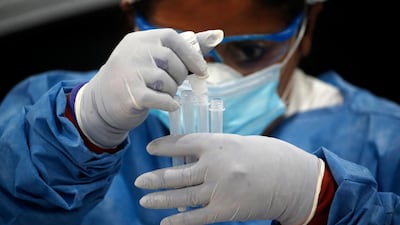
  • A healthcare worker tests for Covid-19, in Buenos Aires, Argentina. AP Photo
    A healthcare worker tests for Covid-19, in Buenos Aires, Argentina. AP Photo
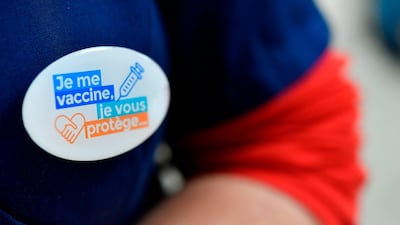
  • A nurse wears a badge reading "I get vaccinated, I protect you" at the Cavale Blanche hospital in Brest, western France during a vaccination operation of the medical staff against the Covid-19 disease. AFP
    A nurse wears a badge reading "I get vaccinated, I protect you" at the Cavale Blanche hospital in Brest, western France during a vaccination operation of the medical staff against the Covid-19 disease. AFP
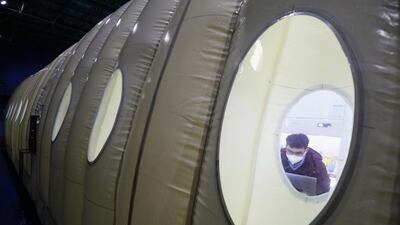
  • A worker installs equipment in a temporary Covid-19 testing laboratory built on an indoor tennis court in Shijiazhuang in northern China's Hebei Province. Xinhua via AP
    A worker installs equipment in a temporary Covid-19 testing laboratory built on an indoor tennis court in Shijiazhuang in northern China's Hebei Province. Xinhua via AP
  • Volunteer and medical student Tereza Zalesakova treats a Covid-19 patient in an intensive care unit at Prague's General University Hospital. AFP
    Volunteer and medical student Tereza Zalesakova treats a Covid-19 patient in an intensive care unit at Prague's General University Hospital. AFP
  • Candles and flowers are placed by a relative on the grave of Joao Marinho, 76, who passed away due to Covid-19 at the Parque Taruma cemetery in Manaus, Brazil. Reuters
    Candles and flowers are placed by a relative on the grave of Joao Marinho, 76, who passed away due to Covid-19 at the Parque Taruma cemetery in Manaus, Brazil. Reuters
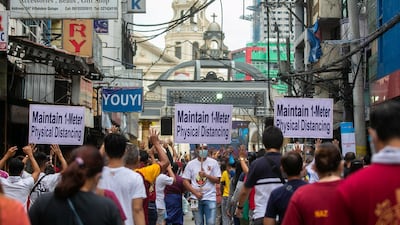
  • A church worker carries a placard reminding mass-goers to maintain physical distancing outside Quiapo Church in Manila, Philippines. Reuters
    A church worker carries a placard reminding mass-goers to maintain physical distancing outside Quiapo Church in Manila, Philippines. Reuters
  • A waiter picks up a sweet takeaway at a bakery in the Gothic Quartier in Barcelona, Spain. Reuters
    A waiter picks up a sweet takeaway at a bakery in the Gothic Quartier in Barcelona, Spain. Reuters
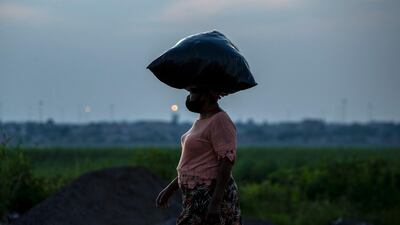
  • A woman walka back home from work in Spruitview near Johannesburg, South Africa. AP Photo
    A woman walka back home from work in Spruitview near Johannesburg, South Africa. AP Photo
  • A man transports children on his tricycle, in Havana, Cuba. AP Photo
    A man transports children on his tricycle, in Havana, Cuba. AP Photo
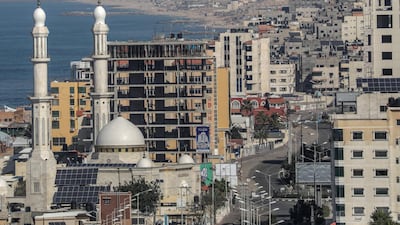
  • An empty main road seen during a complete closure amid the ongoing Covid-19 coronavirus pandemic in Gaza City. EPA
    An empty main road seen during a complete closure amid the ongoing Covid-19 coronavirus pandemic in Gaza City. EPA
  • US President-elect Joe Biden removes his mask as he announces members of economics and jobs team at his transition headquarters in Wilmington, Delaware, US. Reuters
    US President-elect Joe Biden removes his mask as he announces members of economics and jobs team at his transition headquarters in Wilmington, Delaware, US. Reuters

Coronavirus latest: Tests and quarantine as UK hits new record for deaths


  • English
  • Arabic

Top stories

Attacks on Egypt’s long rooted Copts

Egypt’s Copts belong to one of the world’s oldest Christian communities, with Mark the Evangelist credited with founding their church around 300 AD. Orthodox Christians account for the overwhelming majority of Christians in Egypt, with the rest mainly made up of Greek Orthodox, Catholics and Anglicans.

The community accounts for some 10 per cent of Egypt’s 100 million people, with the largest concentrations of Christians found in Cairo, Alexandria and the provinces of Minya and Assiut south of Cairo.

Egypt’s Christians have had a somewhat turbulent history in the Muslim majority Arab nation, with the community occasionally suffering outright persecution but generally living in peace with their Muslim compatriots. But radical Muslims who have first emerged in the 1970s have whipped up anti-Christian sentiments, something that has, in turn, led to an upsurge in attacks against their places of worship, church-linked facilities as well as their businesses and homes.

More recently, ISIS has vowed to go after the Christians, claiming responsibility for a series of attacks against churches packed with worshippers starting December 2016.

The discrimination many Christians complain about and the shift towards religious conservatism by many Egyptian Muslims over the last 50 years have forced hundreds of thousands of Christians to migrate, starting new lives in growing communities in places as far afield as Australia, Canada and the United States.

Here is a look at major attacks against Egypt's Coptic Christians in recent years:

November 2: Masked gunmen riding pickup trucks opened fire on three buses carrying pilgrims to the remote desert monastery of St. Samuel the Confessor south of Cairo, killing 7 and wounding about 20. IS claimed responsibility for the attack.

May 26, 2017: Masked militants riding in three all-terrain cars open fire on a bus carrying pilgrims on their way to the Monastery of St. Samuel the Confessor, killing 29 and wounding 22. ISIS claimed responsibility for the attack.

April 2017Twin attacks by suicide bombers hit churches in the coastal city of Alexandria and the Nile Delta city of Tanta. At least 43 people are killed and scores of worshippers injured in the Palm Sunday attack, which narrowly missed a ceremony presided over by Pope Tawadros II, spiritual leader of Egypt Orthodox Copts, in Alexandria's St. Mark's Cathedral. ISIS claimed responsibility for the attacks.

February 2017: Hundreds of Egyptian Christians flee their homes in the northern part of the Sinai Peninsula, fearing attacks by ISIS. The group's North Sinai affiliate had killed at least seven Coptic Christians in the restive peninsula in less than a month.

December 2016A bombing at a chapel adjacent to Egypt's main Coptic Christian cathedral in Cairo kills 30 people and wounds dozens during Sunday Mass in one of the deadliest attacks carried out against the religious minority in recent memory. ISIS claimed responsibility.

July 2016Pope Tawadros II says that since 2013 there were 37 sectarian attacks on Christians in Egypt, nearly one incident a month. A Muslim mob stabs to death a 27-year-old Coptic Christian man, Fam Khalaf, in the central city of Minya over a personal feud.

May 2016: A Muslim mob ransacks and torches seven Christian homes in Minya after rumours spread that a Christian man had an affair with a Muslim woman. The elderly mother of the Christian man was stripped naked and dragged through a street by the mob.

New Year's Eve 2011A bomb explodes in a Coptic Christian church in Alexandria as worshippers leave after a midnight mass, killing more than 20 people.

SPECS

Nissan 370z Nismo

Engine: 3.7-litre V6

Transmission: seven-speed automatic

Power: 363hp

Torque: 560Nm

Price: Dh184,500

Mercer, the investment consulting arm of US services company Marsh & McLennan, expects its wealth division to at least double its assets under management (AUM) in the Middle East as wealth in the region continues to grow despite economic headwinds, a company official said.

Mercer Wealth, which globally has $160 billion in AUM, plans to boost its AUM in the region to $2-$3bn in the next 2-3 years from the present $1bn, said Yasir AbuShaban, a Dubai-based principal with Mercer Wealth.

Within the next two to three years, we are looking at reaching $2 to $3 billion as a conservative estimate and we do see an opportunity to do so,” said Mr AbuShaban.

Mercer does not directly make investments, but allocates clients’ money they have discretion to, to professional asset managers. They also provide advice to clients.

“We have buying power. We can negotiate on their (client’s) behalf with asset managers to provide them lower fees than they otherwise would have to get on their own,” he added.

Mercer Wealth’s clients include sovereign wealth funds, family offices, and insurance companies among others.

From its office in Dubai, Mercer also looks after Africa, India and Turkey, where they also see opportunity for growth.

Wealth creation in Middle East and Africa (MEA) grew 8.5 per cent to $8.1 trillion last year from $7.5tn in 2015, higher than last year’s global average of 6 per cent and the second-highest growth in a region after Asia-Pacific which grew 9.9 per cent, according to consultancy Boston Consulting Group (BCG). In the region, where wealth grew just 1.9 per cent in 2015 compared with 2014, a pickup in oil prices has helped in wealth generation.

BCG is forecasting MEA wealth will rise to $12tn by 2021, growing at an annual average of 8 per cent.

Drivers of wealth generation in the region will be split evenly between new wealth creation and growth of performance of existing assets, according to BCG.

Another general trend in the region is clients’ looking for a comprehensive approach to investing, according to Mr AbuShaban.

“Institutional investors or some of the families are seeing a slowdown in the available capital they have to invest and in that sense they are looking at optimizing the way they manage their portfolios and making sure they are not investing haphazardly and different parts of their investment are working together,” said Mr AbuShaban.

Some clients also have a higher appetite for risk, given the low interest-rate environment that does not provide enough yield for some institutional investors. These clients are keen to invest in illiquid assets, such as private equity and infrastructure.

“What we have seen is a desire for higher returns in what has been a low-return environment specifically in various fixed income or bonds,” he said.

“In this environment, we have seen a de facto increase in the risk that clients are taking in things like illiquid investments, private equity investments, infrastructure and private debt, those kind of investments were higher illiquidity results in incrementally higher returns.”

The Abu Dhabi Investment Authority, one of the largest sovereign wealth funds, said in its 2016 report that has gradually increased its exposure in direct private equity and private credit transactions, mainly in Asian markets and especially in China and India. The authority’s private equity department focused on structured equities owing to “their defensive characteristics.”