


The Glasgow Climate Pact approved by almost 200 countries on the final day of Cop26 followed a long list of promises and announcements aimed at reining in global warming.
The Glasgow talks began with a promise to focus on four key areas: coal, cars, cash and trees, as UK Prime Minister Boris Johnson put it.
As well as announcements on these, there were landmark promises on greenhouse gas emissions and a surprise deal between two of the world’s largest polluters.
But many climate activists are sceptical over whether enough progress has been made in Glasgow.
The National looks at the main agreements secured at the UN summit.
Stopping deforestation
A pledge by more than 100 countries to reverse the loss of forests was one of the first breakthroughs of the summit.
The UK hailed the promise as a “landmark commitment” and welcomed the fact that Brazil, home to much of the Amazon rainforest and often criticised for its climate policies, was one of the signatories.
The countries promised to turn the tide on deforestation by 2030 by tackling wildfires, restoring degraded land and protecting the livelihoods of forest dwellers.
Climate activists welcomed the focus on nature but said planting trees was no substitute for cutting greenhouse gas emissions.
“We want to see nature protection and restoration happening alongside the urgent phasing out of fossil fuels,” said Nathalie Pettorelli, a researcher at the Zoological Society of London.
“This cannot be seen as a strategy to reduce ambition or offset continued emissions.”

Cut methane emissions
A push by the EU and US to persuade countries to cut their methane emissions led to 103 nations promising a 30 per cent reduction this decade.
Leaders described it as a significant pledge because methane is a major factor in warming the planet, meaning emissions cuts could have a big impact.
Those who did not sign up were invited in the final agreement to “consider further actions” to reduce methane emissions.
US President Joe Biden promised to lead the way by fixing the leaky gas pipelines that produce some of America’s methane.
But critics said leaders had sidestepped one of the main options for cutting methane emissions – telling people to eat less meat.
-

Oxfam campaigners dressed in the roles of 'ineffective fire-fighting world leaders' pose outside the Cop26 Summit in Glasgow, Scotland. AP Photo -
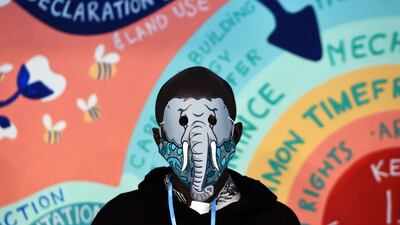
Members of the World Wildlife Fund stage a small protest to hold world leaders to the 1.5 degrees celsius pledge. AFP -

A man walks through the main room in the OVO Hydro building at the summit. Getty Images -
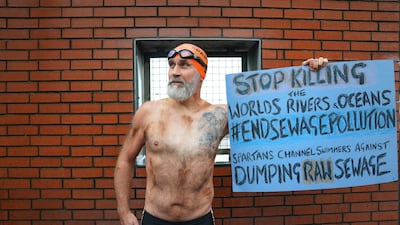
English Channel swimmer Peter Green protests against the dumping of raw sewage into the sea. PA -
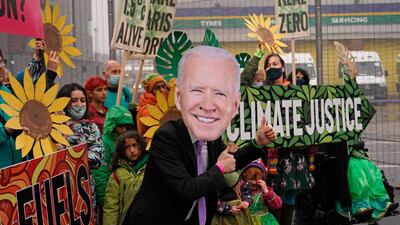
A climate activist wearing a mask of US President Joe Biden takes part in a demonstration against the use of fossil fuels. AP Photo -

Indonesian delegates pose for a picture inside the Blue Zone. PA -
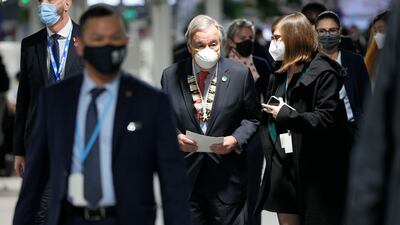
UN Secretary General Antonio Guterres walks through the venue. AP Photo -

Delegates watch a video wall in the pavilion area. AFP -
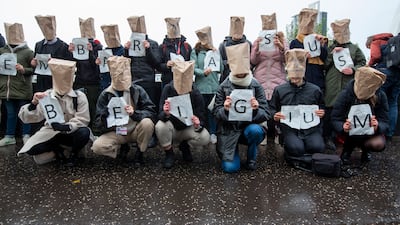
Activists hold placards forming the slogan 'You embarrass us Belgium' during a protest outside the Cop26 venue. EPA


Keeping 1.5°C alive
As part of the Cop26 process, most of the countries involved submitted a five-year plan which sets out how they plan to reduce emissions.
Under the 2015 Paris Agreement, these should become increasingly ambitious and aim to cap global warming at below 2°C, and ideally 1.5°C, above pre-industrial levels. Scientists say the extra half a degree would have drastic consequences.
India became the last of the world’s major polluters to announce a drive towards net-zero emissions, although its 2070 target date is conspicuously later than other countries.
Together with the agreements in Glasgow, there was optimism that the latest suite of proposals could keep the temperature rise below 2°C – but only if they are all implemented.
And there was no suggestion that the world is on track for 1.5°C.
By the end of the summit, attention was shifting to how these ambitions could be raised in time for next year’s Cop27 summit in Egypt. The final text called on countries to revisit their 2030 proposals next year.
Frans Timmermans, the EU’s top delegate in Glasgow, said the world needed to be on track for 1.5°C by the time of Cop27.
“We need to make sure major emitters reduce their emissions so that we keep 1.5°C alive,” he said.

US/China pact
The talks brought an unexpected announcement on Wednesday when the US and China said they would work more closely together on climate change.
The geopolitical rivals are two of the world’s biggest polluters and coal users, and have often been accused of inaction on climate change.
Their joint announcement said they would co-operate on issues such as clean energy, carbon capture and environmental standards.
“It was definitely a positive and important signal for the negotiations,” said the World Wide Fund for Nature. “But here, too, the focus is now on implementation.”
Agriculture tech
The US and UAE unveiled a joint initiative at Cop26 to help the agriculture sector, which accounts for about a quarter of greenhouse gas emissions, to go green.
The Agriculture Innovation Mission for Climate has mobilised $4 billion in a project backed by the UK hosts. Target areas include climate-resilient crops and better water management to ensure resources are not wasted.
Other supporters include the UN's Food and Agriculture Organisation and prominent non-governmental agencies, including the Bill and Melinda Gates Foundation.
The project was one of the so-called Glasgow Breakthroughs, projects which aim to bolster green technology in sectors such as power, steel and road transport.
“By making clean technology the most affordable, accessible and attractive choice – the default go-to in what are currently the most polluting sectors – we can cut emissions right around the world,” Mr Johnson said.

Phasing out coal power
In the run-up to the summit, Cop26 president Alok Sharma repeatedly described it as the moment when coal power should be “consigned to history”.
The UK celebrated a breakthrough when dozens of countries, including major coal users such as Poland, promised for the first time to step away from the fossil fuel.
It came alongside promises by major investors to stop financing coal power abroad.
However, the world’s three biggest coal users, China, India and the US, made no promise to phase it out.
And a contentious passage on coal in the final text was watered down in the summit's last moments. India pushed through an amendment for a phase-out to be replaced with a phase-down.
“The only reason why we cannot lean back and declare Cop26 a success is because of the urgency, because we have only 10 years left of the global carbon budget,” said Prof Johan Rockstrom, a Swedish climate expert who attended the summit.
“It doesn’t add up because we do not have China, we do not have the US on board on all of the coal phase-out.”

Financing the green transition
Investors who manage a combined $130 trillion of assets unveiled a promise in Glasgow to use their funds in the service of climate change goals.
The vast sums of money are needed to build defences against natural disasters and to help poorer countries to develop without damaging the planet.
The rich world sought to reassure developing countries that they would soon get the delayed $100bn in annual funding they were first promised in 2009.
The US agreed to a demand to double its climate finance by 2025 but said this should not only apply to a club of rich countries.
But sceptics said the failure to meet a 2020 deadline had undermined confidence that sufficient funds would ever be delivered.
“We don’t believe you. We don’t believe that banks will suddenly put trillions of dollars on the table for climate action when rich countries have struggled to find $100bn,” said activist Vanessa Nakate in an emotional speech in Glasgow.
Green travel
Of Mr Johnson’s four key words, cars perhaps featured the least prominently at Cop26. But 30 countries promised to work together to make zero-emission vehicles “the new normal” by the end of the decade.
Car makers, including Ford, Volvo and Jaguar Land Rover, set 2040 as their target date for selling exclusively zero-emission cars and vans. Some major manufacturers such as Volkswagen and Toyota did not join the pledge.
India’s motor industry used the summit to launch a plan to go electric which insiders hope will spur similar action in other developing countries.
Meanwhile, tourist industry leaders signed a Glasgow Declaration promising to halve the sector’s emissions by 2030. Saudi Arabia hopes to lead the way by opening a hub of expertise in the kingdom.

