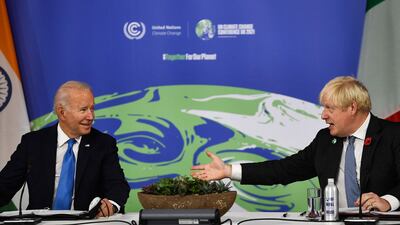
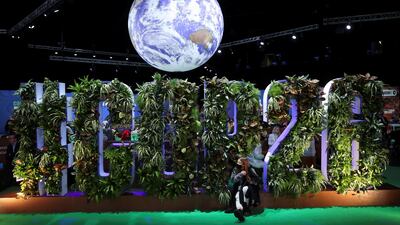
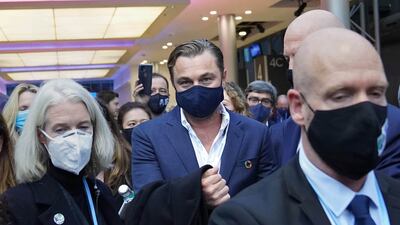
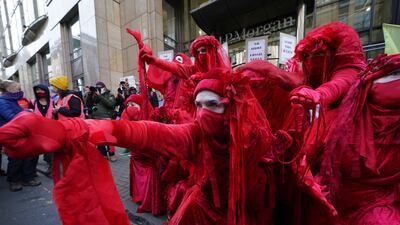
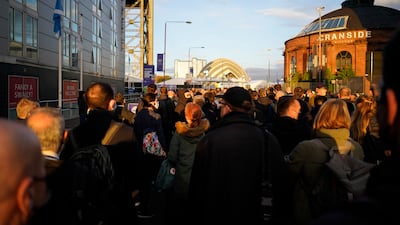
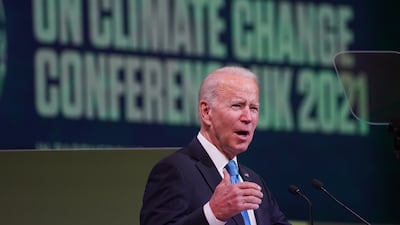
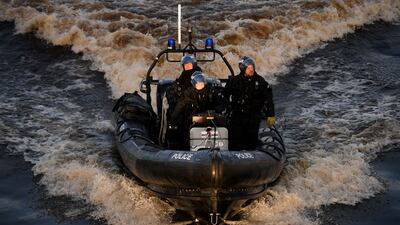
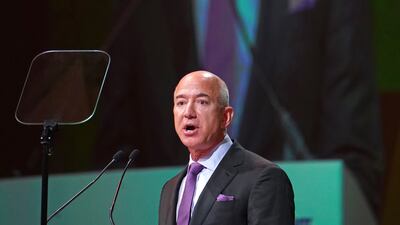
The UAE has joined calls for the security impact of climate change to climb to the top of the agenda at Cop26.
Ministers speaking at the Glasgow summit have raised concerns about conflicts triggered by scarce resources as the natural environment worsens.
Many countries which are vulnerable to climate change are also politically and economically fragile, increasing the risk of conflict.
Mariam Al Mheiri, the UAE’s Minister of Climate Change and Environment, said the country was already spending billions of dollars on relief for disasters and conflicts that were “unequivocally worsened by climate change”.
She said the UAE’s partners had described displacement, damaged infrastructure and even extremism in their countries as resources become scarcer.
“It is accordingly time for climate security to assume a place at the top of the international agenda, especially here at the Cop”, she told a panel co-hosted by the UAE.
She set out four priorities: investing in fragile countries, innovation in agriculture, pre-emptive humanitarian aid, and the impact on women and girls.
Her proposals for farming included solar-powered irrigation systems, drought-resistant seeds and better coastal management.
She spoke on the day that more than 40 world leaders at Cop26 promised to bring clean technology to farmers in vulnerable countries.
It was one of numerous agreements on the second day of the summit, which saw dozens of leaders agree to cut methane emissions and tackle deforestation.
“We cannot overstate the security implications of the collapse of rural economies”, the minister said.
Decisions at Cop26 “must be informed by the fact that many countries are experiencing climate change as a form of violence”.
Military concerns
Nato countries increasingly see climate change as a security threat and agreed a 10-point action plan at a summit in June. The alliance is represented at UN climate talks for the first time.
Diplomatic efforts will continue after Cop26, with Germany planning to launch an initiative at a conference in February.
Ben Wallace, the UK’s Defence Secretary, said military forces would be dealing with the fallout if climate negotiations fail.
Ministers face the separate challenge of cutting carbon emissions in their own armed forces. Mr Wallace said the British military was looking to go green but could not power down essential technology while it waits for cleaner options.
“As a defence minister, we have to effectively deal with both sides of the coin”, he said.
“We have a strong obligation to make sure that our forces deliver a sustainable deployment and indeed make sure they move from traditional energies and fuel requirements to more modern requirements.
“But also, we will have to deal with the consequences of a failed climate change policy, if that happens.”
Nato Secretary General Jens Stoltenberg said troops were preparing for climate change by training in the extreme heat where they might one day have to fight.
“I really believe that security and climate, that is two sides of the same coin”, he said.
“Climate change is making our world more dangerous. Therefore, it matters for security, and therefore it matters for Nato.”
Martha Pobee, a UN delegate to Africa, said eight of the 15 countries most susceptible to climate risks hosted a UN peacekeeping or political mission. This was no coincidence, she said.
“Climate change and armed conflict may represent distinct policy areas, but their consequences increasingly converge in the real world”, she said.

First Person
Richard Flanagan
Chatto & Windus
Retirement funds heavily invested in equities at a risky time
Pension funds in growing economies in Asia, Latin America and the Middle East have a sharply higher percentage of assets parked in stocks, just at a time when trade tensions threaten to derail markets.
Retirement money managers in 14 geographies now allocate 40 per cent of their assets to equities, an 8 percentage-point climb over the past five years, according to a Mercer survey released last week that canvassed government, corporate and mandatory pension funds with almost $5 trillion in assets under management. That compares with about 25 per cent for pension funds in Europe.
The escalating trade spat between the US and China has heightened fears that stocks are ripe for a downturn. With tensions mounting and outcomes driven more by politics than economics, the S&P 500 Index will be on course for a “full-scale bear market” without Federal Reserve interest-rate cuts, Citigroup’s global macro strategy team said earlier this week.
The increased allocation to equities by growth-market pension funds has come at the expense of fixed-income investments, which declined 11 percentage points over the five years, according to the survey.
Hong Kong funds have the highest exposure to equities at 66 per cent, although that’s been relatively stable over the period. Japan’s equity allocation jumped 13 percentage points while South Korea’s increased 8 percentage points.
The money managers are also directing a higher portion of their funds to assets outside of their home countries. On average, foreign stocks now account for 49 per cent of respondents’ equity investments, 4 percentage points higher than five years ago, while foreign fixed-income exposure climbed 7 percentage points to 23 per cent. Funds in Japan, South Korea, Malaysia and Taiwan are among those seeking greater diversification in stocks and fixed income.
• Bloomberg
RedCrow Intelligence Company Profile
Started: 2016
Founders: Hussein Nasser Eddin, Laila Akel, Tayeb Akel
Based: Ramallah, Palestine
Sector: Technology, Security
# of staff: 13
Investment: $745,000
Investors: Palestine’s Ibtikar Fund, Abu Dhabi’s Gothams and angel investors
'C'mon C'mon'
Director:Mike Mills
Stars:Joaquin Phoenix, Gaby Hoffmann, Woody Norman
Rating: 4/5
Company profile
Date started: 2015
Founder: John Tsioris and Ioanna Angelidaki
Based: Dubai
Sector: Online grocery delivery
Staff: 200
Funding: Undisclosed, but investors include the Jabbar Internet Group and Venture Friends
US tops drug cost charts
The study of 13 essential drugs showed costs in the United States were about 300 per cent higher than the global average, followed by Germany at 126 per cent and 122 per cent in the UAE.
Thailand, Kenya and Malaysia were rated as nations with the lowest costs, about 90 per cent cheaper.
In the case of insulin, diabetic patients in the US paid five and a half times the global average, while in the UAE the costs are about 50 per cent higher than the median price of branded and generic drugs.
Some of the costliest drugs worldwide include Lipitor for high cholesterol.
The study’s price index placed the US at an exorbitant 2,170 per cent higher for Lipitor than the average global price and the UAE at the eighth spot globally with costs 252 per cent higher.
High blood pressure medication Zestril was also more than 2,680 per cent higher in the US and the UAE price was 187 per cent higher than the global price.
Name: Colm McLoughlin
Country: Galway, Ireland
Job: Executive vice chairman and chief executive of Dubai Duty Free
Favourite golf course: Dubai Creek Golf and Yacht Club
Favourite part of Dubai: Palm Jumeirah
How to get there
Emirates (www.emirates.com) flies directly to Hanoi, Vietnam, with fares starting from around Dh2,725 return, while Etihad (www.etihad.com) fares cost about Dh2,213 return with a stop. Chuong is 25 kilometres south of Hanoi.
Mercer, the investment consulting arm of US services company Marsh & McLennan, expects its wealth division to at least double its assets under management (AUM) in the Middle East as wealth in the region continues to grow despite economic headwinds, a company official said.
Mercer Wealth, which globally has $160 billion in AUM, plans to boost its AUM in the region to $2-$3bn in the next 2-3 years from the present $1bn, said Yasir AbuShaban, a Dubai-based principal with Mercer Wealth.
“Within the next two to three years, we are looking at reaching $2 to $3 billion as a conservative estimate and we do see an opportunity to do so,” said Mr AbuShaban.
Mercer does not directly make investments, but allocates clients’ money they have discretion to, to professional asset managers. They also provide advice to clients.
“We have buying power. We can negotiate on their (client’s) behalf with asset managers to provide them lower fees than they otherwise would have to get on their own,” he added.
Mercer Wealth’s clients include sovereign wealth funds, family offices, and insurance companies among others.
From its office in Dubai, Mercer also looks after Africa, India and Turkey, where they also see opportunity for growth.
Wealth creation in Middle East and Africa (MEA) grew 8.5 per cent to $8.1 trillion last year from $7.5tn in 2015, higher than last year’s global average of 6 per cent and the second-highest growth in a region after Asia-Pacific which grew 9.9 per cent, according to consultancy Boston Consulting Group (BCG). In the region, where wealth grew just 1.9 per cent in 2015 compared with 2014, a pickup in oil prices has helped in wealth generation.
BCG is forecasting MEA wealth will rise to $12tn by 2021, growing at an annual average of 8 per cent.
Drivers of wealth generation in the region will be split evenly between new wealth creation and growth of performance of existing assets, according to BCG.
Another general trend in the region is clients’ looking for a comprehensive approach to investing, according to Mr AbuShaban.
“Institutional investors or some of the families are seeing a slowdown in the available capital they have to invest and in that sense they are looking at optimizing the way they manage their portfolios and making sure they are not investing haphazardly and different parts of their investment are working together,” said Mr AbuShaban.
Some clients also have a higher appetite for risk, given the low interest-rate environment that does not provide enough yield for some institutional investors. These clients are keen to invest in illiquid assets, such as private equity and infrastructure.
“What we have seen is a desire for higher returns in what has been a low-return environment specifically in various fixed income or bonds,” he said.
“In this environment, we have seen a de facto increase in the risk that clients are taking in things like illiquid investments, private equity investments, infrastructure and private debt, those kind of investments were higher illiquidity results in incrementally higher returns.”
The Abu Dhabi Investment Authority, one of the largest sovereign wealth funds, said in its 2016 report that has gradually increased its exposure in direct private equity and private credit transactions, mainly in Asian markets and especially in China and India. The authority’s private equity department focused on structured equities owing to “their defensive characteristics.”
Key facilities
- Olympic-size swimming pool with a split bulkhead for multi-use configurations, including water polo and 50m/25m training lanes
- Premier League-standard football pitch
- 400m Olympic running track
- NBA-spec basketball court with auditorium
- 600-seat auditorium
- Spaces for historical and cultural exploration
- An elevated football field that doubles as a helipad
- Specialist robotics and science laboratories
- AR and VR-enabled learning centres
- Disruption Lab and Research Centre for developing entrepreneurial skills
heading
Iran has sent five planeloads of food to Qatar, which is suffering shortages amid a regional blockade.
A number of nations, including Iran's major rival Saudi Arabia, last week cut ties with Qatar, accusing it of funding terrorism, charges it denies.
The land border with Saudi Arabia, through which 40% of Qatar's food comes, has been closed.
Meanwhile, mediators Kuwait said that Qatar was ready to listen to the "qualms" of its neighbours.
Electoral College Victory
Trump has so far secured 295 Electoral College votes, according to the Associated Press, exceeding the 270 needed to win. Only Nevada and Arizona remain to be called, and both swing states are leaning Republican. Trump swept all five remaining swing states, North Carolina, Georgia, Pennsylvania, Michigan and Wisconsin, sealing his path to victory and giving him a strong mandate.
Popular Vote Tally
The count is ongoing, but Trump currently leads with nearly 51 per cent of the popular vote to Harris’s 47.6 per cent. Trump has over 72.2 million votes, while Harris trails with approximately 67.4 million.
The specs
Engine: 2.0-litre 4cyl turbo
Power: 261hp at 5,500rpm
Torque: 405Nm at 1,750-3,500rpm
Transmission: 9-speed auto
Fuel consumption: 6.9L/100km
On sale: Now
Price: From Dh117,059