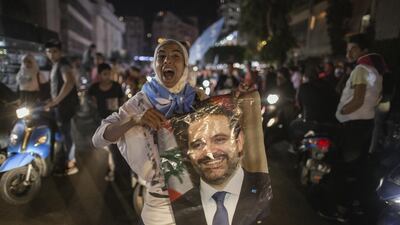
Supporters of former Lebanese prime minister Saad Hariri gather in Tariq El Jdideh in Beirut, in October last year. Getty Images

Beirut clash between rival clans leaves one dead


Khaled Yacoub Oweis
  • English
  • Arabic

A young man was killed in Beirut overnight on Tuesday in a Sunni turf war linked to leadership rivalries in a community marginalised by the loss of political power over the past decade.

The Lebanese military said machine-guns and rocket-propelled grenades were used in the fighting. Army units “took security measures to control the situation,” an official statement said.

The killing in the mostly Sunni Tariq El Jdideh district resulted from a clash between a clan loyal to former prime minister Saad Hariri and another supporting his brother Bahaa, two residents told The National.

Both Saad and Bahaa issued statements in Twitter condemning the violence in Tariq El Jdideh.

The clash occurred between members of the Palestinian Shishniyeh clan and the Krombis, a Lebanese family originally from Arsal in the Bekaa Valley.

Both were pro-Saad Hariri until the Krombis switched sides to Bahaa Hariri three months ago, one of the residents said.

A Shishniyeh street gang attacked a Krombi gang late on Monday in retaliation for the stabbing of Alaa Shishniyeh, one of their own, two days ago. Taha Krombi was killed in the attack and two other people were wounded, the residents said.

Video footage purporting to show the violence also appeared on social media.

“The Shishniyehs felt they had to retaliate after Alaa was stabbed. It required 160 stitches to save him,” one of the witnesses, who declined to be named, said.

“The incident started as personal but the political background helped escalate it,” he said.

Saad and Bahaa Hariri (C) pray in 2005 at the site of the explosion iin Beirut in which their father was killed. Their third brother, Ayman, is to Saad's left. AFP

Tariq El Jdideh, a working class neighbourhood, is a barometer of popular Sunni sentiment in Lebanon.

The district is adjacent to the Palestinian Sabra and Shatila refugee camps and is near Hezbollah strongholds in the south of Beirut.

In 2018, the district was scene to fighting between Hezbollah gunmen who overran most of Beirut and Tariq El Jdideh’s Sunni residents, after the cabinet moved to ban a private telecoms network operated by Hezbollah.

The fighting in and around Beirut, and in north Lebanon in May that year killed 37 people. Since then several skirmishes occurred between Hezbollah supporters and armed Sunnis in Tariq El Jdideh.

A peaceful protest movement against the entire political class forced Mr Hariri to resign as prime minister in October, as the economy started to melt down.

Fault lines among Lebanon’s Sunni community emerged after the 2005 assassination in Beirut of statesman Rafik Al Hariri, the father of Saad and his elder brother Bahaa.


UAE currency: the story behind the money in your pockets
While you're here
2018 ICC World Twenty20 Asian Western Sub Regional Qualifier

Event info: The tournament in Kuwait is the first phase of the qualifying process for sides from Asia for the 2020 World T20 in Australia. The UAE must finish within the top three teams out of the six at the competition to advance to the Asia regional finals. Success at regional finals would mean progression to the World T20 Qualifier.

Teams: UAE, Bahrain, Saudi Arabia, Kuwait, Maldives, Qatar

Friday fixtures: 9.30am (UAE time) - Kuwait v Maldives, Qatar v UAE; 3pm - Saudi Arabia v Bahrain

Ten tax points to be aware of in 2026

1. Domestic VAT refund amendments: request your refund within five years

If a business does not apply for the refund on time, they lose their credit.

2. E-invoicing in the UAE

Businesses should continue preparing for the implementation of e-invoicing in the UAE, with 2026 a preparation and transition period ahead of phased mandatory adoption. 

3. More tax audits

Tax authorities are increasingly using data already available across multiple filings to identify audit risks. 

4. More beneficial VAT and excise tax penalty regime

Tax disputes are expected to become more frequent and more structured, with clearer administrative objection and appeal processes. The UAE has adopted a new penalty regime for VAT and excise disputes, which now mirrors the penalty regime for corporate tax.

5. Greater emphasis on statutory audit

There is a greater need for the accuracy of financial statements. The International Financial Reporting Standards standards need to be strictly adhered to and, as a result, the quality of the audits will need to increase.

6. Further transfer pricing enforcement

Transfer pricing enforcement, which refers to the practice of establishing prices for internal transactions between related entities, is expected to broaden in scope. The UAE will shortly open the possibility to negotiate advance pricing agreements, or essentially rulings for transfer pricing purposes. 

7. Limited time periods for audits

Recent amendments also introduce a default five-year limitation period for tax audits and assessments, subject to specific statutory exceptions. While the standard audit and assessment period is five years, this may be extended to up to 15 years in cases involving fraud or tax evasion. 

8. Pillar 2 implementation 

Many multinational groups will begin to feel the practical effect of the Domestic Minimum Top-Up Tax (DMTT), the UAE's implementation of the OECD’s global minimum tax under Pillar 2. While the rules apply for financial years starting on or after January 1, 2025, it is 2026 that marks the transition to an operational phase.

9. Reduced compliance obligations for imported goods and services

Businesses that apply the reverse-charge mechanism for VAT purposes in the UAE may benefit from reduced compliance obligations. 

10. Substance and CbC reporting focus

Tax authorities are expected to continue strengthening the enforcement of economic substance and Country-by-Country (CbC) reporting frameworks. In the UAE, these regimes are increasingly being used as risk-assessment tools, providing tax authorities with a comprehensive view of multinational groups’ global footprints and enabling them to assess whether profits are aligned with real economic activity. 

Contributed by Thomas Vanhee and Hend Rashwan, Aurifer

Dhadak 2

Director: Shazia Iqbal

Starring: Siddhant Chaturvedi, Triptii Dimri 

Rating: 1/5

Our legal consultant

Name: Hassan Mohsen Elhais

Position: legal consultant with Al Rowaad Advocates and Legal Consultants.

The years Ramadan fell in May

1987

1954

1921

1888

The%20specs
%3Cp%3E%3Cstrong%3EEngine%3A%20%3C%2Fstrong%3E2.3-litre%20turbo%204-cyl%3Cbr%3E%3Cstrong%3ETransmission%3A%20%3C%2Fstrong%3E10-speed%20auto%3Cbr%3E%3Cstrong%3EPower%3A%20%3C%2Fstrong%3E298hp%3Cbr%3E%3Cstrong%3ETorque%3A%20%3C%2Fstrong%3E452Nm%3Cbr%3E%3Cstrong%3ETowing%20capacity%3A%20%3C%2Fstrong%3E3.4-tonne%3Cbr%3E%3Cstrong%3EPayload%3A%20%3C%2Fstrong%3E4WD%20%E2%80%93%20776kg%3B%20Rear-wheel%20drive%20819kg%3Cbr%3E%3Cstrong%3EPrice%3A%20%3C%2Fstrong%3EPrice%3A%20Dh138%2C945%20(XLT)%20Dh193%2C095%20(Wildtrak)%3Cbr%3E%3Cstrong%3EDelivery%3A%3C%2Fstrong%3E%20from%20August%3C%2Fp%3E%0A

Veere di Wedding
Dir: Shashanka Ghosh
Starring: Kareena Kapoo-Khan, Sonam Kapoor, Swara Bhaskar and Shikha Talsania ​​​​​​​
Verdict: 4 Stars

Polarised public

31% in UK say BBC is biased to left-wing views

19% in UK say BBC is biased to right-wing views

19% in UK say BBC is not biased at all

Source: YouGov