
Pakistan will be forced to reimpose strict lockdown restrictions in the nation of 220 million if residents continue to flout Covid-19 safety precautions, ministers have said.
The first three days of a new, eased regime of restrictions have seen markets thronged and streets packed with traffic, even as the country has recorded its highest number of daily infections yet.
More than 2,250 new coronavirus infections were recorded on Tuesday and the death toll hit 735. The total number of confirmed cases in Pakistan officially stands at over 34,000. The country is thought to be weeks off its peak yet, with the World Health Organisation predicting there may be as many as 200,000 cases by July.
Prime Minister Imran Khan eased nearly two months of restrictions at the weekend after lobbying for a “smart lockdown” of targeted quarantines and restrictions that would be less harmful to the nation's poor. Small shops and swathes of industry were allowed to resume business, though schools and shopping malls remained closed.
But the easing appears to have been largely interpreted as a return to normal life, with widespread disregard for distancing rules. Exasperated officials now fear carelessness will supercharge the country's outbreak.
Planning Minister Asad Umar said that the government would have no option but to lock back down if people did not “act in a responsible and cautious manner”.
“After witnessing the public rush in the markets, it seems that the virus has vanished away and situation has become normal,” he told a gathering of volunteers recruited to help efforts against the new coronavirus that Murad Ali Shah, chief minister of Sindh, said in his own video message that “With sorrow I have to say that the people didn’t come up to our expectations."
-
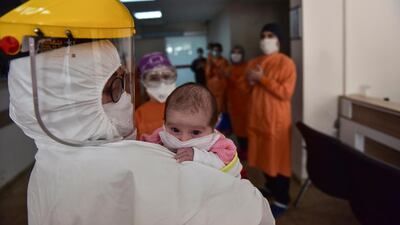
Staff applaud as a nurse, wearing a face mask and a shield to protect against coronavirus, carries baby Amine Tepe out of intensive care unit following a week's treatment, at an Istanbul hospital. Tepe was found to have coronavirus 37 days after her birth, contracting the virus from her parents, according to doctors. The baby has been moved to a hospital ward. AP -

An Indian man puts on a mask on the face of a young girl as they wait with their luggage at the check-in counter for a repatriation flight from the Omani capital at Muscat International Airport. AFP -
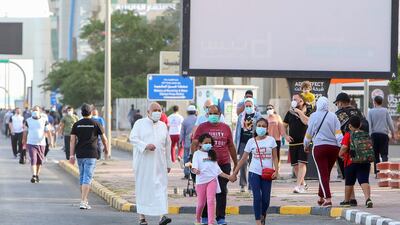
Residents walk in a neighbourhood of Kuwait City as authorities allowed people to exercise for two hours under nationwide lockdown rules. AFP -
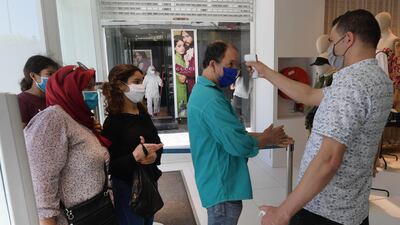
A clothing store employee measures the temperature of shoppers in the Tunisian capital Tunis. AFP -

A view of the the city and traffic during a night-time curfew in Cairo, Egypt. Reuters -

Shoppers walk through the main market of the Kurdish-majority city of Qamishli in Syria's north-east Hasakeh province. AFP -

A worker sanitises the hands of mothers as they arrive to enroll their daughters in an UNRWA-run school in the central Gaza Strip. Reuters -
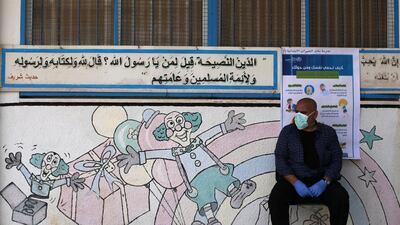
A Palestinian worker wearing a mask and gloves sits in an UNRWA-run school in the central Gaza Strip. Reuters -
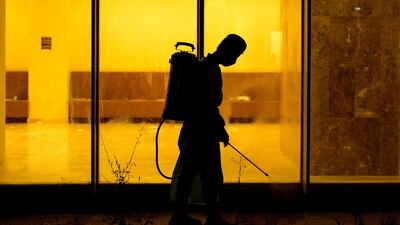
A medical staffer wearing PPE sterilises the entrance of an isolated section for the coronavirus disease treatment at a hotel in Basra. AFP -

Mask-clad shoppers buy sweets in Syria's north-east Hasakeh province. AFP -
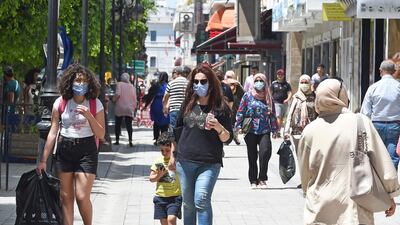
Tunisian people wearing protective face masks walk in the Habib Bourguiba avenue in Tunis. AFP -
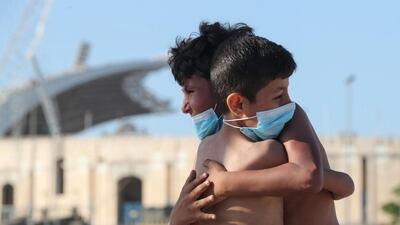
Mask-clad boys hug each other while playing football in front of the Camille Chamoun Sports City Stadium in Beirut. AFP -
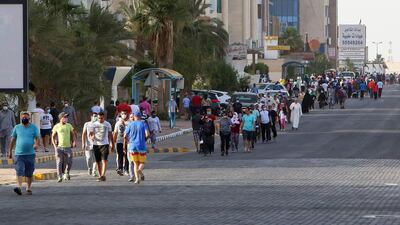
Mask-clad residents walk in a neighbourhood of Kuwait City. AFP -
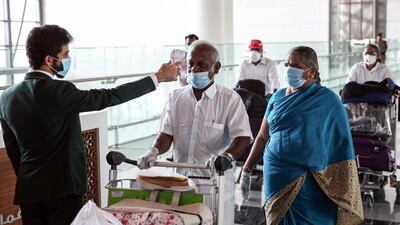
Indian nationals residing in Oman have their body temperatures measured at a terminal in Muscat International Airport ahead of their repatriation flight from the Omani capital. AFP -
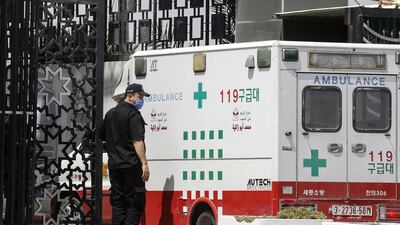
Palestinian security forces loyal to Gaza's Hamas rulers check the papers of an intensive care ambulance at the Rafah border crossing with Egypt. AFP


“If you observe the precautionary measures, then you will remain safe and if in case this doesn’t happen then you will not just endanger yourself but will also threaten other people around you,” he said.
In Islamabad's busy Aabpara market, the bustle seemed close to normal levels, with only around half of shoppers wearing masks.
“People are not scared, it's like nothing is happening, they are just not fearing anything,” said Abdur Rahman, selling sequined cloth to women wanting new party clothes for their upcoming Eid celebrations.
Many shoppers had told him they fully expected a renewed lockdown soon and were shopping while they could, he said.
Pakistan's official Covid-19 death toll has grown far less steeply than in many other countries experiencing outbreaks. The difference has led the government to speculate that the virus is behaving less virulently in Pakistan, India and Bangladesh, perhaps because of the heat or the country's younger populations.
Yet international officials fear the lower death toll is more likely to be only a sign of lower testing rates and patchy death registrations, which hide the true scale of deaths in the country.
Ministers acknowledge that infections and deaths are predicted to keep rising until at least June, if not July.

