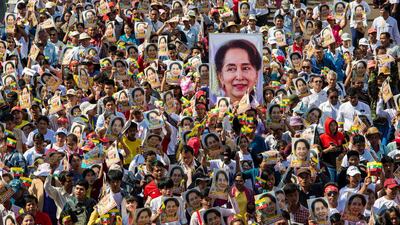

A UN envoy said on Monday that a recent spate of attacks by increasingly organised civilian fighters on Myanmar's security forces is pushing the country closer towards civil war.
UN negotiator Christine Schraner Burgener said so-called People’s Defence Force (PDF) units have staged a series of strikes against police and security forces in recent days.
The attacks are part of a wider upsurge in violence that has occurred since the military overthrew elected leader Aung San Suu Kyi on February 1 and then launched a deadly crackdown on pro-democracy protests.
“Protesters have started to shift from defensive to the offensive, with sometimes home-made weapons or receiving military training from certain ethnic armed organisations,” Ms Schraner Burgener told reporters via video link from Thailand.
“The people are really frustrated and fearing attacks. And they just told me that they need to have self-defence. And if this leads to a civil war – [it] could happen.”
PDF fighters seized a police station in the town of Mobye on Sunday, killing at least 13 soldiers, torching the building and detaining four men, likely police officers, according to local media.
Ms Schraner Burgener said PDF units were setting off “explosions” at military targets across the country and that there is a “huge long list” of reports she has collected about attacks staged by the increasingly organised armed civilians.
An anti-coup shadow government is stitching together PDF units from across the country “under a single command structure”, added the UN envoy, though she questioned whether it could effectively threaten the military, known as the Tatmadaw.
"The weapons, they are mostly handmade," Ms Schraner Burgener said in answer to a question from The National.
“It's difficult to combat with a very strong army [that] still has a lot of lethal weapons.”
Some ethnic militias that have fought the central government for greater autonomy for decades have rallied behind the protesters, bringing fighting to the peripheries of the country.
At the weekend, shooting broke out near the Chinese border and an armed ethnic group opposed to the junta launched an attack on a jade mining town near the Indian border.
Myanmar has been in chaos and its economy paralysed since the putsch. More than 800 people have died and more than 5,000 have been arrested since the military moved to crack down on dissent.
The country’s deposed leader Ms Suu Kyi appeared in person at a court hearing on Monday for the first time since her government was ousted by the military, her lawyer told Reuters.
The 75-year-old appeared to be in good health and held a face-to-face meeting with her legal team for about 30 minutes before the hearing, said her lawyer Thae Maung Maung.
Ms Suu Kyi, a Nobel Peace Prize laureate who struggled for decades to build up democracy in the country, is among the thousands of people detained since the coup. She faces charges that include illegally possessing walkie-talkie radios to violating a state secrets law.
Junta leader Min Aung Hlaing has justified his power grab by citing alleged electoral fraud in the November elections, which Ms Suu Kyi's National League for Democracy party won in a landslide.
-
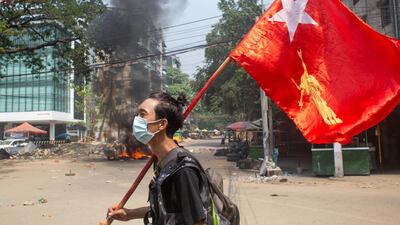
A man holds a National League for Democracy flag during a protest against the military coup in Yangon, Myanmar. Reuters -
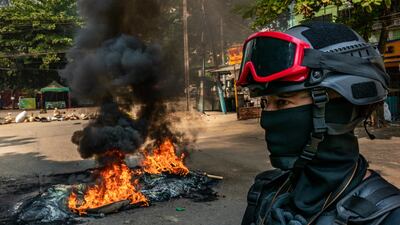
Protesters set fire to tyres on a road to slow the progress of security forces in Yangon. Getty Images -
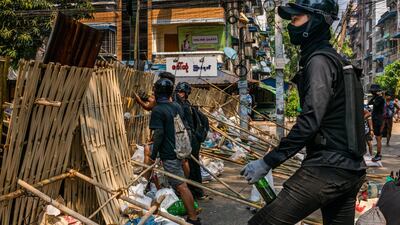
Protesters stand behind a barricade while waiting for security forces to approach in Yangon. Getty Images -
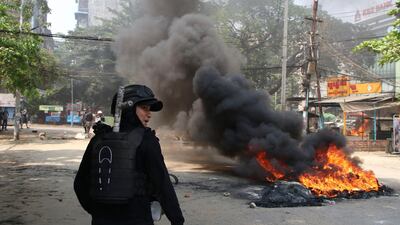
A protester stands near a fire during a demonstration in Dala township, Yangon. AP Photo -

Protesters gesture with a three-finger salute in Thaketa township Yangon. AP Photo -
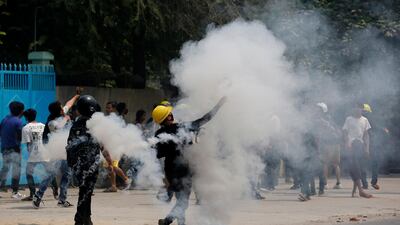
Protesters hurl back tear gas canisters towards police in Mandalay. AP Photo -
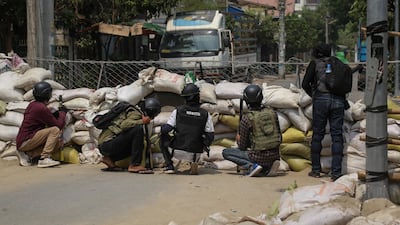
Protesters take cover during a protest against the military coup in Mandalay. EPA -
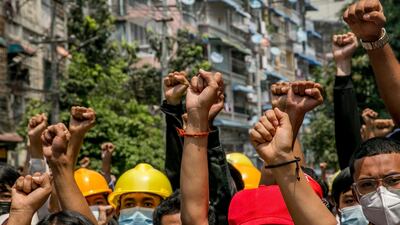
Protesters take part in a demonstration against the military coup in Yangon's Tamwe township. AFP -
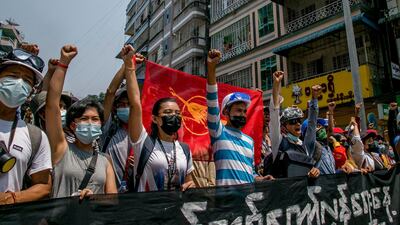
Protesters take part in a demonstration against the military coup in Yangon's Tamwe township. AFP -
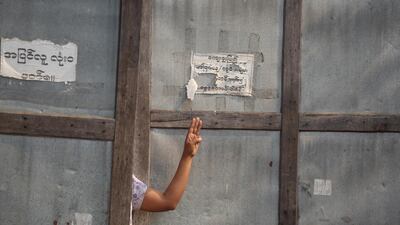
A resident flashes the three-finger salute as demonstrators march during a protest against the military coup in Mandalay. EPA -
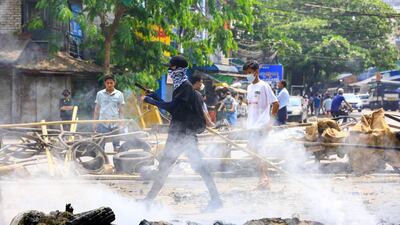
A protester walks past makeshift barricades set up to deter security forces in Yangon's Hlaing township. AFP -
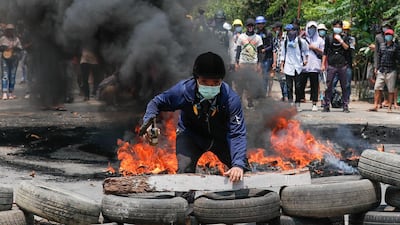
A man stands behind a barricade during a protest against the military coup in Yangon. Reuters -
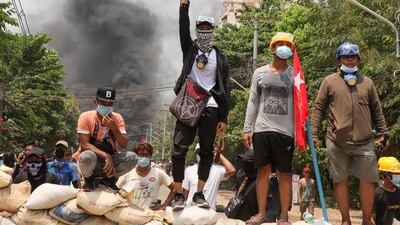
People stand on a barricade during a protest against the military coup in Yangon. Reuters -

Protesters extinguish fires during a protest in Thaketa township Yangon. AP Photo -

A man holds a makeshift gun in Yangon. Reuters -
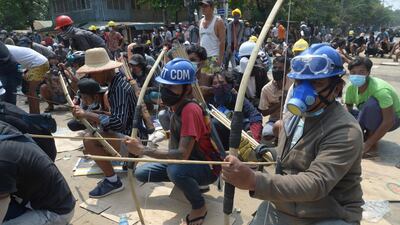
Protesters prepare makeshift bow and arrows to confront police in Thaketa township Yangon. AP Photo -

Family members cry in front of a man after he was shot dead during an anti-coup protesters crackdown in Yangon. Reuters -
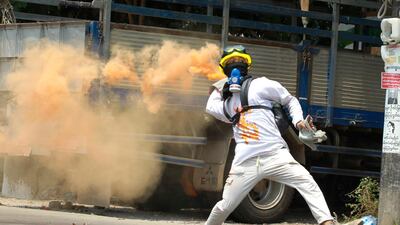
A protester throws a smoke bomb in Thaketa township Yangon. AP Photo -
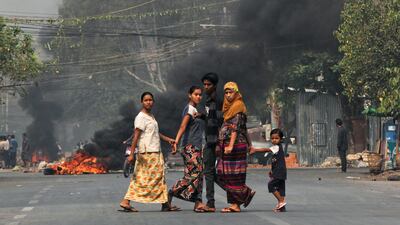
People walk on a street as barricades burn behind them in Mandalay. reuters -
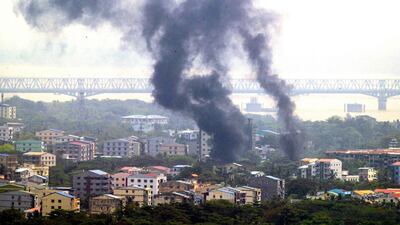
Smoke rises over Thaketa township in Yangon as security forces continue their crackdown on protests against the military coup. AFP



