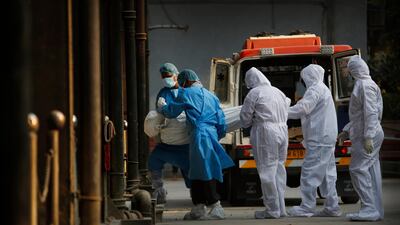
India's coronavirus cases passed nine million on Friday, as the world's second-worst-hit country saw hospitals in the capital New Delhi under pressure and graveyards fill up.
India has now registered more than 132,000 deaths, according to the latest official figures, which are widely seen as understating the true scale of the pandemic.
The total number of infections in India is second only to the tally in the United States, which has recorded 11.6 million cases and more than 250,000 deaths.
India, the world's second-most populous nation, has seen a drop in daily cases over the past month but it is still registering about 45,000 new infections on average every day.
New Delhi, facing the dual scourge of winter pollution and coronavirus, has seen infections soar past half a million with a record rise in daily cases.
On Thursday, the megacity's government quadrupled fines for not wearing a mask in an effort to get a grip on the outbreak.
At one of Delhi's largest cemeteries, burial space is fast running out, gravedigger Mohammed Shamim told AFP.
"Initially when the virus broke (out), I thought I'll bury 100-200 people and it'll be done. But the current situation is beyond my wildest thoughts," Mr Shamim said.
"I only have space left for about 50-60 burials. Then what? I have no idea."
India imposed a stringent lockdown in March but restrictions have been gradually eased as the government seeks to reboot the economy after the loss of millions of jobs.
Experts say this has helped spread the disease, as has a general reluctance to wear masks and maintain physical distancing.
The western city of Ahmedabad, home to six million people, late on Thursday announced an indefinite night curfew after an sharp rise in cases.
"The increase in numbers of cases is a concern, primarily because it is driven by people not following the basic protocol of corona-appropriate behaviour," said Anand Krishnan, a community medicine professor at Delhi's All India Institute of Medical Sciences.
Hemant Shewade, a Bangalore-based community medicine expert, said it was likely cases outside major towns and cities were not being taken into account in the official numbers.
"My guess is that it is spreading slowly and silently in rural areas," Mr Shewade said.
In Delhi, the spectre of the virus wreaking havoc has come back to haunt its 20 million residents, as families scramble to arrange hospital beds.
Over 90 per cent of intensive care beds with ventilators were occupied as on Thursday, a government mobile app showed.
"My father's oxygen saturation level dipped to 35 per cent suddenly and we rushed to the nearby hospital but there were no beds available," Delhi resident Rajeev Nigam told AFP.
"We ran all night from one hospital to another but it was the same story everywhere," he said, blaming the Delhi government for being "unprepared" and "callous" in its approach.
Distraught families were making fervent pleas on social media, tagging Chief Minister Arvind Kejriwal for help in securing beds.
Under pressure to control the new wave, Kejriwal Thursday announced the addition of 1,400 intensive care beds.
Jeevendra Srivastava, an advertising professional, said Delhi was paying the price for overcrowding during the ongoing festive season.
"It's shocking how a few people still are not taking this deadly virus seriously," said Mr Srivastava, 47.
"People are still going to crowded places without masks. It's because of this irresponsible behaviour that now almost every second house has a case of the virus."

SPEC%20SHEET%3A%20NOTHING%20PHONE%20(2a)
%3Cp%3E%3Cstrong%3EDisplay%3A%3C%2Fstrong%3E%206.7%E2%80%9D%20flexible%20Amoled%2C%202412%20x%201080%2C%20394ppi%2C%20120Hz%2C%20Corning%20Gorilla%20Glass%205%3C%2Fp%3E%0A%3Cp%3E%3Cstrong%3EProcessor%3A%3C%2Fstrong%3E%20MediaTek%20Dimensity%207200%20Pro%2C%204nm%2C%20octa-core%3C%2Fp%3E%0A%3Cp%3E%3Cstrong%3EMemory%3A%3C%2Fstrong%3E%208%2F12GB%3C%2Fp%3E%0A%3Cp%3E%3Cstrong%3ECapacity%3A%3C%2Fstrong%3E%20128%2F256GB%3C%2Fp%3E%0A%3Cp%3E%3Cstrong%3EPlatform%3A%3C%2Fstrong%3E%20Android%2014%2C%20Nothing%20OS%202.5%3C%2Fp%3E%0A%3Cp%3E%3Cstrong%3EMain%20camera%3A%3C%2Fstrong%3E%20Dual%2050MP%20main%2C%20f%2F1.88%20%2B%2050MP%20ultra-wide%2C%20f%2F2.2%3B%20OIS%2C%20EIS%2C%20auto-focus%2C%20ultra%20XDR%2C%20night%20mode%3C%2Fp%3E%0A%3Cp%3E%3Cstrong%3EMain%20camera%20video%3A%3C%2Fstrong%3E%204K%20%40%2030fps%2C%20full-HD%20%40%2060fps%3B%20slo-mo%20full-HD%20at%20120fps%3C%2Fp%3E%0A%3Cp%3E%3Cstrong%3EFront%20camera%3A%3C%2Fstrong%3E%2032MP%20wide%2C%20f%2F2.2%3C%2Fp%3E%0A%3Cp%3E%3Cstrong%3EBattery%3A%3C%2Fstrong%3E%205000mAh%3B%2050%25%20in%2030%20mins%20w%2F%2045w%20charger%3C%2Fp%3E%0A%3Cp%3E%3Cstrong%3EConnectivity%3A%3C%2Fstrong%3E%20Wi-Fi%2C%20Bluetooth%205.3%2C%20NFC%20(Google%20Pay)%3C%2Fp%3E%0A%3Cp%3E%3Cstrong%3EBiometrics%3A%3C%2Fstrong%3E%20Fingerprint%2C%20face%20unlock%3C%2Fp%3E%0A%3Cp%3E%3Cstrong%3EI%2FO%3A%3C%2Fstrong%3E%20USB-C%3C%2Fp%3E%0A%3Cp%3E%3Cstrong%3EDurability%3A%3C%2Fstrong%3E%20IP54%2C%20limited%20protection%20from%20water%2Fdust%3C%2Fp%3E%0A%3Cp%3E%3Cstrong%3ECards%3A%3C%2Fstrong%3E%20Dual-nano%20SIM%3C%2Fp%3E%0A%3Cp%3E%3Cstrong%3EColours%3A%3C%2Fstrong%3E%20Black%2C%20milk%2C%20white%3C%2Fp%3E%0A%3Cp%3E%3Cstrong%3EIn%20the%20box%3A%3C%2Fstrong%3E%20Nothing%20Phone%20(2a)%2C%20USB-C-to-USB-C%20cable%2C%20pre-applied%20screen%20protector%2C%20SIM%20tray%20ejector%20tool%3C%2Fp%3E%0A%3Cp%3E%3Cstrong%3EPrice%20(UAE)%3A%3C%2Fstrong%3E%20Dh1%2C199%20(8GB%2F128GB)%20%2F%20Dh1%2C399%20(12GB%2F256GB)%3C%2Fp%3E%0A
Ten tax points to be aware of in 2026
1. Domestic VAT refund amendments: request your refund within five years
If a business does not apply for the refund on time, they lose their credit.
2. E-invoicing in the UAE
Businesses should continue preparing for the implementation of e-invoicing in the UAE, with 2026 a preparation and transition period ahead of phased mandatory adoption.
3. More tax audits
Tax authorities are increasingly using data already available across multiple filings to identify audit risks.
4. More beneficial VAT and excise tax penalty regime
Tax disputes are expected to become more frequent and more structured, with clearer administrative objection and appeal processes. The UAE has adopted a new penalty regime for VAT and excise disputes, which now mirrors the penalty regime for corporate tax.
5. Greater emphasis on statutory audit
There is a greater need for the accuracy of financial statements. The International Financial Reporting Standards standards need to be strictly adhered to and, as a result, the quality of the audits will need to increase.
6. Further transfer pricing enforcement
Transfer pricing enforcement, which refers to the practice of establishing prices for internal transactions between related entities, is expected to broaden in scope. The UAE will shortly open the possibility to negotiate advance pricing agreements, or essentially rulings for transfer pricing purposes.
7. Limited time periods for audits
Recent amendments also introduce a default five-year limitation period for tax audits and assessments, subject to specific statutory exceptions. While the standard audit and assessment period is five years, this may be extended to up to 15 years in cases involving fraud or tax evasion.
8. Pillar 2 implementation
Many multinational groups will begin to feel the practical effect of the Domestic Minimum Top-Up Tax (DMTT), the UAE's implementation of the OECD’s global minimum tax under Pillar 2. While the rules apply for financial years starting on or after January 1, 2025, it is 2026 that marks the transition to an operational phase.
9. Reduced compliance obligations for imported goods and services
Businesses that apply the reverse-charge mechanism for VAT purposes in the UAE may benefit from reduced compliance obligations.
10. Substance and CbC reporting focus
Tax authorities are expected to continue strengthening the enforcement of economic substance and Country-by-Country (CbC) reporting frameworks. In the UAE, these regimes are increasingly being used as risk-assessment tools, providing tax authorities with a comprehensive view of multinational groups’ global footprints and enabling them to assess whether profits are aligned with real economic activity.
Contributed by Thomas Vanhee and Hend Rashwan, Aurifer
RESULTS
5pm: Maiden | Dh80,000 | 1,600m
Winner: AF Al Moreeb, Tadhg O’Shea (jockey), Ernst Oertel (trainer)
5.30pm: Handicap | Dh80,000 | 1,600m
Winner: AF Makerah, Adrie de Vries, Ernst Oertel
6pm: Handicap | Dh80,000 | 2,200m
Winner: Hazeme, Richard Mullen, Jean de Roualle
6.30pm: Handicap | Dh85,000 | 2,200m
Winner: AF Yatroq, Brett Doyle, Ernst Oertel
7pm: Shadwell Farm for Private Owners Handicap | Dh70,000 | 2,200m
Winner: Nawwaf KB, Patrick Cosgrave, Helal Al Alawi
7.30pm: Handicap (TB) | Dh100,000 | 1,600m
Winner: Treasured Times, Bernardo Pinheiro, Rashed Bouresly
More from Rashmee Roshan Lall
Company%20Profile
%3Cp%3E%3Cstrong%3ECompany%20name%3A%3C%2Fstrong%3E%20Cargoz%3Cbr%3E%3Cstrong%3EDate%20started%3A%3C%2Fstrong%3E%20January%202022%3Cbr%3E%3Cstrong%3EFounders%3A%3C%2Fstrong%3E%20Premlal%20Pullisserry%20and%20Lijo%20Antony%3Cbr%3E%3Cstrong%3EBased%3A%3C%2Fstrong%3E%20Dubai%3Cbr%3E%3Cstrong%3ENumber%20of%20staff%3A%3C%2Fstrong%3E%2030%3Cbr%3E%3Cstrong%3EInvestment%20stage%3A%3C%2Fstrong%3E%20Seed%3C%2Fp%3E%0A
The 12 Syrian entities delisted by UK
Ministry of Interior
Ministry of Defence
General Intelligence Directorate
Air Force Intelligence Agency
Political Security Directorate
Syrian National Security Bureau
Military Intelligence Directorate
Army Supply Bureau
General Organisation of Radio and TV
Al Watan newspaper
Cham Press TV
Sama TV
