


India's Prime Minister Narendra Modi on Monday expressed confidence that his Bharatiya Janata Party would win a third term in government as he addressed Parliament for the last time before elections scheduled to begin in May.
“People will give 370 seats to BJP ... third term of BJP government is not far," Mr Modi said while addressing the motion of thanks in the upper house of the Parliament in a response to President Droupadi Murmu, who outlined the government’s policies, achievements and plans at the opening of the budget session on January 31.
“I want you to support me to make the lives of the citizens of the country prosperous but if you don't do that and just throw bricks at me then I will use those bricks to build a developed India,” he said as members from his party thumped their desks.
The BJP won 282 of the 543 seats in the lower house of parliament in 2014, and 303 seats in the general election five years later.
A party or political alliance requires 272 seats to form a government and nominate a prime minister.
Opposition parties and critics have accused the BJP of failing to fulfil its electoral promises, chiefly creating jobs, curbing inflation and corruption and developing infrastructure.
But in a nearly two-hour speech, Mr Modi vaunted his government’s policies and schemes for the poor, women, farmers and people from the marginalised lowest rung of the Hindu caste hierarchy.
-

Indian Prime Minister Narendra Modi at the Pran Pratishtha ceremony of Shri Ram Janmabhoomi Temple in Ayodhya, Uttar Pradesh. Photo: India's Press Information Bureau -

Indian Prime Minister Narendra Modi fulfilled a long-standing electoral promise of his Hindu nationalist Bharatiya Janata Party. Photo: India's Press Information Bureau -

Indian Prime Minister Narendra Modi at the Pran Pratishtha ceremony. Photo: India's Press Information Bureau -

The ceremony, which was televised live, showed Mr Modi performing religious rituals inside the temple's sanctum. Photo: India's Press Information Bureau -

Indian Air Force helicopters showered petals over the temple. Photo: India's Press Information Bureau -

The federal government declared a half-day holiday for its employees, while several states announced a holiday for banks and educational institutions. Photo: India's Press Information Bureau -

The temple fulfils a decades-long Hindu nationalist pledge to build a shrine to Lord Ram in Ayodhya. Photo: India's Press Information Bureau -

The Pran Pratishtha ceremony at the temple. Photo: India's Press Information Bureau -

The temple's inauguration has also been marked by controversy over its consecration before the structure is fully built. Photo: India's Press Information Bureau -

More than 7,000 people attended the Pran Pratishtha ceremony. Photo: India's Press Information Bureau -
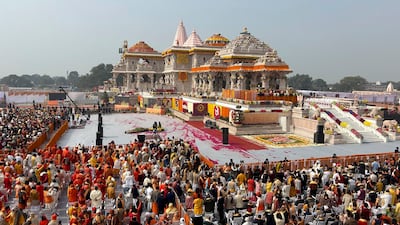
Attendees during the opening of a temple dedicated to Hindu deity Lord Ram, in Ayodhya, India. AP -
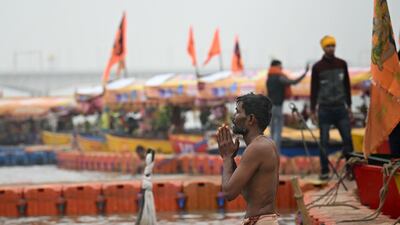
A man prays on the banks of the Sarayu River ahead of Ram temple's consecration ceremony. AFP -
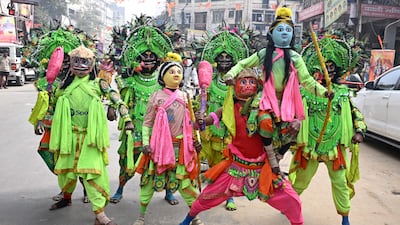
Traditional Chhau dancers dress in the guise of Hindu deities in Kolkata. AFP -
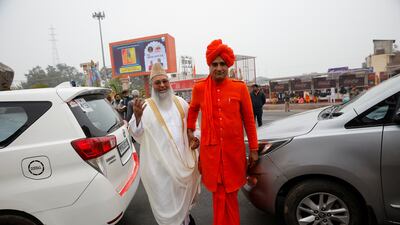
A Muslim cleric and a Hindu priest arrive to attend the inauguration ceremony. Reuters -
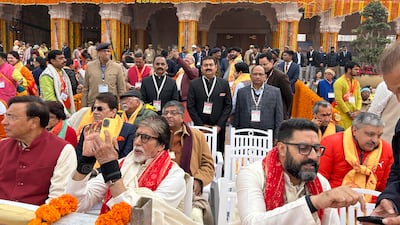
Bollywood actor Amitabh Bachchan, with his son, was among the chief guests at the opening of a temple. AP -
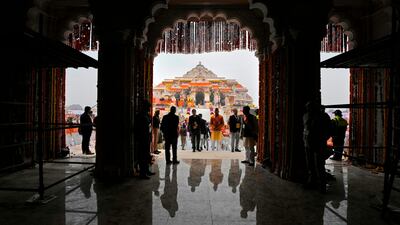
People arrive ahead of the inauguration of the temple. AP -
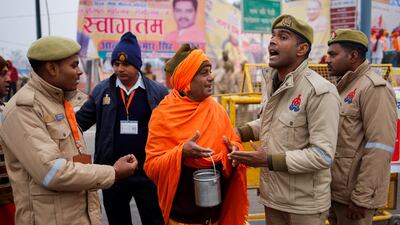
Police officers ask a Hindu holy man to leave the area before the inauguration in Ayodhya. Reuters


He also highlighted his government’s efforts to encourage the gig economy and start-ups.
He also spoke about scrapping Article 370, which gave autonomous powers to the Kashmir region in India. The revocation of the article was in his election manifesto in 2019.
Mr Modi highlighted his government's efforts to abandon colonial-era relics, including replacing the criminal justice system, as well as introducing the women’s reservation bill, which proposes to reserve 33 per cent of seats in the lower house of parliament for women.
He also spoke about the “return” of Hindu deity Lord Ram last month to a temple built on the site of a 16th-century mosque that was demolished in 1992.
“Lord Ram not only returned to his home, but a temple was built which gave a new energy to the country,” said Mr Modi, who inaugurated the temple in grand ceremony.
Mr Modi also took a dig at the main opposition party, the Indian National Congress, for being a dynastic party.
The Congress party has given India three prime ministers – its first, Jawaharlal Nehru, his daughter Indira Gandhi, and her son Rajiv – since independence from Britain in 1947.
Congress ruled the country for 10 years until it was routed by the BJP in the 2014 elections, and subsequently suffered losses in state elections that coincided with the rise of Hindu nationalism in the officially secular nation.
“The country has borne the brunt of 'family-ism', and Congress has also suffered from the same. Congress thinks of itself as a royal party. It has failed to be a strong opposition," Mr Modi said.
“Opposition has failed to fulfil their responsibility as opposition. I have always said that the country needs a good opposition,” he said.

