

China will speed up its vaccination programme for the elderly, authorities have announced following record case numbers and rare protests over the country's zero-Covid policy.
The plan is to push vaccinations in places including nursing homes, while making those unwilling to be inoculated provide a reason for their refusal, the National Health Commission said on Tuesday.
A working group will be established to boost elderly inoculation. It will shorten the time between vaccinations and booster shots to three months for people over 80 and also increase the vaccination rate for people aged 60-79, the commission said.
China is the world's last major economy still enforcing strict measures to curb the virus, which originated in the city of Wuhan three years ago. It uses domestically produced vaccines Sinopharm and Sinovac, refusing western vaccines.
The low elderly vaccination rate is viewed as a roadblock to opening up, as other countries have done. Only 65.7 per cent of the over-80s are fully vaccinated and just 40 per cent have received booster shots, according to figures from the health commission.
About 86 per cent of those aged 60 and above have had two shots of the vaccine.
The announcement came as China grapples both with record case numbers and rare protests over its strict virus-related measures that have left tens of millions of people under some form of lockdown in recent months.
The demonstrations have not prompted authorities to make any other major changes, however, with a spokesman for the commission saying on Tuesday that efforts will continue to "fine-tune" policy.
-
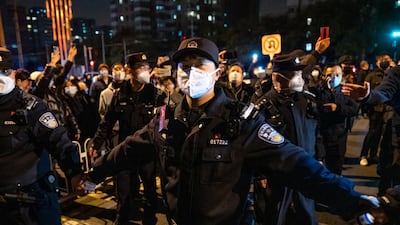
Police stand guard during a protest against Covid-19 restrictions, in China's capital Beijing. Bloomberg -
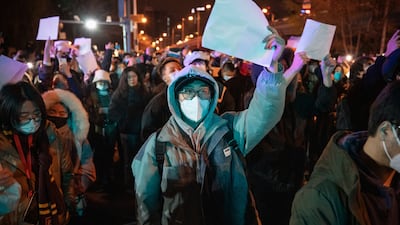
Demonstrators hold blank signs during a protest in Beijing, China. Bloomberg -
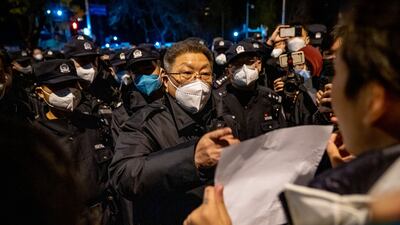
An official speaks with a demonstrator holding a blank sign, during a protest in Beijing. Bloomberg -
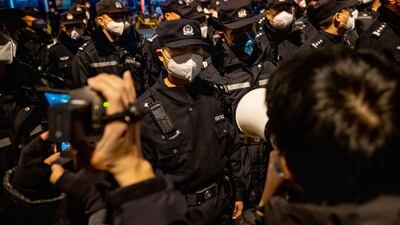
The death of at least 10 people in a fire in Urumqi, north-west China, which is under strict Covid restrictions, has led to protests nationwide. Bloomberg -
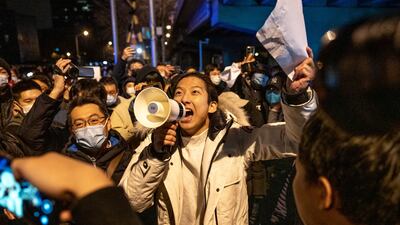
Demonstrators in Beijing. Protesters blame the deaths in Urumqi on strict Covid restrictions on leaving buildings. The authorities deny this. Bloomberg -
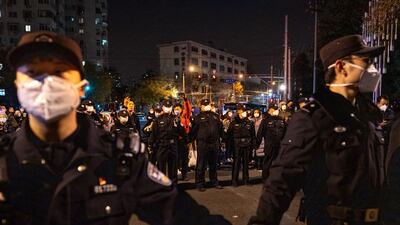
Police form a chain at Beijing protests. Demonstrations have also been reported in cities including, Shanghai, Nanjing, Chengdu, Lanzhou, Guangzhou and Wuhan – where Covid-19 was first reported. Bloomberg -
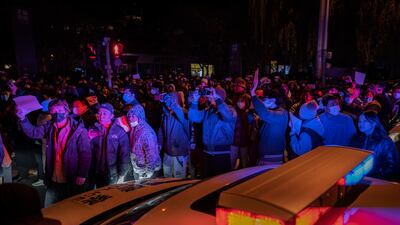
Protesters march past a police vehicle during a demonstration against China's strict zero-Covid measures, in Beijing. Getty -
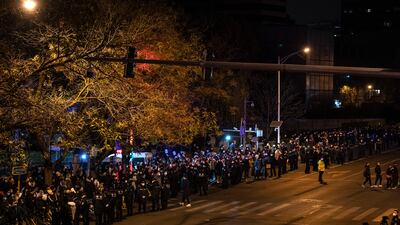
Protesters and police in Beijing. Chinese stocks fell over concerns about the impact of the demonstrations. Getty -

Demonstrators rally in Beijing. China reported more than 40,000 new cases of Covid-19 on Monday. AFP


Protests erupted at the weekend in several Chinese cities after people blamed Covid restrictions for the death of 10 people in a fire in an Urumqi apartment building. There was no word of protests on Tuesday after an increased security force presence in various cities.
Officials on Tuesday said public anger is directed at the “one-size-fits-all” approach and not at the Covid measures themselves.
Complaints stem from “overzealous implementation” of the rules, said Cheng Youquan of the National Disease Control and Prevention Administration.
China will move swiftly to resolve issues people have drawn attention to, Mr Youquan added.
The state has said its strict anti-Covid measures are necessary to avoid “disaster” in a country of 1.4 billion people. In October, a government official said the country had “no timeline” for an exit away from its policy.
Its strict lockdowns have kept its death toll relatively low, with an official count of 5,233 deaths since the pandemic began.

