

Wuhan city in China on Wednesday shut some businesses and public transport in a district on the outskirts, affecting almost a million people, after four asymptomatic Covid-19 cases were found.
Residents of Jiangxia district were urged not to leave the area for three days and travellers were asked to avoid entry, Reuters reported.
Life in the pandemic-scarred city of 11 million people had largely returned to normal since its initial lockdown in 2020.
China, heavily invested in its "dynamic Covid zero" policy, relies on mass testing, quick restriction on business activity and people's movements and strict quarantine of cases to block nascent clusters from widening.
Jiangxia, with more than 900,000 residents, said its main urban areas must enter a three-day restriction from Wednesday.
-
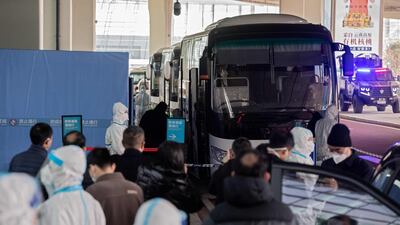
Members of the World Health Organisation team investigating the origins of the Covid-19 pandemic board a bus following their arrival at a cordoned-off section in the international arrivals area at the airport in Wuhan. AFP -

Peter Ben Embarek, a member of the WHO team tasked with investigating the origins of the Covid-19 pandemic, waves from a bus while leaving Wuhan Tianhe International Airport in Wuhan, Hubei province, China. Reuters -

Marion Koopmans, from the Netherlands' Erasmus Medical Centre Department of Viroscience and member of the WHO team investigating the origins of the Covid-19 pandemic, on a bus following her arrival at a cordoned-off section in the international arrivals area at the airport in Wuhan. AFP -
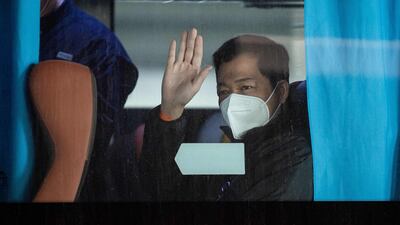
A member of the WHO team investigating the origins of the Covid-19 pandemic waves after boarding a bus following their arrival at a cordoned-off section in the international arrivals area at the airport in Wuhan. AFP -
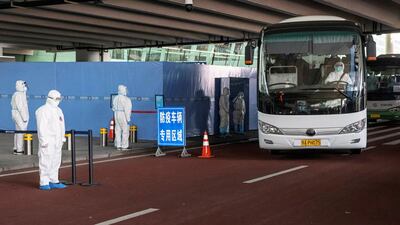
A bus carrying members of the WHO team tasked with investigating the origins of the pandemic leaves Wuhan Tianhe International Airport in Wuhan, Hubei province, China. Reuters -
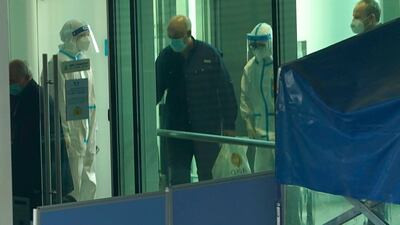
A member of the WHO team is screened on arriving at the airport in Wuhan in central China's Hubei province. AP Photo -
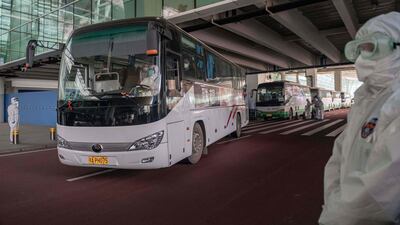
A bus carrying members of the WHO team investigating the origins of the Covid-19 pandemic leaves the airport following their arrival at a cordoned-off section in the international arrivals area at the airport in Wuhan. AFP -
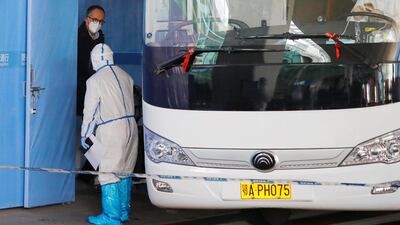
Peter Ben Embarek, a member of the WHO team, boards a bus before leaving Wuhan Tianhe International Airport in Wuhan, Hubei province, China. Reuters -

Members of the WHO team investigating the origins of the Covid-19 pandemic board a bus following their arrival at a cordoned-off section in the international arrivals area at the airport in Wuhan. AFP


During this time, it will ban many large group events and dining at restaurants, close various public entertainment venues, agricultural produce marketplaces and small clinics and suspend bus and subway services.
The order came quickly after Jiangxia authorities said late on Tuesday they had detected two cases during regular testing drives and found another two from the screening of individuals who came in close contact with the infection.
The southern manufacturing centre of Shenzhen also reported four new cases to take the tally since July 19 to more than 150.
The flare-up prompted an order for some of China’s biggest companies to operate in a “closed loop” system for seven days, raising concerns about global supply chain disruptions.

