



Indian authorities demolished the house of a Muslim politician and campaigner said to be responsible for street protests against insulting remarks about Prophet Mohammed made by two Bharatiya Janata Party officials.
Bulldozers were sent on Sunday to flatten the two-storey house of Javed Mohammad, a local leader with Welfare Party of India in Prayagraj in northern Uttar Pradesh, a day after he and relatives were arrested by police.
Thousands of armed officers were sent to the demolition that was carried out on an hour's notice to the family.
Authorities said the house was an unauthorised construction, a claim Mr Mohammad's family denied.
Police conducted a search operation before the demolition and claimed they recovered illegal weapons, flags and posters in support of the protesters at his house.
“We have found a 12 bore illegal pistol and a 315 bore pistol and cartridges and some documents that show objectionable comments against the honourable court,” said Ajay Kumar, Senior Superintendent of Prayagraj Police.
Police claimed that Mr Mohammad's daughter, Afreen Fatima, a student leader, was involved in the protests.
“First police took away my father and then they detained my mother and sister … they came to detain me but we resisted. Since then, police have cordoned off our house,” Ms Fatima said before the demolition.
Violent protests broken out across several Indian cities on Friday after Muslim demonstrators demanded the arrest of Nupur Sharma and Naveen Kumar Jindal.
They insulted the Prophet Mohammed during a television debate and on social media.
Both face legal cases in several states concerning hurting religious sentiments — a provision designed to deal with hate speech — but neither was arrested.
Several people were injured in Prayagraj district, where a mob attacked police cars and hurled stones at riot police.
The demolition of Mr Mohammad's home happened a day after Uttar Pradesh Chief Minister Yogi Adityanath’s government knocked down the homes of two Muslim men for their part in Friday's protests in Saharanpur district.
His government also confiscated three buildings owned by Jafar Hayat Hashmi whom police have accused of organising protests in Kanpur last Friday.
-

Demonstrators shout anti-Indian slogans during a protest in Quetta against former Bharatiya Janata Party spokeswoman Nupur Sharma and her remarks about the Prophet Mohammed. AFP -
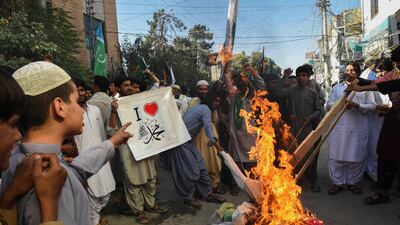
Demonstrators burn an effigy of India's Prime Minister Narendra Modi. AFP -
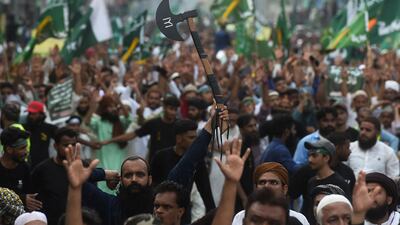
Demonstrators in Karachi. AFP -
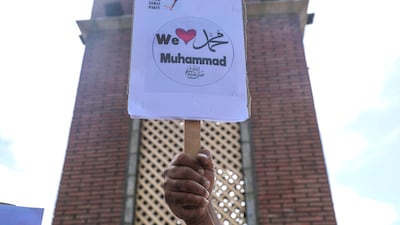
A member of the JK Awami Aawaz Party holds a placard during a protest in Srinagar, the summer capital of Indian Kashmir. EPA -
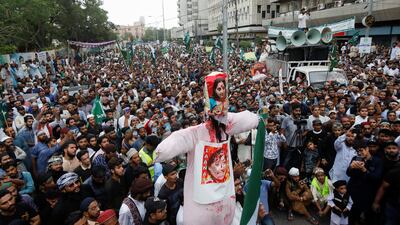
Supporters of Tehreek-e-Labbaik Pakistan, a religious and political party, gather in Karachi. Reuters -
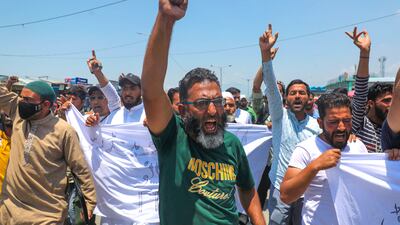
Kashmiri Muslims shout slogans during a protest march in Srinagar. EPA -
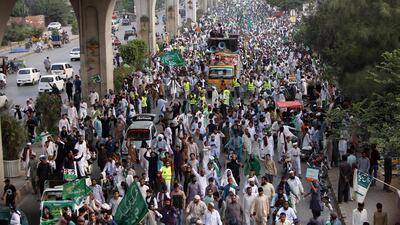
Activits of the Tehreek-e-Labbaik Pakistan party march in Rawalpindi. AFP -
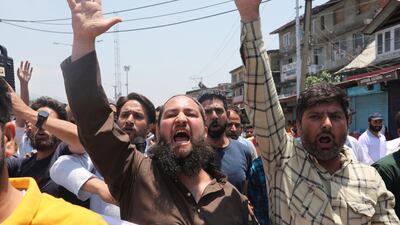
Kashmiri Muslims protest in Srinagar. EPA -

Kashmiri Muslims march in Srinagar. EPA


The demolitions are the latest in a series of arbitrary acts by Yogi Adityanath’s government, when Muslim-owned properties were also demolished following communal violence.
The Hindu monk-politician has been accused of by-passing legal processes, in what opponents and critics claim is retaliation against protesters and dissenters and to create a chilling effect.
Lawyers sent a joint letter to the chief justice of the Allahabad High Court claiming the demolition was illegal.
In New Delhi, students of the Jawaharlal Nehru University Students' Union on Sunday staged a demonstration on the campus against the Uttar Pradesh government, holding placards that read “Stop the witch-hunt of Muslims”.
Bulldozers were also used against the property of Muslims after communal clashes in BJP-ruled states of Madhya Pradesh and Gujarat in May.

