Afghanistan is heading towards a full humanitarian catastrophe, top ICRC official says


Mina Aldroubi
  • English
  • Arabic

Afghanistan is heading towards a "full-fledged” humanitarian disaster if its economy is not saved from collapse, the vice president of the International Committee of the Red Cross (ICRC) said on Tuesday.

The country has been plunged into crisis by the abrupt end of billions of dollars in foreign assistance following the collapse of the western-backed government and the return to power of the Taliban last August.

Since then, the ICRC, which has operated in Afghanistan for 30 years, has increased its efforts in the country as the humanitarian situation worsens.

“Afghanistan is the most acute humanitarian crisis and it’s going towards a full-fledged humanitarian catastrophe. We see that the majority of Afghans, 39 million, are highly insecure because of a collapsing economy and high liquidity,” Gilles Carbonnier told The National during a visit to the UAE.

“We see that if the whole economy collapses, then no humanitarian organisation can respond.

“There is no humanitarian solution to such a humanitarian catastrophe.”

“Ordinary people don't have an opportunity to get an income and sustain their livelihoods,” Mr Carbonnier said.

The top ICRC official said the collapse could happen very quickly and it was important to find a temporary solution to avert a disaster.

"Fifty per cent of the Afghan population needs humanitarian assistance to survive, “so it’s already a sign of the gravity of the situation”, he said.

Afghanistan has a population of about 40 million people, meaning that approximately 20 million are on the brink of starvation.

“We need to buy time through the winter and hope that then a more sustainable solution can be found,” Mr Carbonnier said.

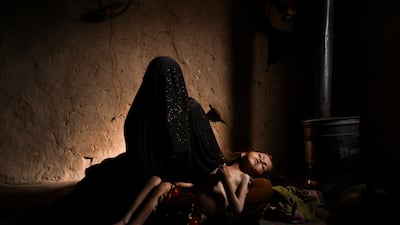
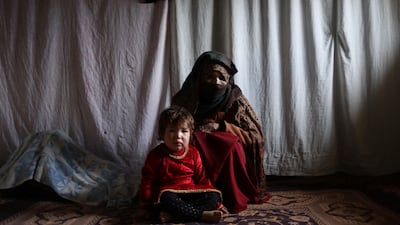
  • Fatima holds her daughter Nazia, 4, who is suffering from acute malnutrition, at their house near Herat, western Afghanistan, December 16, 2021. Two years ago, Nazia was a plump toddler, Fatima says. Aid groups say more than half the population faces acute food shortages. AP Photo
    Fatima holds her daughter Nazia, 4, who is suffering from acute malnutrition, at their house near Herat, western Afghanistan, December 16, 2021. Two years ago, Nazia was a plump toddler, Fatima says. Aid groups say more than half the population faces acute food shortages. AP Photo
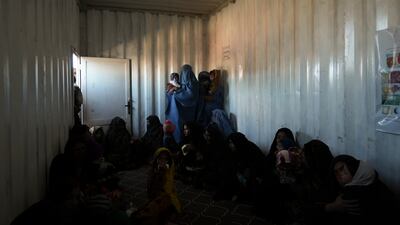
  • Afghan women at a makeshift clinic run by World Vision at a settlement near Herat. The aid-dependent country’s economy was already teetering when the Taliban seized power in mid-August. The consequences have been devastating for a country battered by four decades of war, a punishing drought and the coronavirus pandemic. AP Photo
    Afghan women at a makeshift clinic run by World Vision at a settlement near Herat. The aid-dependent country’s economy was already teetering when the Taliban seized power in mid-August. The consequences have been devastating for a country battered by four decades of war, a punishing drought and the coronavirus pandemic. AP Photo
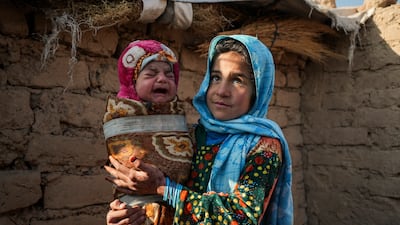
  • Qandi Gul holds her brother outside their home in a camp for those displaced by war and drought near Herat. Qandi's father sold her into marriage without telling his wife, taking a down payment so he could feed his family of five children. AP Photo
    Qandi Gul holds her brother outside their home in a camp for those displaced by war and drought near Herat. Qandi's father sold her into marriage without telling his wife, taking a down payment so he could feed his family of five children. AP Photo
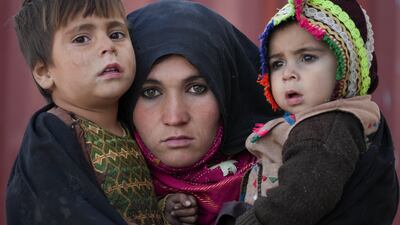
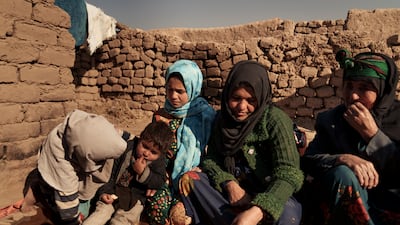
  • An Afghan woman with her children outside a makeshift clinic at a sprawling settlement of mud brick huts housing those displaced by war and drought near Herat. AP Photo
    An Afghan woman with her children outside a makeshift clinic at a sprawling settlement of mud brick huts housing those displaced by war and drought near Herat. AP Photo
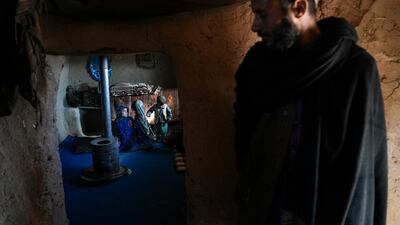
  • Hamid Abdullah outside a room where his children are playing at a settlement near Herat. Mr Abdullah is selling his young daughters into arranged marriages, desperate for money to treat his chronically ill wife, who is pregnant with their fifth child. AP Photo
    Hamid Abdullah outside a room where his children are playing at a settlement near Herat. Mr Abdullah is selling his young daughters into arranged marriages, desperate for money to treat his chronically ill wife, who is pregnant with their fifth child. AP Photo
  • Kubra, 57, with her grandchild in a house in Bamiyan, Afghanistan, December 22, 2021. 'We got two sacks of flour last spring that we're still using. After that, we have to have faith that God will help us," Kubra says. Reuters
    Kubra, 57, with her grandchild in a house in Bamiyan, Afghanistan, December 22, 2021. 'We got two sacks of flour last spring that we're still using. After that, we have to have faith that God will help us," Kubra says. Reuters
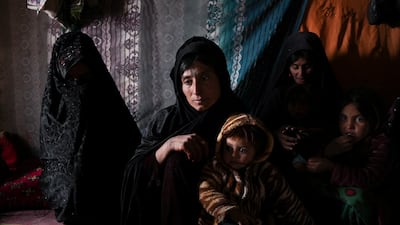
  • Guldasta and members of her family in their house at a settlement near Qala-e-Naw, Afghanistan. Guldasta says that after days with nothing to eat, she told her husband to take their son Salahuddin, 8, to the bazaar and sell him to buy food for the others. AP Photo
    Guldasta and members of her family in their house at a settlement near Qala-e-Naw, Afghanistan. Guldasta says that after days with nothing to eat, she told her husband to take their son Salahuddin, 8, to the bazaar and sell him to buy food for the others. AP Photo
  • Aziz Gul, second from right, and her 10-year-old daughter Qandi, centre, outside their home with other family members, near Hera. Qandi's father sold her into marriage without telling his wife, Aziz, taking a down-payment so he could feed his family. AP Photo
    Aziz Gul, second from right, and her 10-year-old daughter Qandi, centre, outside their home with other family members, near Hera. Qandi's father sold her into marriage without telling his wife, Aziz, taking a down-payment so he could feed his family. AP Photo

The official said his organisation is advocating some form of liquidity be made available so that payment systems can resume across the country to revive the economy.

“This is the first time we have had such a humanitarian catastrophe where we have to engage ministries of finance and others because the questions are not just humanitarian but also others.”

The ICRC supports 17 hospitals across Afghanistan and employs about 1,800 people — 100 are international staff while the other 1,700 are Afghans.

“These 17 hospitals, they are run by 5,500 civil servants, who are midwives, nurses, who were present before the arrival of the Taliban in Kabul and they have not received any salaries since August,” he said.

Portrait of ICRC Vice-President, Gilles Carbonnier, speaking on “Addressing Challenges in International Humanitarian Actions under New Circumstances: ICRC’s innovative Approaches” with a focus on partnership with the business sector. Photo: ICRC

The Taliban expelled many foreign aid groups when it was last in power from 1996-2001 but this time has welcomed foreign donors, saying will protect their rights and those of their staff.

But the group has faced criticism for failing to protect human rights — including access to education for girls.

Despite this, many international groups say aid should not be tied to conditions, especially given the impending humanitarian disaster.

“We have been advocating for unconditional humanitarian assistance to save lives so that humanitarian assistance is not made conditional on the number of targets and policies that should be implemented,” Mr Carbonnier said.

The response should be based on need and not anything else, he stressed.

Three-day coronation

Royal purification

The entire coronation ceremony extends over three days from May 4-6, but Saturday is the one to watch. At the time of 10:09am the royal purification ceremony begins. Wearing a white robe, the king will enter a pavilion at the Grand Palace, where he will be doused in sacred water from five rivers and four ponds in Thailand. In the distant past water was collected from specific rivers in India, reflecting the influential blend of Hindu and Buddhist cosmology on the coronation. Hindu Brahmins and the country's most senior Buddhist monks will be present. Coronation practices can be traced back thousands of years to ancient India.

The crown

Not long after royal purification rites, the king proceeds to the Baisal Daksin Throne Hall where he receives sacred water from eight directions. Symbolically that means he has received legitimacy from all directions of the kingdom. He ascends the Bhadrapitha Throne, where in regal robes he sits under a Nine-Tiered Umbrella of State. Brahmins will hand the monarch the royal regalia, including a wooden sceptre inlaid with gold, a precious stone-encrusted sword believed to have been found in a lake in northern Cambodia, slippers, and a whisk made from yak's hair.

The Great Crown of Victory is the centrepiece. Tiered, gold and weighing 7.3 kilograms, it has a diamond from India at the top. Vajiralongkorn will personally place the crown on his own head and then issues his first royal command.

The audience

On Saturday afternoon, the newly-crowned king is set to grant a "grand audience" to members of the royal family, the privy council, the cabinet and senior officials. Two hours later the king will visit the Temple of the Emerald Buddha, the most sacred space in Thailand, which on normal days is thronged with tourists. He then symbolically moves into the Royal Residence.

The procession

The main element of Sunday's ceremonies, streets across Bangkok's historic heart have been blocked off in preparation for this moment. The king will sit on a royal palanquin carried by soldiers dressed in colourful traditional garb. A 21-gun salute will start the procession. Some 200,000 people are expected to line the seven-kilometre route around the city.

Meet the people

On the last day of the ceremony Rama X will appear on the balcony of Suddhaisavarya Prasad Hall in the Grand Palace at 4:30pm "to receive the good wishes of the people". An hour later, diplomats will be given an audience at the Grand Palace. This is the only time during the ceremony that representatives of foreign governments will greet the king.

How to apply for a drone permit
  • Individuals must register on UAE Drone app or website using their UAE Pass
  • Add all their personal details, including name, nationality, passport number, Emiratis ID, email and phone number
  • Upload the training certificate from a centre accredited by the GCAA
  • Submit their request
What are the regulations?
  • Fly it within visual line of sight
  • Never over populated areas
  • Ensure maximum flying height of 400 feet (122 metres) above ground level is not crossed
  • Users must avoid flying over restricted areas listed on the UAE Drone app
  • Only fly the drone during the day, and never at night
  • Should have a live feed of the drone flight
  • Drones must weigh 5 kg or less
England squads for Test and T20 series against New Zealand

Test squad: Joe Root (capt), Jofra Archer, Stuart Broad, Rory Burns, Jos Buttler, Zak Crawley, Sam Curran, Joe Denly, Jack Leach, Saqib Mahmood, Matthew Parkinson, Ollie Pope, Dominic Sibley, Ben Stokes, Chris Woakes

T20 squad: Eoin Morgan (capt), Jonny Bairstow, Tom Banton, Sam Billings, Pat Brown, Sam Curran, Tom Curran, Joe Denly, Lewis Gregory, Chris Jordan, Saqib Mahmood, Dawid Malan, Matt Parkinson, Adil Rashid, James Vince

360Vuz PROFILE

Date started: January 2017
Founder: Khaled Zaatarah 
Based: Dubai and Los Angeles
Sector: Technology 
Size: 21 employees
Funding: $7 million 
Investors: Shorooq Partners, KBW Ventures, Vision Ventures, Hala Ventures, 500Startups, Plug and Play, Magnus Olsson, Samih Toukan, Jonathan Labin

Indoor cricket in a nutshell

Indoor Cricket World Cup - Sep 16-20, Insportz, Dubai

16 Indoor cricket matches are 16 overs per side

8 There are eight players per team

There have been nine Indoor Cricket World Cups for men. Australia have won every one.

5 Five runs are deducted from the score when a wickets falls

Batsmen bat in pairs, facing four overs per partnership

Scoring In indoor cricket, runs are scored by way of both physical and bonus runs. Physical runs are scored by both batsmen completing a run from one crease to the other. Bonus runs are scored when the ball hits a net in different zones, but only when at least one physical run is score.

Zones

A Front net, behind the striker and wicketkeeper: 0 runs

B Side nets, between the striker and halfway down the pitch: 1 run

Side nets between halfway and the bowlers end: 2 runs

Back net: 4 runs on the bounce, 6 runs on the full

Updated: January 19, 2022, 8:30 AM